
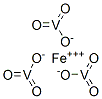
ferrovanadium
- CAS NO.:12604-58-9
- Empirical Formula: Fe.V
- Molecular Weight: 106.787
- MDL number: MFCD06326207
- SAFETY DATA SHEET (SDS)
- Update Date: 2024-12-18 14:07:02

What is ferrovanadium?
Description
Ferrovanadium, a noncombustible solid; thedust may be an explosion hazard. It consists of dark, odorless solid particles (particulate): dispersed in air. An alloyhaving the composition of 50-80% vanadium with iron,carbon, trace silicon, manganese, chromium, nickel, etc.Molecular weight=106.8; Freezing/Meltingpoint=1482-1521 C; Minimum explosive concentration(MEC)=1.3 g/m3.[NIOSH] Insoluble in water.
Chemical properties
Ferrovanadium, a noncombustible solid; the dust may be an explosion hazard. It consists of dark, odorless solid particles (particulate): dispersed in air. An alloy having the composition of 50% 80% vanadium with iron, carbon, and trace silicon, manganese, chro mium, nickel, etc.
The Uses of ferrovanadium
Added to steel to produce fineness of grain, toughness, and resistance to high temperature and torsion
Definition
An iron–vanadium alloy used to add vanadium to steel. Vanadium is used in engineering steels to the extent of 0.1–0.25% and in high-speed steels to the extent of 1–2.5% or higher. Melting range 1482– 1521C. Furnished in a variety of lump, crushed, and gro
Hazard
Moderate fire risk.
Health Hazard
Ferrovanadium dust is a mild irritant of the eyes and respiratory tract.
Safety Profile
Can cause pulmonary damage. Combustible when exposed to heat or flame. See also VANADIUM and IRON.
Potential Exposure
Ferrovanadium is added to steel to produce fineness of grain, toughness, torsion properties; and resistance to high temperatures.
First aid
If this chemical gets into the eyes, remove any contact lenses at once and irrigate immediately for at least15 min, occasionally lifting upper and lower lids. Seek medical attention immediately. If this chemical contacts the skin,remove contaminated clothing and wash immediately withsoap and water. Seek medical attention immediately. If thischemical has been inhaled, remove from exposure, begin rescue breathing (using universal precautions, including resuscitation mask) if breathing has stopped and CPR if heart actionhas stopped. Transfer promptly to a medical facility. Whenthis chemical has been swallowed, get medical attention.Give large quantities of water and induce vomiting. Do notmake an unconscious person vomit.Note to physician: For severe poisoning do not use BAL[British Anti-Lewisite, dimercaprol, dithiopropanol(C3H8OS2)] as it is contraindicated or ineffective in poisoning from iron.
Storage
Dust is an explosion hazard. Prior to working withthis material, you should be trained on its proper handlingand storage. Store in tightly closed containers in a cool,well-ventilated area away from oxidizers.
Incompatibilities
Incompatible with oxidizers (chlorates, nitrates, peroxides, permanganates, perchlorates, chlorine, bromine, fluorine, etc.); contact may cause fires or explo sions. Keep away from alkaline materials, strong bases, strong acids, oxoacids, epoxides.
Waste Disposal
Disposal in a sanitary landfill.
Properties of ferrovanadium
| Melting point: | 1400-1500 °C |
| form | Gray to black dust |
| CAS DataBase Reference | 12604-58-9 |
| EPA Substance Registry System | Ferrovanadium (12604-58-9) |
Safety information for ferrovanadium
Computed Descriptors for ferrovanadium
ferrovanadium manufacturer
New Products
2-(2-Chlorophenyl)glycine Propiolic Acid 1-(3-Hydroxy-4-methoxyphenyl)-2-nitroethene (±)-amino(2-fluorophenyl)acetic acid trans-3-Benzyloxy-4-methoxy-beta-nitrostyrene 1-Pentadecanol 2,4-Dihydroxybenzaldehyde Dipropyl disulfide Pyrrolo[1,2-a]pyrimidine-6-carboxylic acid, 4,6,7,8-tetrahydro-4-oxo-, sodium salt (1:1), (6S) Obidoxime hydrochloride API 4 pentyn 1 ol N-Vinylformamide Methacrylate-PEG-Methacrylate, Mn:35000 2,4-Dihydroxyacetophenone 2-Chloro 5-Fluoro Pyridine Vasicinone 2-Chloroisonicotinic Acid Tween 80 or Polysorbate 80 2-Butyn-1-oL N-(4-Cyano-3-(trifluoromethyl)phenyl)-2-methyloxirane-2-carboxamide N-(4-fluoro-2-methoxy-5-nitrophenyl)-4-(1-methyl-1H-indol-3-yl)pyrimidin-2-amine Pirtobrutinib intd. 2-Pentyn-1-oL 4-NitrobenzotrifluorideRelated products of tetrahydrofuran




You may like
-
 12604-58-9 Ferrovanadium 99%View Details
12604-58-9 -
 471-25-0 Propiolic Acid 98+View Details
471-25-0 -
84145-28-8 98+View Details
84145-28-8 -
trans-3-Benzyloxy-4-methoxy-beta-nitrostyrene 98+View Details
63909-29-5 -
2-(2-Chlorophenyl)glycine 88744-36-9 98+View Details
88744-36-9 -
40216-83-9 trans-4-Hydroxy-L-proline methyl ester hydrochloride 98+View Details
40216-83-9 -
629-76-5 98+View Details
629-76-5 -
1-(3-Hydroxy-4-methoxyphenyl)-2-nitroethene 98+View Details
39816-35-8