
Ferrostatin-1 (Fer-1)
- CAS NO.:347174-05-4
- Empirical Formula: C15H22N2O2
- Molecular Weight: 262.35
- MDL number: MFCD08072959
- SAFETY DATA SHEET (SDS)
- Update Date: 2026-07-17 09:03:53
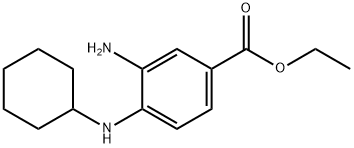
What is Ferrostatin-1 (Fer-1)?
Description
Ferrostatin-1 (347174-05-4) inhibits ferroptosis (EC50=60 nM), an iron-dependent form of nonapoptotic cell death.1?Potent inhibitor of ferroptosis in cancer cells and glutamate-induced cell death in organotypic rat brain slices.1?Blocks the cytotoxic effects of sorafenib in hepatocellular carcinoma cells.2?Ferrostatin-1 inhibits oxidative lipid damage and cell death in diverse disease models3 and prevents apoptosis of renal proximal tubular cells induced by reactive oxygen species4.
The Uses of Ferrostatin-1 (Fer-1)
Ferrostatin-1 (Fer-1) is a potent and selective inhibitor of ferroptosis.
What are the applications of Application
Ferrostatin 1 is a potent inhibitor of non-apoptotic cell death induced by erastin call ferroptosis
Definition
ChEBI: Ferrostatin-1 is an ethyl ester resulting from the formal condensation of the carboxy group of 3-amino-4-(cyclohexylamino)benzoic acid with ethanol. It is a potent inhibitor of ferroptosis, a distinct non-apoptotic form of cell death caused by lipid peroxidation. It is also a radical-trapping antioxidant and has the ability to reduce the accumulation of lipid peroxides and chain-carrying peroxyl radicals. It has a role as a ferroptosis inhibitor, a radiation protective agent, an antioxidant, a radical scavenger, an antifungal agent and a neuroprotective agent. It is a substituted aniline, an ethyl ester and a primary arylamine.
Biochem/physiol Actions
Ferrostatin-1 is an active radical-trapping antioxidant that traps peroxyl radicals, and thus serves as a potential inhibitor of ferroptosis. Ferroptosis is considered as regulated necrosis, which differs from apoptosis and autophagy. Ferrostatin-1 is known to show protective effects against Huntington′s disease and also prevents neurotoxicity induced by glutamate in cellular models.
Storage
Store at +4°C
References
1) Dixon et al. (2012), Ferroptosis: an iron-dependent form of nonapoptotic cell death; Cell, 149 1060 2) Louandre et al. (2013), Iron-dependent cell death of hepatocellular carcinoma cells exposed to sorafenib; Int. J. Cancer, 133 1732 3) Skouta et al. (2014), Ferrostatins inhibit oxidative lipid damage and cell death in diverse disease models; J. Am. Chem. Soc., 136 4551 4) Nowak et al. (2013), Protein kinase C-α interaction with iHSP70 in mitochondria promotes recovery of mitochondrial function after injury in renal proximal tubular cells; Am. J. Physiol. Renal. Physiol., 305 F764
Properties of Ferrostatin-1 (Fer-1)
| Boiling point: | 437.3±35.0 °C(Predicted) |
| Density | 1.150±0.06 g/cm3(Predicted) |
| storage temp. | 2-8°C |
| solubility | DMSO: soluble10mg/mL, clear |
| pka | 4.78±0.11(Predicted) |
| form | powder |
| color | , faint purple to brown |
| Stability: | Stable for 2 years from date of purchase as supplied. Solutions in DMSO or ethanol may be stored at -20° for up to 1 month. |
Safety information for Ferrostatin-1 (Fer-1)
| Signal word | Warning |
| Pictogram(s) |
 Exclamation Mark Irritant GHS07 |
| GHS Hazard Statements |
H315:Skin corrosion/irritation H319:Serious eye damage/eye irritation H335:Specific target organ toxicity, single exposure;Respiratory tract irritation |
| Precautionary Statement Codes |
P261:Avoid breathing dust/fume/gas/mist/vapours/spray. P264:Wash hands thoroughly after handling. P264:Wash skin thouroughly after handling. P271:Use only outdoors or in a well-ventilated area. P280:Wear protective gloves/protective clothing/eye protection/face protection. P302+P352:IF ON SKIN: wash with plenty of soap and water. P305+P351+P338:IF IN EYES: Rinse cautiously with water for several minutes. Remove contact lenses, if present and easy to do. Continuerinsing. |
Computed Descriptors for Ferrostatin-1 (Fer-1)
| InChIKey | UJHBVMHOBZBWMX-UHFFFAOYSA-N |
Ferrostatin-1 (Fer-1) manufacturer
New Products
9-Mesityl-10-methylacridinium perchlorate Sulfapyridine Fmoc-OSu (R)-(-)-2-Amino-1-propanol Cyclobutanone 5-bromo-4-fluoro-2-nitrobenzaldehyde 4 pentyn 1 ol N-Vinylformamide Phenethyl cinnamate Pyrrolo[1,2-a]pyrimidine-6-carboxylic acid, 4,6,7,8-tetrahydro-4-oxo-, sodium salt (1:1), (6S) Ethyl 3-phenylpropanoate β-Bromostyrene Methacrylate-PEG-Methacrylate, Mn:35000 2,4-Dihydroxyacetophenone 2-Chloro 5-Fluoro Pyridine Vasicinone 2-Chloroisonicotinic Acid Tween 80 or Polysorbate 80 5-Bromo-1-Pentyne 1-(2-Methyl-5-nitrophenyl)guanidine Nitrate Methyl trans-4-Aminocyclohexanecarboxylate Hydrochloride N-(4-Cyano-3-(trifluoromethyl)phenyl)-2-methyloxirane-2-carboxamide 4-Nitrobenzotrifluoride 2-Pentyn-1-oLRelated products of tetrahydrofuran

You may like
-
 ethyl 3-amino-4-(cyclohexylamino)benzoate 95% CAS 347174-05-4View Details
347174-05-4 -
Ferrostatin-1 CAS 347174-05-4View Details
347174-05-4 -
Fmoc-OSu 98+View Details
82911-69-1 -
(R)-(-)-2-Amino-1-propanol 35320-23-1 98+View Details
35320-23-1 -
1191-95-3 Cyclobutanone 98+View Details
1191-95-3 -
213382-45-7 98+View Details
213382-45-7 -
Fmoc-OSu 98+View Details
82911-69-1 -
(R)-(-)-2-Amino-1-propanol 35320-23-1 98+View Details
35320-23-1