
Ethyl crotonate
Synonym(s):Ethyl (E)-2-crotonate;Ethyl crotonate
- CAS NO.:10544-63-5
- Empirical Formula: C6H10O2
- Molecular Weight: 114.14
- MDL number: MFCD00009289
- EINECS: 210-808-7
- SAFETY DATA SHEET (SDS)
- Update Date: 2026-09-12 18:50:33
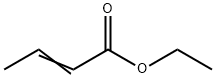
What is Ethyl crotonate?
Chemical properties
clear colorless liquid
Chemical properties
Ethyl crotonate has a powerful, sour, caramellic-fruity odor.
Occurrence
Reported found in Fragaria vesca. Also reported found in guava fruit, guava peel, pineapple, white wine, yellow passion fruit, fresh mango, naranjilla fruit, mussel, loganberry, apple, papaya, concord grape, strawberry, rum, cocoa, plum, kiwifruit and other natural sources.
The Uses of Ethyl crotonate
Crotonic Acid Ethyl Ester, is an intermediate for the preparation of various pharmaceutical compounds. It can be used for the synthesis of (+)-trans-Trikentrin A.
Preparation
By esterification of crotonic acid with ethyl alcohol in the presence of concentrated H2SO4.
Definition
ChEBI: Ethyl crotonate is a fatty acid ester.
Taste threshold values
Taste characteristics at 10 ppm: rum, cognac and pungent with caramellic and fruity nuances.
Synthesis Reference(s)
Journal of the American Chemical Society, 112, p. 2716, 1990 DOI: 10.1021/ja00163a038
Synthetic Communications, 14, p. 701, 1984 DOI: 10.1080/00397918408059583
General Description
A clear colorless liquid with a pungent odor. Flash point 36°F. Less dense than water and insoluble in water. Vapors heavier than air.
Air & Water Reactions
Highly flammable. Insoluble in water.
Reactivity Profile
ETHYL CROTONATE is an ester. Esters react with acids to liberate heat along with alcohols and acids. Strong oxidizing acids may cause a vigorous reaction that is sufficiently exothermic to ignite the reaction products. Heat is also generated by the interaction of esters with caustic solutions. Flammable hydrogen is generated by mixing esters with alkali metals and hydrides.
Health Hazard
May cause toxic effects if inhaled or absorbed through skin. Inhalation or contact with material may irritate or burn skin and eyes. Fire will produce irritating, corrosive and/or toxic gases. Vapors may cause dizziness or suffocation. Runoff from fire control or dilution water may cause pollution.
Fire Hazard
HIGHLY FLAMMABLE: Will be easily ignited by heat, sparks or flames. Vapors may form explosive mixtures with air. Vapors may travel to source of ignition and flash back. Most vapors are heavier than air. They will spread along ground and collect in low or confined areas (sewers, basements, tanks). Vapor explosion hazard indoors, outdoors or in sewers. Runoff to sewer may create fire or explosion hazard. Containers may explode when heated. Many liquids are lighter than water.
Safety Profile
Slightly toxic by ingestion. Corrosive. An eye irritant and lachrymator. A flammable liquid. When heated to decomposition it emits acrid smoke and irritating fumes.
Properties of Ethyl crotonate
| Melting point: | 37.22°C (estimate) |
| Boiling point: | 142-143 °C(lit.) |
| Density | 0.918 g/mL at 25 °C(lit.) |
| vapor density | 3.9 (vs air) |
| FEMA | 3486 | ETHYL TRANS-2-BUTENOATE |
| refractive index | n |
| Flash point: | 36 °F |
| storage temp. | Flammables area |
| form | Liquid |
| color | Clear colorless |
| Odor | at 10.00 % in dipropylene glycol. pungent fruity acrid ester |
| JECFA Number | 1806 |
| EPA Substance Registry System | 2-Butenoic acid, ethyl ester (10544-63-5) |
Safety information for Ethyl crotonate
Computed Descriptors for Ethyl crotonate
New Products
5-bromo-4-fluoro-2-nitrobenzaldehyde Cyclobutanone (R)-(-)-2-Amino-1-propanol Fmoc-OSu 1-(2-Chloroethyl)pyrrolidine Hydrochloride 2-Amino-2-(4-methylphenyl)acetic acid 2,4-Dihydroxybenzaldehyde Obidoxime hydrochloride API Pyrrolo[1,2-a]pyrimidine-6-carboxylic acid, 4,6,7,8-tetrahydro-4-oxo-, sodium salt (1:1), (6S) Dipropyl disulfide 4 pentyn 1 ol N-Vinylformamide Methacrylate-PEG-Methacrylate, Mn:35000 2,4-Dihydroxyacetophenone 2-Chloro 5-Fluoro Pyridine Vasicinone 2-Chloroisonicotinic Acid Tween 80 or Polysorbate 80 2-Butyn-1-oL 2-Pentyn-1-oL 4-Nitrobenzotrifluoride N-(4-Cyano-3-(trifluoromethyl)phenyl)-2-methyloxirane-2-carboxamide N-(4-fluoro-2-methoxy-5-nitrophenyl)-4-(1-methyl-1H-indol-3-yl)pyrimidin-2-amine Pirtobrutinib intd.Related products of tetrahydrofuran
You may like
-
 10544-63-5 ETHYL CROTONATE 98%View Details
10544-63-5 -
 10544-63-5 99%View Details
10544-63-5 -
 7250-67-1 1-(2-Chloroethyl)pyrrolidine Hydrochloride 98+View Details
7250-67-1 -
545445-44-1 3-Morpholino-1-(4-(2-oxopiperidin-1-yl) phenyl)-5,6-dihyropyridin-2-(1H)-one 98%View Details
545445-44-1 -
6629-04-5 98%View Details
6629-04-5 -
4-(4-Αminophenyl)-3-Morpholinone 98%View Details
438056-69-0 -
1-(4-Aminophenyl)-3-morpholino-5,6-dihydropyridin-2(1H)-one 1267610-26-3 98%View Details
1267610-26-3 -
 1H-Indazole | CAS No. 271-44-3 | Pharmaceutical IntermediateView Details
271-44-3