
ENNIATIN FROM MICROBIAL SOURCE
- CAS NO.:11113-62-5
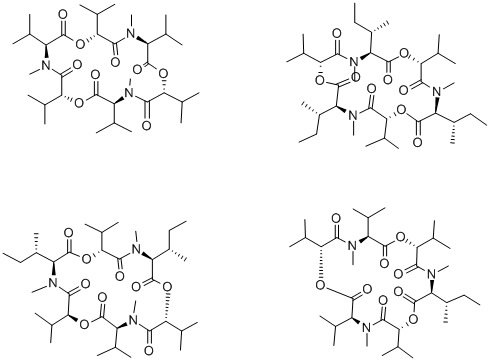
- Empirical Formula: C36H63N3O9.C35H61N3O9.C34H59N3O9.C33H57N3O9
- Molecular Weight: 2643.46
- MDL number: MFCD00214209
- Update Date: 2026-07-16 07:06:08
What is ENNIATIN FROM MICROBIAL SOURCE?
The Uses of ENNIATIN FROM MICROBIAL SOURCE
Enniatins are a complex of depsipeptides produced by several Fusarium species. Typically, the complex contains 4 major components: A, A1, B and B1 together with minor amounts of enniatins C, D, E and F. The enniatins act as ionophores. Recently their effects on acyl-CoA cholesterol transferase, as nematocides and the selectivity of their antitumour action have received more focus.
The Uses of ENNIATIN FROM MICROBIAL SOURCE
Enniatin complex is a complex mixture of Fusarium produced depsipeptide ionophores.This compound can be used to control contamination in fermentation of gaseous substrates.
What are the applications of Application
Enniatin complex is a complex mixture of Fusarium produced depsipeptide ionophores
Biological Activity
enniatins, analogues of beauvericin, is a regular cyclic hexadepsipeptide isolated from fusarium species of fungis, also they have been isolated from other genera, such as verticillium and halosarpheia [1]. they have been involved in many biological activities, such as antiinsectan, antifungal, antibiotic and cytotoxic [1].
in vitro
fusafungine is a mixture of several enniatins with bacteriostatic activity against most micro-organisms responsible for infections and superinfections of the respiratory tract. fusafungine has been developed for treatment of upper respiratory tract infections by oral and/or nasal inhalation. fusafungine in low concentrations down-regulated the expression of intercellular adhesion molecule-1 (icam-1) by activated macrophages, inhibited the production of the proinflammatory cytokines il-1, tnfα and il-6 and inhibited the release of oxygen free radicals by inflammatory macrophages without altering their phagocytic activity. fusafungine also inhibited t-cell activation and proliferation, and the synthesis of ifn-γ by activated t cells [2]. exposure 8 h to enniatins at nanomolar concentrations significantly stimulated cell proliferation. at low micromolar concentrations, enniatins exihibited profound apoptosis-inducing effects against various human cancer cell types. in the fluorescence-activated cell sorting analysis, enniatins induced cell cycle arrest in the g0/g1 phase. in human cancer cells, elevated enn concentrations induced profound p53-dependent cytostatic and p53-independent cytotoxic activities [3]. enniatin easily incorporated into the cell membrane in which it formed cation-selective pores [4].
Purification Methods
It is a cyclic peptidic ester antibiotic which is recrystallised from EtOH/water but is deactivated in alkaline solution. [Ovchinnikov & Ivanov in The Proteins (Neurath and Hill eds) Academic Press, NY, Vol V pp. 365 and 516 1982, Tomeda et al. J Antibiot 45 1626 1992.]
References
[1] sy-cordero a a, pearce c j, oberlies n h. revisiting the enniatins: a review of their isolation, biosynthesis, structure determination and biological activities[j]. the journal of antibiotics, 2012, 65(11): 541-549.
[2] german-fattal m. fusafungine, an antimicrobial with anti-inflammatory properties in respiratory tract infections[j]. clinical drug investigation, 2001, 21(9): 653-670.
[3] dornetshuber r, heffeter p, kamyar m r, et al. enniatin exerts p53-dependent cytostatic and p53-independent cytotoxic activities against human cancer cells[j]. chemical research in toxicology, 2007, 20(3): 465-473.
[4] kamyar m, rawnduzi p, studenik c r, et al. investigation of the electrophysiological properties of enniatins[j]. archives of biochemistry and biophysics, 2004, 429(2): 215-223.
Properties of ENNIATIN FROM MICROBIAL SOURCE
| storage temp. | 2-8°C |
| solubility | Soluble in DMSO |
| form | powder |
| color | white |
Safety information for ENNIATIN FROM MICROBIAL SOURCE
| Signal word | Danger |
| Pictogram(s) |
 Skull and Crossbones Acute Toxicity GHS06 |
| Precautionary Statement Codes |
P260:Do not breathe dust/fume/gas/mist/vapours/spray. P280:Wear protective gloves/protective clothing/eye protection/face protection. P312:Call a POISON CENTER or doctor/physician if you feel unwell. |
Computed Descriptors for ENNIATIN FROM MICROBIAL SOURCE
New Products
Cyclobutanone (R)-(-)-2-Amino-1-propanol Fmoc-OSu 5-bromo-4-fluoro-2-nitrobenzaldehyde 2-Amino-2-(4-methylphenyl)acetic acid 1-(2-Chloroethyl)pyrrolidine Hydrochloride 2,4-Dihydroxybenzaldehyde Obidoxime hydrochloride API Pyrrolo[1,2-a]pyrimidine-6-carboxylic acid, 4,6,7,8-tetrahydro-4-oxo-, sodium salt (1:1), (6S) Dipropyl disulfide N-Vinylformamide 4 pentyn 1 ol Methacrylate-PEG-Methacrylate, Mn:35000 2,4-Dihydroxyacetophenone 2-Chloro 5-Fluoro Pyridine Vasicinone 2-Chloroisonicotinic Acid Tween 80 or Polysorbate 80 2-Butyn-1-oL N-(4-fluoro-2-methoxy-5-nitrophenyl)-4-(1-methyl-1H-indol-3-yl)pyrimidin-2-amine Pirtobrutinib intd. 2-Pentyn-1-oL 4-Nitrobenzotrifluoride N-(4-Cyano-3-(trifluoromethyl)phenyl)-2-methyloxirane-2-carboxamideRelated products of tetrahydrofuran

You may like
-
 7250-67-1 1-(2-Chloroethyl)pyrrolidine Hydrochloride 98+View Details
7250-67-1 -
13227-01-5 98+View Details
13227-01-5 -
7250-67-1 1-(2-Chloroethyl)pyrrolidine Hydrochloride 98+View Details
7250-67-1 -
13227-01-5 98+View Details
13227-01-5 -
545445-44-1 3-Morpholino-1-(4-(2-oxopiperidin-1-yl) phenyl)-5,6-dihyropyridin-2-(1H)-one 98%View Details
545445-44-1 -
6629-04-5 98%View Details
6629-04-5 -
4-(4-Αminophenyl)-3-Morpholinone 98%View Details
438056-69-0 -
1-(4-Aminophenyl)-3-morpholino-5,6-dihydropyridin-2(1H)-one 1267610-26-3 98%View Details
1267610-26-3