
DIPHENYL CHLOROARSINE
- CAS NO.:712-48-1
- Empirical Formula: C12H10AsCl
- Molecular Weight: 264.58
- MDL number: MFCD00053177
- EINECS: 211-921-4
- SAFETY DATA SHEET (SDS)
- Update Date: 2026-05-26 16:21:34
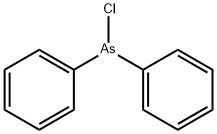
What is DIPHENYL CHLOROARSINE?
General Description
A colorless crystalline solid, or a dark-brown liquid. Strongly irritating to skin and eyes. Toxic by ingestion and inhalation. Used as a military poison gas.
Air & Water Reactions
Slowly decomposed by water [Hawley].
Reactivity Profile
DIPHENYL CHLOROARSINE is incompatible with strong oxidizing agents, amines, and alkalis. May react vigorously or explosively if mixed with diisopropyl ether or other ethers in the presence of trace amounts of metal salts [J. Haz. Mat., 1981, 4, 291].
Health Hazard
Highly toxic, may be fatal if inhaled, swallowed or absorbed through skin. Avoid any skin contact. Effects of contact or inhalation may be delayed. Fire may produce irritating, corrosive and/or toxic gases. Runoff from fire control or dilution water may be corrosive and/or toxic and cause pollution.
Fire Hazard
Non-combustible, substance itself does not burn but may decompose upon heating to produce corrosive and/or toxic fumes. Containers may explode when heated. Runoff may pollute waterways.
Safety Profile
A human poison by inhalation. Poison experimentally by inhalation and skin contact. A powerfully irritating military poison. Exposure yields cold-like symptoms, plus headache, vomiting and nausea. A nonpersistent gas. Decontamination is by use of chlorine or caustic soda in confined spaces. When heated to decomposition it emits toxic fumes of As and Cl-. See also ARSENIC COMPOUNDS.
Properties of DIPHENYL CHLOROARSINE
| Melting point: | 44°C |
| Boiling point: | 337°C |
| Density | 1.4820 |
| refractive index | 1.6332 |
| form | solid |
| EPA Substance Registry System | Diphenylchlorarsine (712-48-1) |
Safety information for DIPHENYL CHLOROARSINE
Computed Descriptors for DIPHENYL CHLOROARSINE
New Products
Dibenzoyl-L-tartaric acid Anhydrous (Resolution Reagent) Cis-Tosylate Dibenzo[b,f][1,4]thiazepin-11(10H)-one 1,2,3,9-Tetrahydro-9-Methyl-4H-Carbazole-4-One 1-(4-methoxyphenyl)-4-(4-Nitrophenyl)Piperazine (IT-1) BOC Piperazine 1-Benzhydrylazetane-3-carbonitrile 8-oxa-1,3-diazaspiro[4.5]decane-2,4-dione (±)-amino(2-fluorophenyl)acetic acid 2-(2-Chlorophenyl)glycine AMINO-(3-CHLORO-PHENYL)-ACETIC ACID 2'-Fluoroacetophenone METHANOL-D1(OD) TERTIARY BUTANOL-D9 N-ETHYL-D5-AMINE HYDROCHLORIDE BENZOIC ACID-D CHLOROFORM-D TOLUENE-D3 Trans,trans muconic acid HC Blue-16 4-Amino-2-chloro-6,7-dimethoxyquinazoline Ethyl 4,5-bis(2-methoxyethoxy)-2-nitrobenzoate 2,3-Dimethoxypyridine 1-(3-Chlorophenyl)piperazine hydrochlorideRelated products of tetrahydrofuran
You may like
-
 Product IntroductionView Details
 -
 Product InrtroductionView Details
 -
 DGO24View Details
 -
 DGO25View Details
 -
 DGO29View Details
 -
 DGO32View Details
 -
 DGO36View Details
 -
 DGO37View Details