
Diisononyl phthalate
Synonym(s):DINP
- CAS NO.:68515-48-0
- Empirical Formula: C26H42O4
- Molecular Weight: 418.61
- MDL number: MFCD00026335
- EINECS: 271-090-9
- SAFETY DATA SHEET (SDS)
- Update Date: 2026-06-24 18:39:39
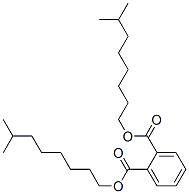
What is Diisononyl phthalate?
Chemical properties
The empirical formula of diisononyl phthalate (DINP) is C26H42O4. The structural formula of DINP varies because the iso-alcohols used in the manufacture contain several isomers. DINP is a clear, colorless to light yellow liquid. DINP is insoluble in water, but it is soluble in organic solvents.
The Uses of Diisononyl phthalate
Diisononyl Phthalate is a general-purpose plasticizer for polyvinyl chloride.
The Uses of Diisononyl phthalate
Its major use is as a plasticizer.
Production Methods
DINP is manufactured by the reaction of phthalic anhydride with isononanol in the presence of an acid catalyst.
Flammability and Explosibility
Non flammable
Carcinogenicity
As stated, there have been two carcinogenesis studies in F344 rats and one in B6C3F1 mice. An increased incidence of hepatocellular neoplasms (i.e., adenomas and carcinomas) is observed in both rats and mice. An increased incidence of renal cell carcinomas and mononuclear cell leukemia has also been described. These studies establish that at dose levels of approximately 600 mg/kg/day, DINP can induce hepatocellular carcinoma in rats and mice. As there was evidence of peroxisomal proliferation at the carcinogenic doses in both species, it seems most likely that this was the mechanism for hepatocellular carcinoma induction. The renal cell carcinomas observed in the male rats were associated with the induction of α 2u-globulin, indicating that it was a sex- and species-specific effect. Kidney tumors that are the consequence of α 2u-globulin induction are not considered to be clinically relevant to humans.MNCL is a tumor type that occurs spontaneously at a high and variable frequency in F344 rats. Because there is no human equivalent, MNCL is not considered to be relevant to humans.
Properties of Diisononyl phthalate
| Boiling point: | 279-287 °C |
| Density | 0.972 g/mL at 25 °C(lit.) |
| vapor pressure | 1 mm Hg ( 200 °C) |
| refractive index | n |
| Flash point: | >230 °F |
| storage temp. | Refrigerator |
| solubility | Chloroform, Methanol |
| form | Oil |
| color | Colourless to Pale Yellow |
| Merck | 13,3319 |
| EPA Substance Registry System | Di(C8-10, C9 rich) branched alkyl phthalates (68515-48-0) |
Safety information for Diisononyl phthalate
Computed Descriptors for Diisononyl phthalate
New Products
2-Bromo-4-hydroxypyridine Dibenzoyl-L-tartaric acid Anhydrous (Resolution Reagent) Dibenzo[b,f][1,4]thiazepin-11(10H)-one 1,2,3,9-Tetrahydro-9-Methyl-4H-Carbazole-4-One Cis-Tosylate 1-(4-methoxyphenyl)-4-(4-Nitrophenyl)Piperazine (IT-1) 2'-Fluoroacetophenone 1-aminocyclobutanecarbonitrile hydrochloride AMINO-O-TOLYL-ACETIC ACID N-Methyl-2-amino-2-methylpropionamide 4-(FMOC-AMINO)-TETRAHYDROPYRAN-4-CARBOXYLIC ACID 1-Aminocyclobutanecarboxylic Acid Hydrochloride METHANOL-D1(OD) TERTIARY BUTANOL-D9 N-ETHYL-D5-AMINE HYDROCHLORIDE BENZOIC ACID-D CHLOROFORM-D TOLUENE-D3 2-(2-Bromophenyl)ethanol Boc-D-Glu(OMe)-OMe 2,5 Dibromopyridine Ethyl 4-hydroxy-3-oxobutanoate Dimethyl (2S)-2-((tert-butoxycarbonyl)amino)-4-(cyanomethyl)pentanedioate 1-(3-Chlorophenyl)piperazine hydrochlorideRelated products of tetrahydrofuran
You may like
-
 Di Isononyl Phthalate CASView Details
 -
Diisononyl phthalate CAS 68515-48-0View Details
68515-48-0 -
106914-07-2 N-Methyl-2-amino-2-methylpropionamide 98+View Details
106914-07-2 -
129592-98-9 98+View Details
129592-98-9 -
4-(FMOC-AMINO)-TETRAHYDROPYRAN-4-CARBOXYLIC ACID 98+View Details
285996-72-7 -
1-aminocyclobutanecarbonitrile hydrochloride 845821-84-3 98+View Details
845821-84-3 -
98071-16-0 1-Aminocyclobutanecarboxylic Acid Hydrochloride 98+View Details
98071-16-0 -
 ADC-151View Details
27176-87-0