
Diisobutylene
- CAS NO.:25167-70-8
- Empirical Formula: C8H16
- Molecular Weight: 112.21264
- MDL number: MFCD29918331
- EINECS: 246-690-9
- SAFETY DATA SHEET (SDS)
- Update Date: 2026-09-12 18:52:51
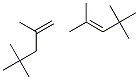
What is Diisobutylene?
Chemical properties
Colorless liquid
The Uses of Diisobutylene
Diisobutylene, an alkene, may be used in the following studies:
- To compose alternalte diesel fuel.
- As fuel in single-cylinder engine; exhaust generated from combustion due to the burning of fuel has been reported to contain high concentrations of olefins.1
- Preparation of mono- and dialkylated diphenylamines.
General Description
A clear colorless liquid with a petroleum-like odor. Flash point 10°F. Less dense than water and insoluble in water. Vapors heavier than air. Used in the manufacture of other chemicals.
Air & Water Reactions
Highly flammable. Insoluble in water.
Reactivity Profile
DIISOBUTYLENE may react vigorously with strong oxidizing agents. May react exothermically with reducing agents to release hydrogen gas.
Health Hazard
Low general toxicity; may act as simple asphyxiant in high vapor concentrations.
Flammability and Explosibility
Highly flammable
Properties of Diisobutylene
| Melting point: | -106°C(lit.) |
| Boiling point: | 101-103 °C (lit.) |
| Density | 0.716 g/mL at 20 °C (lit.) |
| vapor pressure | 58hPa at 25℃ |
| refractive index | n |
| Flash point: | 2 °C |
| solubility | Insoluble in water |
| form | clear liquid |
| color | Colorless to Almost colorless |
| Water Solubility | 2.3mg/L at 20℃ |
| BRN | 1098309 |
| EPA Substance Registry System | 2,4,4-Trimethylpentene (25167-70-8) |
Safety information for Diisobutylene
| Signal word | Danger |
| Pictogram(s) |
 Flame Flammables GHS02  Exclamation Mark Irritant GHS07  Health Hazard GHS08  Environment GHS09 |
| GHS Hazard Statements |
H225:Flammable liquids H304:Aspiration hazard H336:Specific target organ toxicity,single exposure; Narcotic effects H410:Hazardous to the aquatic environment, long-term hazard |
| Precautionary Statement Codes |
P210:Keep away from heat/sparks/open flames/hot surfaces. — No smoking. P233:Keep container tightly closed. P240:Ground/bond container and receiving equipment. P273:Avoid release to the environment. P331:Do NOT induce vomiting. P301+P310:IF SWALLOWED: Immediately call a POISON CENTER or doctor/physician. |
Computed Descriptors for Diisobutylene
| InChIKey | ZZBYUJLKFQXHHJ-UHFFFAOYSA-N |
New Products
5-bromo-4-fluoro-2-nitrobenzaldehyde (R)-(-)-2-Amino-1-propanol Cyclobutanone Fmoc-OSu 1-(2-Chloroethyl)pyrrolidine Hydrochloride 2-Amino-2-(4-methylphenyl)acetic acid β-Bromostyrene Ethyl 3-phenylpropanoate Phenethyl cinnamate Dipropyl disulfide 4 pentyn 1 ol N-Vinylformamide Methacrylate-PEG-Methacrylate, Mn:35000 2,4-Dihydroxyacetophenone 2-Chloro 5-Fluoro Pyridine Vasicinone 2-Chloroisonicotinic Acid Tween 80 or Polysorbate 80 2-Butyn-1-oL 2-Pentyn-1-oL 4-Nitrobenzotrifluoride N-(4-fluoro-2-methoxy-5-nitrophenyl)-4-(1-methyl-1H-indol-3-yl)pyrimidin-2-amine Pirtobrutinib intd. N-(4-Cyano-3-(trifluoromethyl)phenyl)-2-methyloxirane-2-carboxamideRelated products of tetrahydrofuran
You may like
-
 25167-70-8 Diisobutylene, 90% 98%View Details
25167-70-8 -
 25167-70-8 98%View Details
25167-70-8 -
 Diisobutylene (mixture of isomers) (stabilized with BHT) CAS 25167-70-8View Details
25167-70-8 -
Diisobutylene CAS 25167-70-8View Details
25167-70-8 -
7250-67-1 1-(2-Chloroethyl)pyrrolidine Hydrochloride 98+View Details
7250-67-1 -
13227-01-5 98+View Details
13227-01-5 -
7250-67-1 1-(2-Chloroethyl)pyrrolidine Hydrochloride 98+View Details
7250-67-1 -
13227-01-5 98+View Details
13227-01-5
Statement: All products displayed on this website are only used for non medical purposes such as industrial applications or scientific research, and cannot be used for clinical diagnosis or treatment of humans or animals. They are not medicinal or edible.