
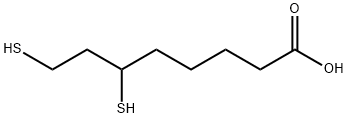
Dihydrolipoic acid
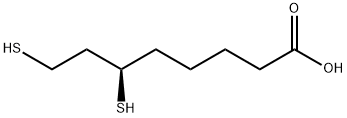
Synonym(s):(±)-6,8-Dimercaptooctanoic acid;(±)-Dihydrolipoic acid;DL -6,8-Thioctic acid, reduced;DHLA;DHLA, Dihydrolipoic Acid, Thiocytic Acid, Dihydro-
- CAS NO.:462-20-4
- Empirical Formula: C8H16O2S2
- Molecular Weight: 208.34
- MDL number: MFCD00166974
- EINECS: 610-288-5
- SAFETY DATA SHEET (SDS)
- Update Date: 2026-09-12 18:52:44
What is Dihydrolipoic acid?
The Uses of Dihydrolipoic acid
γ-Lipoic Acid, is a metabolite of α-Lipoic Acid (L468730), which is a over-the-counter nutritional supplements, that has been used as antioxidant. It is also fat-metabolism stimulator, and thus used a "weight loss" and "energy" supplement.
What are the applications of Application
Dihydrolipoic acid is the reduced form of lipoic acid, increases ROS and NO levels and activates caspase-9 and caspase-3
Definition
ChEBI: A thio-fatty acid that is reduced form of lipoic acid. A potent antioxidant shown to directly destroy superoxide, hydroperoxy and hydroxyl radicals; also has neuroprotective and anti-tumour effects.
Properties of Dihydrolipoic acid
| Melting point: | 62 °C |
| Boiling point: | 161.5 °C(Press: 0.7 Torr) |
| Density | 1.132 g/cm3 |
| vapor pressure | 0Pa at 25℃ |
| refractive index | 1.5220-1.5260 |
| storage temp. | +2C to +8C |
| solubility | Chloroform (Slightly), Methanol (Slightly) |
| pka | 4.74±0.10(Predicted) |
| form | liquid |
| color | light yellow |
Safety information for Dihydrolipoic acid
| Signal word | Danger |
| Pictogram(s) |
 Corrosion Corrosives GHS05  Exclamation Mark Irritant GHS07  Environment GHS09 |
| GHS Hazard Statements |
H302:Acute toxicity,oral H315:Skin corrosion/irritation H317:Sensitisation, Skin H318:Serious eye damage/eye irritation H411:Hazardous to the aquatic environment, long-term hazard |
| Precautionary Statement Codes |
P261:Avoid breathing dust/fume/gas/mist/vapours/spray. P273:Avoid release to the environment. P280:Wear protective gloves/protective clothing/eye protection/face protection. P301+P312:IF SWALLOWED: call a POISON CENTER or doctor/physician IF you feel unwell. P302+P352:IF ON SKIN: wash with plenty of soap and water. P305+P351+P338:IF IN EYES: Rinse cautiously with water for several minutes. Remove contact lenses, if present and easy to do. Continuerinsing. |
Computed Descriptors for Dihydrolipoic acid
Dihydrolipoic acid manufacturer
MSC Chemicals
Karnataka
Phone:91-9513681002
Whatsapp: 91-9513681002
product: 6,8-Dimercaptooctanoic acid
New Products
2-(2-Chlorophenyl)glycine Propiolic Acid 1-(3-Hydroxy-4-methoxyphenyl)-2-nitroethene (±)-amino(2-fluorophenyl)acetic acid trans-3-Benzyloxy-4-methoxy-beta-nitrostyrene 1-Pentadecanol 4-(4-Αminophenyl)-3-Morpholinone 3-Morpholino-1-(4-(2-oxopiperidin-1-yl) phenyl)-5,6-dihyropyridin-2-(1H)-one 1-(4-Aminophenyl)-3-morpholino-5,6-dihydropyridin-2(1H)-one N-cyanoacetylurethane 1H-IndazoleRelated products of tetrahydrofuran

You may like
-
 Dihydrolipoic Acid CAS 462-20-4View Details
462-20-4 -
DL-α-Lipoic Acid, Dihydro- CAS 462-20-4View Details
462-20-4 -
471-25-0 Propiolic Acid 98+View Details
471-25-0 -
84145-28-8 98+View Details
84145-28-8 -
trans-3-Benzyloxy-4-methoxy-beta-nitrostyrene 98+View Details
63909-29-5 -
2-(2-Chlorophenyl)glycine 88744-36-9 98+View Details
88744-36-9 -
40216-83-9 trans-4-Hydroxy-L-proline methyl ester hydrochloride 98+View Details
40216-83-9 -
1-(3-Hydroxy-4-methoxyphenyl)-2-nitroethene 98+View Details
39816-35-8
Statement: All products displayed on this website are only used for non medical purposes such as industrial applications or scientific research, and cannot be used for clinical diagnosis or treatment of humans or animals. They are not medicinal or edible.