
DIHYDROCODEINE TRIFLUOROACETATE
- CAS NO.:125-28-0
- Empirical Formula: C20H24F3NO4
- Molecular Weight: 399.4
- MDL number: MFCD02253008
- EINECS: 204-732-3
- SAFETY DATA SHEET (SDS)
- Update Date: 2026-05-28 02:56:17
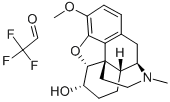
What is DIHYDROCODEINE TRIFLUOROACETATE?
Absorption
Bioavailability is low (approximately 20%) if administered orally. This may be due to poor gastrointestinal absorption. It is also likely due to pre-systemic metabolism by the liver and intestinal wall. [2]
The AUCs after oral and intravenous administration are similar (3203ug/l/h and 3401ug/l/h, respectively). [2]
Time to peak values are 1.6 and 1.8hours for a 30mg and 60mg dose, respectively. The concentrations achieved were 71.8 ug/1 and 146 ug/1, respectively. [2]
Originator
Bicodein,Uquifa
Background
Dihydrocodeine is an opioid analgesic used as an alternative or adjunct to codeine to treat moderate to severe pain, severe dyspnea, and cough.
It is semi-synthetic, and was developed in Germany in 1908 during an international search to find a more effective antitussive agent to help reduce the spread of airborne infectious diseases such as tuburculosis. It was marketed in 1911.
Indications
Dihydrocodeine is used for the treatment of moderate to severe pain, including post-operative and dental pain [2]. It can also be used to treat chronic pain [1], breathlessness and coughing.
In heroin addicts, dihydrocodeine has been used as a substitute drug, in doses up to 2500mg/day to treat addiction. [http://www.ncbi.nlm.nih.gov/pmc/articles/PMC2014322/]
Definition
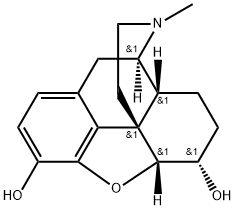
ChEBI: Dihydrocodeine is a morphinane alkaloid.
Manufacturing Process
The codein was reduced by hydrogen in the presence catalyst Pt (or Pd, or Ni)
and 7,8-dihydrocodein was obtained.
To the 7,8-dihydrocodein tartaric acid was added and mixed, in the result 7,8-
dihydrocodein bitartrate was obtained.
Therapeutic Function
Antitussive, Narcotic analgesic
Pharmacokinetics
Possible opioid related side effects include, but are not limited to, drowsiness, nausea, headache, dry mouth, constipation, difficulty passing urine, and mild euphoria.
Safety Profile
Poison by ingestion, intravenous, and subcutaneous routes. Human systemic effects by ingestion and subcutaneous routes: somnolence, miosis (pupillary constriction), and respiratory depression. An analgesic. Can cause drug dependency with repeated doses. When heated to decomposition it emits toxic fumes of NOx. See also CODEINE.
Metabolism
Metabolized in the liver by CYP 2D6 into an active metabolite, dihydromorphine, and by CYP 3A4 into secondary primary metabolite, nordihydrocodeine. A third primary metabolite is dihydrocodeine-6-glucuronide. [1]
The time for mean peak concentration in acid metabolites is 1.76h and 1.98h for a 30 and 60mg dose, respectively. The concentrations achieved were 563 ug/1 and 1476 ug/1, respectively. [2]
Properties of DIHYDROCODEINE TRIFLUOROACETATE
| Melting point: | 112-113° |
| Boiling point: | bp15 248° |
| Density | 1.1412 (rough estimate) |
| refractive index | 1.5740 (estimate) |
| Flash point: | 9℃ |
| storage temp. | 2-8°C |
| solubility | DMF: 20 mg/ml; DMF:PBS(pH 7.2)(1:1): 0.5 mg/ml; DMSO: 10 mg/ml |
| form | A neat solid |
| EPA Substance Registry System | Morphinan-6-ol, 4,5-epoxy-3-methoxy-17-methyl-, (5?,6?)- (125-28-0) |
Safety information for DIHYDROCODEINE TRIFLUOROACETATE
| Signal word | Danger |
| Pictogram(s) |
 Flame Flammables GHS02  Skull and Crossbones Acute Toxicity GHS06  Health Hazard GHS08 |
| GHS Hazard Statements |
H225:Flammable liquids H370:Specific target organ toxicity, single exposure |
| Precautionary Statement Codes |
P210:Keep away from heat/sparks/open flames/hot surfaces. — No smoking. P260:Do not breathe dust/fume/gas/mist/vapours/spray. P280:Wear protective gloves/protective clothing/eye protection/face protection. P311:Call a POISON CENTER or doctor/physician. P301+P310:IF SWALLOWED: Immediately call a POISON CENTER or doctor/physician. |
Computed Descriptors for DIHYDROCODEINE TRIFLUOROACETATE
New Products
2-Amino-5-bromo- benzoic acid Dibenzoyl-L-tartaric acid Anhydrous (Resolution Reagent) 1,2,3,9-Tetrahydro-9-Methyl-4H-Carbazole-4-One Cis-Tosylate Dibenzo[b,f][1,4]thiazepin-11(10H)-one BOC Piperazine N-Methyl-2-amino-2-methylpropionamide 4-(FMOC-AMINO)-TETRAHYDROPYRAN-4-CARBOXYLIC ACID 1-Aminocyclobutanecarboxylic Acid Hydrochloride 3-Oxocyclobutanecarboxylic acid AMINO(2-BROMOPHENYL)ACETIC ACID 6-BROMOTETRAZOLO[1,5-A]PYRIDINE 4-Amino-2-chloro-6,7-dimethoxyquinazoline 2,3-Dimethoxypyridine 2,6-bis(bromomethyl)pyridine tert-Butyl 4-mercaptopiperidine-1-carboxylate 4'-(Methylmercapto)-acetophrnonone 1-Benzhydrylazetidin-3-ol-Hcl 1-(3-Chlorophenyl)piperazine hydrochloride Enzyme Breaker for Coal Bed Methane Slickwaterr Gas Well Guar Gum Enzyme Breaker Enzyme Breaker for Conventional Slickwater Fracturing Conventional Fracturing Guar Gum Enzyme Breaker Coalbed Methane Guar Gum Enzyme BreakerRelated products of tetrahydrofuran


You may like
-
 254762-66-8 AMINO(2-BROMOPHENYL)ACETIC ACID 98+View Details
254762-66-8 -
254762-66-8 AMINO(2-BROMOPHENYL)ACETIC ACID 98+View Details
254762-66-8 -
23716-23-1 98+View Details
23716-23-1 -
6-BROMOTETRAZOLO[1,5-A]PYRIDINE 98+View Details
5799-75-7 -
254762-66-8 AMINO(2-BROMOPHENYL)ACETIC ACID 98+View Details
254762-66-8 -
23716-23-1 98+View Details
23716-23-1 -
6-BROMOTETRAZOLO[1,5-A]PYRIDINE 98+View Details
5799-75-7 -
1778-09-2 4'-(Methylmercapto)-acetophrnonone 98%View Details
1778-09-2