
DICHLOROACETIC ANHYDRIDE
- CAS NO.:4124-30-5
- Empirical Formula: C4H2Cl4O3
- Molecular Weight: 239.87
- MDL number: MFCD00000842
- EINECS: 223-924-8
- SAFETY DATA SHEET (SDS)
- Update Date: 2026-05-27 23:46:09
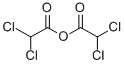
What is DICHLOROACETIC ANHYDRIDE?
Chemical properties
clear colorless liquid after melting
The Uses of DICHLOROACETIC ANHYDRIDE
Dichloroacetic anhydride was employed as an acylating agent for acylation of 10-Deacetylbaccatin III using Pseudomonas cepacia. It was also used in the preparation of cellulose dichloroacetates.
General Description
Dichloroacetic anhydride is an acylating agent and was evaluated for inducing autoimmune responses.
Properties of DICHLOROACETIC ANHYDRIDE
| Melting point: | ~30 °C |
| Boiling point: | 214-216 °C (lit.) |
| Density | 1.574 g/mL at 25 °C (lit.) |
| refractive index | n |
| Flash point: | >230 °F |
| storage temp. | Store below +30°C. |
| solubility | Acetonitrile (Soluble), Chloroform (Soluble) |
| form | Liquid After Melting |
| color | Clear colorless |
| Sensitive | Moisture Sensitive |
| BRN | 512173 |
| Stability: | Moisture sensitive |
| CAS DataBase Reference | 4124-30-5 |
| EPA Substance Registry System | Acetic acid, dichloro-, anhydride (4124-30-5) |
Safety information for DICHLOROACETIC ANHYDRIDE
| Signal word | Danger |
| Pictogram(s) |
 Corrosion Corrosives GHS05  Skull and Crossbones Acute Toxicity GHS06 |
| GHS Hazard Statements |
H311:Acute toxicity,dermal H314:Skin corrosion/irritation |
| Precautionary Statement Codes |
P260:Do not breathe dust/fume/gas/mist/vapours/spray. P280:Wear protective gloves/protective clothing/eye protection/face protection. P303+P361+P353:IF ON SKIN (or hair): Remove/Take off Immediately all contaminated clothing. Rinse SKIN with water/shower. P305+P351+P338:IF IN EYES: Rinse cautiously with water for several minutes. Remove contact lenses, if present and easy to do. Continuerinsing. |
Computed Descriptors for DICHLOROACETIC ANHYDRIDE
New Products
2-Bromo-4-hydroxypyridine Dibenzoyl-L-tartaric acid Anhydrous (Resolution Reagent) Dibenzo[b,f][1,4]thiazepin-11(10H)-one 1,2,3,9-Tetrahydro-9-Methyl-4H-Carbazole-4-One Cis-Tosylate 1-(4-methoxyphenyl)-4-(4-Nitrophenyl)Piperazine (IT-1) 2'-Fluoroacetophenone 1-aminocyclobutanecarbonitrile hydrochloride AMINO-O-TOLYL-ACETIC ACID N-Methyl-2-amino-2-methylpropionamide 4-(FMOC-AMINO)-TETRAHYDROPYRAN-4-CARBOXYLIC ACID 1-Aminocyclobutanecarboxylic Acid Hydrochloride METHANOL-D1(OD) TERTIARY BUTANOL-D9 N-ETHYL-D5-AMINE HYDROCHLORIDE BENZOIC ACID-D CHLOROFORM-D TOLUENE-D3 2-(2-Bromophenyl)ethanol Boc-D-Glu(OMe)-OMe 2,5 Dibromopyridine Ethyl 4-hydroxy-3-oxobutanoate Dimethyl (2S)-2-((tert-butoxycarbonyl)amino)-4-(cyanomethyl)pentanedioate 1-(3-Chlorophenyl)piperazine hydrochlorideRelated products of tetrahydrofuran
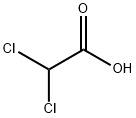


You may like
-
 Dichloroacetic anhydride, 98% CAS 4124-30-5View Details
4124-30-5 -
106914-07-2 N-Methyl-2-amino-2-methylpropionamide 98+View Details
106914-07-2 -
129592-98-9 98+View Details
129592-98-9 -
4-(FMOC-AMINO)-TETRAHYDROPYRAN-4-CARBOXYLIC ACID 98+View Details
285996-72-7 -
1-aminocyclobutanecarbonitrile hydrochloride 845821-84-3 98+View Details
845821-84-3 -
98071-16-0 1-Aminocyclobutanecarboxylic Acid Hydrochloride 98+View Details
98071-16-0 -
 ADC-151View Details
27176-87-0 -
 Nickel Acetate | Eastmen Chemicals - Manufacturer, Supplier, Exporter metallic saltsView Details
Statement: All products displayed on this website are only used for non medical purposes such as industrial applications or scientific research, and cannot be used for clinical diagnosis or treatment of humans or animals. They are not medicinal or edible.