
dichlorine oxide
- CAS NO.:7791-21-1
- Empirical Formula: Cl2O
- Molecular Weight: 86.91
- EINECS: 2322435
- SAFETY DATA SHEET (SDS)
- Update Date: 2026-05-28 01:16:34
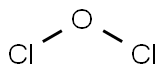
What is dichlorine oxide ?
Chemical properties
yellowish brown gas; disagreeable penetrating odor; explodes on contact with organic matter; decomposes at a moderate rate at room temp; anhydride of hypochlorous acid; Henry’s constant at 3.46°C is 14.23kPa/(molarity); enthalpy of vaporization 25.9kJ/mol; can be prepared by reacting Cl2 with HgO; used as an intermediate in manufacture of calcium hypochlorite and in sterilization; reacts with a variety of organic compounds [MER06] [KIR78]
Physical properties
Yellowish-brown gas; disagreeable suffocating odor; unstable at room temperature; gas density 3.89 g/L at 0°C; condenses to a reddish brown liquid at 2.2°C; freezes at -20°C; highly soluble in water; also soluble in alkalis, sulfuric acid, and carbon tetrachloride.
The Uses of dichlorine oxide
Dichlorine oxide is a chlorinating agent.
The Uses of dichlorine oxide
Chlorine monoxide is used as a strongand selective chlorinating agent. It is storedbelow -80°C ( -112°F) as a liquid or solid.
Definition
An orange gas made by passing chlorine over mercury(II) oxide. It is a strong oxidizing agent and dissolves in water to give chloric( I) acid.
Preparation
Chlorine monoxide is prepared by passing chlorine gas over yellow mercuric oxide. It is stored below -80°C as a liquid or solid.
General Description
Red-yellow gas. Very reactive and unstable. Unusually stored as hydrate in frozen form. Used as a wood bleach, biocide and swimming pool treatment.
Air & Water Reactions
Decomposes in water forming chlorine and oxygen gases.
Reactivity Profile
Explodes when heated or by reaction with organic materials, including: carbon, carbon disulfide, ethers, hydrocarbons, dicyanogen, any readily oxidizable materials (ammonia, potassium, arsenic, antimony, sulfur, mercury sulfide, calcium phosphide, phosphine, phosphorus, hydrogen sulfide, antimony sulfide, barium sulfide, mercury sulfide, and tin sulfide). Dissolves in alkalis, forming a mixture of chlorite and chlorate. Concentration of gas should be limited to less than 10% to reduce explosion hazard. Alcohols are oxidized explosively.
Hazard
Although a nonflammable gas, it reacts explosively with many substances, including organics, metals, metal sulfides, sulfur, phosphorus, nitric oxide, ammonia, carbon disulfide, metal hydrides, and charcoal. It is a severe irritant to the eyes, nose, skin, and respiratory tract. Inhalation of the gas at 100 ppm can be fatal to humans.
Health Hazard
Chlorine monoxide is severely irritating tothe eyes, skin, and mucous membranes.Exposure can cause lung damage. LC50 dataare not available for this compound. Ashort exposure to 100 ppm concentration cancause death to humans.
Fire Hazard
Nonflammable gas. Chlorine monoxide is a highly reactive compound, exploding by itself when rapidly heated. Chlorine monoxide explodes with organic compounds, charcoal, metals, metal sulfides, sulfur, phosphorus, ammonia, nitric oxide, and carbon disulfide.
Properties of dichlorine oxide
| Melting point: | -120.6° |
| Boiling point: | bp 2.2° |
| Density | 1.549 (estimate) |
| solubility | very soluble in H2O |
| form | yellow-brown gas |
| color | yellow-brown |
| Water Solubility | 1 volume of water dissolves more than 100 volumes (0°C); saturation solubility is 143.6g/100g H2O (?9.4°C) [MER06] [KIR78] |
| EPA Substance Registry System | Chlorine monoxide (7791-21-1) |
Safety information for dichlorine oxide
Computed Descriptors for dichlorine oxide
New Products
3-AMINO-3-(2-CHLORO-PHENYL)-PROPIONIC ACID 4-Fluorophenylglycine 1-Boc-3-(cyanomethyl)azetidine Dimedone 1-N-Boc-3-(aminoethyl)azetidine N-BOC-piperidine-4-carboxylic acid 4,6-Dichlororesorcinol 5-Amino-2-Bromo-3-Chloropyridine 2-Picolinic acid N-oxide 4-Butyl Resorcinol 2-Bromo-5-Chloropyridine 5-Bromo-2-Hydroxy-3-Nitro Pyridine 2-Amino-4-phenyl-thiazole N-(4-Bromophenyl)-2-chloroacetamide TRIFLOURO ACETICACID-D METHANE SULFONIC ACID-D4 PHOSPORIC ACID-D3 85 W% IN D2O DEUTERIUM OXIDE FOR NMR BENZENE-D6 TOLUENE-D3You may like
-
 IODOETHANE-D5 6485-58-1 99%View Details
6485-58-1 -
32008-59-6 PARAFORMALDEHYDE-D2 98%View Details
32008-59-6 -
CHLORO BENZENE-D5 3114-55-4 99%View Details
3114-55-4 -
PHENYL ACETYLENE-D 3240-11-07 99%View Details
3240-11-07 -
918-20-7 TERT-BUTYL CHLORIDE-D9 98%View Details
918-20-7 -
84358-13-4 N-BOC-piperidine-4-carboxylic acid 98+View Details
84358-13-4 -
84358-13-4 N-BOC-piperidine-4-carboxylic acid 98+View Details
84358-13-4 -
84358-13-4 N-BOC-piperidine-4-carboxylic acid 98+View Details
84358-13-4