
Dibenzyl disulfide
Synonym(s):Benzyl disulfide;Bis(phenylmethyl) disulfide;Dibenzyl disulfide
- CAS NO.:150-60-7
- Empirical Formula: C14H14S2
- Molecular Weight: 246.39
- MDL number: MFCD00004783
- EINECS: 205-764-0
- SAFETY DATA SHEET (SDS)
- Update Date: 2026-06-24 18:39:39
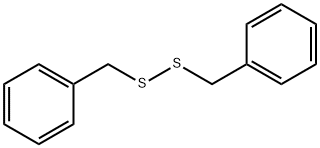
What is Dibenzyl disulfide?
Chemical properties
Benzyl disulfide is a pale yellow leafy or small leafy crystals that has a powerful, burnt-caramel odor; irritating when concentrated. Boiling point >270°C(decomposition). Several insoluble in water, soluble in hot ethanol and ether.
The Uses of Dibenzyl disulfide
Dibenzyl disulfide has been used in lubricating oil formulations to improve thermal and aging resistance of the oil. It is used an antioxidant in rubber compounding, stabilizer for petroleum fractions, additive to silicone oils. The soly in oils is increased by the presence of benzyl alcohol.
Definition
ChEBI: Dibenzyl disulfide is an organic disulfide that results from the formal oxidative dimerisation of benzyl thiol. It has a role as a metabolite. It is an organic disulfide and an organic aromatic compound.
Preparation
Dibenzyl disulfide is synthesized from benzyl chloride and Na2S2; also from benzyl mercaptan via oxidation.
Md. Tajbakhsh et al. (2004) synthesized disulfide from thiols by oxidation with 2,6- DCPCC in acetonitirle at room temperature. For synthesis of DBDS, they used benzyl mercaptan. In 8 min, 96% yield was obtained.
Vivek Polshettiwar et al. (2003) obtained disulfide from reaction of alkyl halide with reagent (C6H5CH2N(Et)3)6Mo7S24 in presence of CHCl3 at room temperature. Pure disulfide was obtained by purification by column chromatography method on silica gel. 89% yield was obtained.
What are the applications of Application
Dibenzyl Disulfide (DBDS) is one of several sulfur compounds known to cause copper corrosion in transformers under certain circumstances. Originating from Petiveria alliacea L. This compound along with the other sulfur-containing compound found in this plant display antibacterial and antifungal activity.
Synthesis Reference(s)
The Journal of Organic Chemistry, 54, p. 2998, 1989 DOI: 10.1021/jo00274a002
Synthetic Communications, 22, p. 3277, 1992 DOI: 10.1080/00397919208021143
Tetrahedron Letters, 31, p. 5007, 1990 DOI: 10.1016/S0040-4039(00)97790-6
General Description
Dibenzyl Disulfide (DBDS) also called Benzyl disulfide is an aromatic disulfide with molecular formula C14H14S2. It has a structural unit, which consists of a linked pair of sulfur atoms. It is insoluble in water whereas soluble in hot methanol, benzene, ether and hot ethanol. Large disulfides-linked agglomerates are rifely found in proteins and many other biologically active molecules.
Solubility in organics
Poorly soluble in cold alcohol, soluble in hot alcohol and in oils.
Purification Methods
Crystallise the disulfide from EtOH (m 77o), pet ether or CS2 (m 72o) or distil it. The AgNO3 complex has m 103o. [Beilstein 6 H 465, 6 I 229, 6 II 437, 6 III 1635, 6 IV 2760.]
Properties of Dibenzyl disulfide
| Melting point: | 69-72 °C (lit.) |
| Boiling point: | 210-216°C 18mm |
| Density | 1.3 |
| refractive index | 1.6210 (estimate) |
| FEMA | 3617 | BENZYL DISULFIDE |
| Flash point: | 150°C |
| storage temp. | 2-8°C |
| solubility | Chloroform (Slightly), Ethyl Acetate (Slightly) |
| form | neat |
| form | Solid |
| color | White |
| Odor | at 0.10 % in propylene glycol. smoky burnt earthy green caramel |
| Merck | 14,3013 |
| JECFA Number | 579 |
| BRN | 1110443 |
| CAS DataBase Reference | 150-60-7(CAS DataBase Reference) |
| NIST Chemistry Reference | Benzyl disulfide(150-60-7) |
| EPA Substance Registry System | Disulfide, bis(phenylmethyl) (150-60-7) |
Safety information for Dibenzyl disulfide
| Signal word | Warning |
| Pictogram(s) |
 Exclamation Mark Irritant GHS07 |
| GHS Hazard Statements |
H317:Sensitisation, Skin |
| Precautionary Statement Codes |
P280:Wear protective gloves/protective clothing/eye protection/face protection. |
Computed Descriptors for Dibenzyl disulfide
New Products
2-(2-Chlorophenyl)glycine Propiolic Acid trans-3-Benzyloxy-4-methoxy-beta-nitrostyrene 1-(3-Hydroxy-4-methoxyphenyl)-2-nitroethene (±)-amino(2-fluorophenyl)acetic acid 1-Pentadecanol N-Vinylformamide 4 pentyn 1 ol 4-(4-Αminophenyl)-3-Morpholinone 3-Morpholino-1-(4-(2-oxopiperidin-1-yl) phenyl)-5,6-dihyropyridin-2-(1H)-one 1-(4-Aminophenyl)-3-morpholino-5,6-dihydropyridin-2(1H)-one N-cyanoacetylurethane 1H-IndazoleRelated products of tetrahydrofuran

You may like
-
 Dibenzyl disulfide CAS 150-60-7View Details
150-60-7 -
Dibenzyl Disulfide CAS 150-60-7View Details
150-60-7 -
Benzyl disulfide CAS 150-60-7View Details
150-60-7 -
Dibenzyl disulfide CAS 150-60-7View Details
150-60-7 -
471-25-0 Propiolic Acid 98+View Details
471-25-0 -
2-(2-Chlorophenyl)glycine 88744-36-9 98+View Details
88744-36-9 -
40216-83-9 trans-4-Hydroxy-L-proline methyl ester hydrochloride 98+View Details
40216-83-9 -
1-(3-Hydroxy-4-methoxyphenyl)-2-nitroethene 98+View Details
39816-35-8