
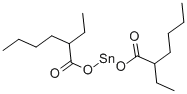
DI-N-BUTYLTIN BIS(2-ETHYLHEXANOATE)
- CAS NO.:2781-10-4
- Empirical Formula: C24H48O4Sn
- Molecular Weight: 519.35
- MDL number: MFCD00015261
- EINECS: 220-481-2
- SAFETY DATA SHEET (SDS)
- Update Date: 2026-05-28 03:01:42
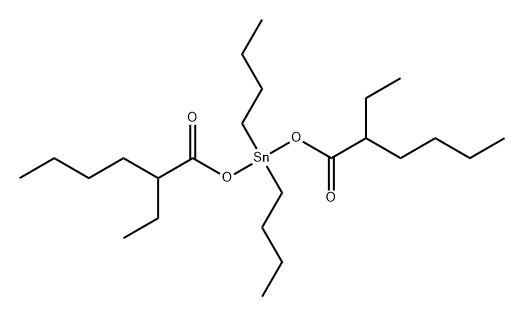
What is DI-N-BUTYLTIN BIS(2-ETHYLHEXANOATE)?
Chemical properties
white crystalline powder
The Uses of DI-N-BUTYLTIN BIS(2-ETHYLHEXANOATE)
Di-n-butyltin bis(2-ethylhexanoate) is used in silanol condensation reactions for caulk and sealant applications and in the production of silicones. It is also used in one or two component systems which are compatible with aromatic solvents.
Properties of DI-N-BUTYLTIN BIS(2-ETHYLHEXANOATE)
| Melting point: | 57-59 °C(lit.) |
| Boiling point: | 215-20°C 2mm |
| Density | 1,07 g/cm3 |
| vapor pressure | 0.1Pa at 19.85℃ |
| refractive index | 1.4653 |
| Flash point: | 26°C |
| solubility | Soluble in mineral oil, acetone, xylene |
| form | solid |
| Specific Gravity | 1.07 |
| Water Solubility | 4mg/L at 20℃ |
| Hydrolytic Sensitivity | 4: no reaction with water under neutral conditions |
| Exposure limits | ACGIH: TWA 0.1 mg/m3; STEL 0.2 mg/m3 (Skin) NIOSH: IDLH 25 mg/m3; TWA 0.1 mg/m3 |
| CAS DataBase Reference | 2781-10-4(CAS DataBase Reference) |
| EPA Substance Registry System | Hexanoic acid, 2-ethyl-, 1,1'-(dibutylstannylene) ester (2781-10-4) |
Safety information for DI-N-BUTYLTIN BIS(2-ETHYLHEXANOATE)
| Signal word | Danger |
| Pictogram(s) |
 Corrosion Corrosives GHS05  Skull and Crossbones Acute Toxicity GHS06  Exclamation Mark Irritant GHS07  Health Hazard GHS08  Environment GHS09 |
| GHS Hazard Statements |
H301:Acute toxicity,oral H310:Acute toxicity,dermal H314:Skin corrosion/irritation H317:Sensitisation, Skin H361:Reproductive toxicity H401:Hazardous to the aquatic environment, acute hazard H410:Hazardous to the aquatic environment, long-term hazard H411:Hazardous to the aquatic environment, long-term hazard |
| Precautionary Statement Codes |
P273:Avoid release to the environment. P280:Wear protective gloves/protective clothing/eye protection/face protection. P309:IF exposed or if you feel unwell: P310:Immediately call a POISON CENTER or doctor/physician. P305+P351+P338:IF IN EYES: Rinse cautiously with water for several minutes. Remove contact lenses, if present and easy to do. Continuerinsing. P501:Dispose of contents/container to..… |
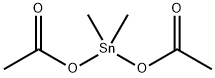
Computed Descriptors for DI-N-BUTYLTIN BIS(2-ETHYLHEXANOATE)
New Products
Dibenzoyl-L-tartaric acid Anhydrous (Resolution Reagent) Cis-Tosylate Dibenzo[b,f][1,4]thiazepin-11(10H)-one 1,2,3,9-Tetrahydro-9-Methyl-4H-Carbazole-4-One 1-(4-methoxyphenyl)-4-(4-Nitrophenyl)Piperazine (IT-1) BOC Piperazine 1-Benzhydrylazetane-3-carbonitrile 8-oxa-1,3-diazaspiro[4.5]decane-2,4-dione (±)-amino(2-fluorophenyl)acetic acid 2-(2-Chlorophenyl)glycine AMINO-(3-CHLORO-PHENYL)-ACETIC ACID 2'-Fluoroacetophenone METHANOL-D1(OD) TERTIARY BUTANOL-D9 N-ETHYL-D5-AMINE HYDROCHLORIDE BENZOIC ACID-D CHLOROFORM-D TOLUENE-D3 Trans,trans muconic acid HC Blue-16 4-Amino-2-chloro-6,7-dimethoxyquinazoline Ethyl 4,5-bis(2-methoxyethoxy)-2-nitrobenzoate 2,3-Dimethoxypyridine 1-(3-Chlorophenyl)piperazine hydrochlorideRelated products of tetrahydrofuran


You may like
-
 Di-n-butyltin bis (2-ethylhexanoate) CAS 2781-10-4View Details
2781-10-4 -
DI-NORMAL-BUTYLTIN DI-2-ETHYLHEXANOATE CAS 2781-10-4View Details
2781-10-4 -
 Product IntroductionView Details
 -
 Product InrtroductionView Details
 -
 DGO24View Details
 -
 DGO25View Details
 -
 DGO29View Details
 -
 DGO32View Details
Statement: All products displayed on this website are only used for non medical purposes such as industrial applications or scientific research, and cannot be used for clinical diagnosis or treatment of humans or animals. They are not medicinal or edible.