
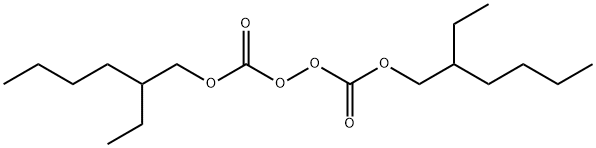
Di-(2-ethylhexyl)peroxydicarbonate
- CAS NO.:16111-62-9
- Empirical Formula: C18H34O6
- Molecular Weight: 346.46
- MDL number: MFCD00072725
- EINECS: 240-282-4
- SAFETY DATA SHEET (SDS)
- Update Date: 2026-10-13 16:36:52
What is Di-(2-ethylhexyl)peroxydicarbonate?
Chemical properties
It is colorless liquid with unpleasant odor. Thermally unstable with required continuous refrigeration below -10°C (-14°F). Refer to the Code for the Storage of Organic Peroxide Formulations. Storage incompatibility includes strong acids, oxidizing agents, alkaline materials, reducing agents, and amines. Also, it should be stored away from excessive heat, sources of ignition, and reactive materials (12b).
General Description
Di-(2-ethylhexyl)peroxydicarbonate is particularly sensitive to temperature rises. Above a given "Control Temperature" they decompose violently. They are generally stored or transported in a solvent slurry.
Reactivity Profile
DI-(2-ETHYLHEXYL) PEROXYDICARBONATE decomposes violently or explosively at temperatures 0-10° C. owing to self-accelerating exothermic decomposition; Several explosions were due to shock, heat or friction; amines and certain metals can cause accelerated decomposition [Bretherick, 1979 p. 156], Danger of explosion when dry
Safety Profile
Moderately toxic by ingestion. When heated to decomposition it emits acrid smoke and irritating fumes. See also PEROXIDES, ORGANIC
Properties of Di-(2-ethylhexyl)peroxydicarbonate
| Boiling point: | 401.18°C (rough estimate) |
| Density | 1.0722 (rough estimate) |
| vapor pressure | 0.001Pa at 25℃ |
| refractive index | 1.4450 (estimate) |
| Water Solubility | 880mg/L at 25℃ |
| Stability: | Unstable if heated. Heating presents a potential risk of explosion. May be shock sensitive. Flammable. May react violently with organic materials. |
| EPA Substance Registry System | Peroxydicarbonic acid, bis(2-ethylhexyl) ester (16111-62-9) |
Safety information for Di-(2-ethylhexyl)peroxydicarbonate
Computed Descriptors for Di-(2-ethylhexyl)peroxydicarbonate
New Products
2-(2-Chlorophenyl)glycine Propiolic Acid 1-(3-Hydroxy-4-methoxyphenyl)-2-nitroethene (±)-amino(2-fluorophenyl)acetic acid trans-3-Benzyloxy-4-methoxy-beta-nitrostyrene 1-Pentadecanol 4-(4-Αminophenyl)-3-Morpholinone 3-Morpholino-1-(4-(2-oxopiperidin-1-yl) phenyl)-5,6-dihyropyridin-2-(1H)-one 1-(4-Aminophenyl)-3-morpholino-5,6-dihydropyridin-2(1H)-one N-cyanoacetylurethane 1H-IndazoleRelated products of tetrahydrofuran

You may like
-
 40216-83-9 trans-4-Hydroxy-L-proline methyl ester hydrochloride 98+View Details
40216-83-9 -
471-25-0 Propiolic Acid 98+View Details
471-25-0 -
84145-28-8 98+View Details
84145-28-8 -
trans-3-Benzyloxy-4-methoxy-beta-nitrostyrene 98+View Details
63909-29-5 -
2-(2-Chlorophenyl)glycine 88744-36-9 98+View Details
88744-36-9 -
40216-83-9 trans-4-Hydroxy-L-proline methyl ester hydrochloride 98+View Details
40216-83-9 -
629-76-5 98+View Details
629-76-5 -
1-(3-Hydroxy-4-methoxyphenyl)-2-nitroethene 98+View Details
39816-35-8