
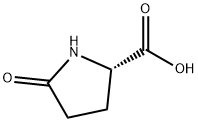
D-Pyroglutamic acid
Synonym(s):D -5-Oxo-2-pyrrolidinecarboxylic acid;D -Pyroglutamic acid
- CAS NO.:4042-36-8
- Empirical Formula: C5H7NO3
- Molecular Weight: 129.11
- MDL number: MFCD00066212
- EINECS: 223-735-0
- SAFETY DATA SHEET (SDS)
- Update Date: 2026-05-27 17:36:05

What is D-Pyroglutamic acid?
Description
D-Pyroglutamic acid, also known as 5-oxo-D-proline, is a metabolite of D-glutamate. It is formed from D-glutamate by D-glutamate cyclase. The levels of D-pyroglutamic acid are increased in the urine of patients with nascent metabolic syndrome and the plasma of patients with end-stage renal disease.
Chemical properties
white to light yellow crystal powder.
Occurrence
D-pyroglutamic acid is formed by the dehydration between the α-NH2 group and the γ-hydroxyl group of glutamic acid to form an intramolecular amide bond; it can also be formed by the loss of an amide group in the glutamine molecule.
The Uses of D-Pyroglutamic acid
Serves as a building block in the synthesis of diphthamide
The Uses of D-Pyroglutamic acid
Serves as a building block in the synthesis of diphthamide.
Definition
ChEBI: D-Pyroglutamic acid is the D-enantiomer of 5-oxoproline. It has a role as a metabolite. It is a D-proline derivative and a 5-oxoproline. It is a conjugate acid of a 5-oxo-D-prolinate. It is an enantiomer of a 5-oxo-L-proline.
Biological Activity
D-Pyroglutamic acid (PCA) is a cyclic derivative of glutamic acid, physiologically present in mammalian tissues. It has been shown that PCA releases GABA from the cerebral cortex and displays anti-anxiety effects in a simple approach-avoidance conflict situation in the rat. In clinical pharmacology experiments, PCA significantly shortens the plasma half-life of ethanol during acute intoxication.
Purification Methods
Purify R-pyroglutamic acid by dissolving it in H2O, filtering, passing the filtrate through Dowex 50 (H+ form), washing with H2O, pooling washings, evaporating, removing H2O azeotropically with Me2CO and *C6H6, washing the residue with Et2O and recrystallising from EtOH/pet ether. [Pradeller et al. Collect Czech Chem Commun 42 79, 80 1977, Beilstein 22/6 V 7.]
References
1. Ariyoshi, M., Katane, M., Hamase, K., et al. D-Glutamate is metabolized in the heart mitochondria. Sci. Rep. 7, 43911 (2017). DOI:10.1038/srep43911
2. Shim, K., Gulhar, R., and Jialal, I. Exploratory metabolomics of nascent metabolic syndrome. J. Diabetes Complications 33(3), 212-216 (2019). DOI:10.1016/j.jdiacomp.2018.12.002
3. Palekar AG, et al. Accumulation of 50oxo-L-proline and 5-oxo-D-proline in the blood plasma in end stage renal disease. Biochem Med. 1975 Nov;14(3):339-45. DOI:10.1016/0006-2944(75)90052-6
4. D-Pyroglutamic Acid Production from L-Glutamic Acid by Successive
Racemization, Resolution and Dehydration. DOI:10.6967/JCICE.200003.0177
Properties of D-Pyroglutamic acid
| Melting point: | 155-162 °C |
| Boiling point: | 239.15°C (rough estimate) |
| alpha | 27.5 º (c=10,1N NaOH) |
| Density | 1.3816 (rough estimate) |
| refractive index | 10 ° (C=5, H2O) |
| storage temp. | Sealed in dry,Room Temperature |
| solubility | Dimethylformamide, DMSO (Slightly), Methanol (Slightly), Water |
| form | Solid |
| pka | 3.48±0.20(Predicted) |
| color | Off-White to Light Beige |
| optical activity | [α]22/D +10°, c = 1.5 in H2O |
| Water Solubility | soluble |
| Merck | 14,8001 |
| BRN | 82133 |
| CAS DataBase Reference | 4042-36-8(CAS DataBase Reference) |
Safety information for D-Pyroglutamic acid
| Signal word | Warning |
| Pictogram(s) |
 Exclamation Mark Irritant GHS07 |
| GHS Hazard Statements |
H315:Skin corrosion/irritation H319:Serious eye damage/eye irritation H335:Specific target organ toxicity, single exposure;Respiratory tract irritation |
| Precautionary Statement Codes |
P261:Avoid breathing dust/fume/gas/mist/vapours/spray. P304+P340:IF INHALED: Remove victim to fresh air and Keep at rest in a position comfortable for breathing. P305+P351+P338:IF IN EYES: Rinse cautiously with water for several minutes. Remove contact lenses, if present and easy to do. Continuerinsing. P405:Store locked up. |
Computed Descriptors for D-Pyroglutamic acid
| InChIKey | ODHCTXKNWHHXJC-GSVOUGTGSA-N |
New Products
9-Mesityl-10-methylacridinium perchlorate Sulfapyridine Fmoc-OSu (R)-(-)-2-Amino-1-propanol Cyclobutanone 5-bromo-4-fluoro-2-nitrobenzaldehyde 4 pentyn 1 ol N-Vinylformamide Phenethyl cinnamate Pyrrolo[1,2-a]pyrimidine-6-carboxylic acid, 4,6,7,8-tetrahydro-4-oxo-, sodium salt (1:1), (6S) Ethyl 3-phenylpropanoate β-Bromostyrene Methacrylate-PEG-Methacrylate, Mn:35000 2,4-Dihydroxyacetophenone 2-Chloro 5-Fluoro Pyridine Vasicinone 2-Chloroisonicotinic Acid Tween 80 or Polysorbate 80 5-Bromo-1-Pentyne 1-(2-Methyl-5-nitrophenyl)guanidine Nitrate Methyl trans-4-Aminocyclohexanecarboxylate Hydrochloride 2-Pentyn-1-oL 4-Nitrobenzotrifluoride N-(4-Cyano-3-(trifluoromethyl)phenyl)-2-methyloxirane-2-carboxamideRelated products of tetrahydrofuran

You may like
-
 4042-36-8 99%View Details
4042-36-8 -
D-Pyroglutamic acid 98% (HPLC) CAS 4042-36-8View Details
4042-36-8 -
D-Pyroglutamic Acid CAS 4042-36-8View Details
4042-36-8 -
D-Pyroglutamic acid 98% CAS 4042-36-8View Details
4042-36-8 -
 D-Pyroglutamic Acid CAS 4042-36-8View Details
4042-36-8 -
1191-95-3 Cyclobutanone 98+View Details
1191-95-3 -
Fmoc-OSu 98+View Details
82911-69-1 -
(R)-(-)-2-Amino-1-propanol 35320-23-1 98+View Details
35320-23-1