
Polyglutamic acid
- CAS NO.:25513-46-6
- Empirical Formula: (C5H9NO4)x
- Molecular Weight: 147.13
- MDL number: MFCD00148021
- EINECS: 200-293-7
- SAFETY DATA SHEET (SDS)
- Update Date: 2026-09-24 21:23:22
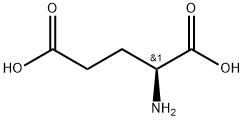
What is Polyglutamic acid?
Description
Polyglutamic acid (PGA), a poly amino acid produced by Bacillus spp. is a naturally occurring anionic, water-soluble, biodegradable, non-toxic, viscous, edible biopolymer containing D and L-glutamic acid residues with different industrial applications.
The Uses of Polyglutamic acid
Polyglutamic acid is commonly used in cosmetics as a powerful humectant for moisturising the skin. It is ideal for people with dry or dehydrated skin and may help to reduce the appearance of fine lines and wrinkles. Polyglutamic acid is also used in the food industry and has the ability to improve taste and flavour. In addition, Polyglutamic acid is an environmentally friendly biomaterial that can be used as a drug carrier/delivery agent and as a contrast agent.
Definition
ChEBI: A macromolecule composed of repeating gamma-linked L-glutamyl units.
What are the applications of Application
Polyglutamic acid is considered a promising bio-based chemical and is already widely used in the food, medical, and wastewater industries due to its biodegradable, non-toxic, and non-immunogenic properties.
Preparation
The Preparation method of Polyglutamic acid is as follows:poplar sawdust was used to produce Polyglutamic acid. Poplar sawdust was treated with acid and then hydrolyzed with cellulose. The enzymatic hydrolysate was used to produce Polyglutamic acid. Through single factor and orthogonal experiments, the optimum enzymatic conditions were determined as follows: solid-liquid ratio 1:5, enzyme amount 22 FPU/g, pH 5.0 and 53 min. Under the enzymatic hydrolysate medium, the Polyglutamic acid yield reached 30.87 ± 0.44 g/L, which was 5.11% higher than that in glucose medium (29.37 ± 0.43 g/L). In addition, the amount of glucose added to the medium was reduced, which realized the comprehensive utilization of various sugars in sawdust enzymatic hydrolysate.
Benefits
The primary benefit of polyglutamic acid is its impressive ability to hydrate skin. Because it’s a polymer, it forms a flexible, smooth, moisture-binding film on skin’s surface. This film helps skin keep moisture in its surface layers, even in conditions of low humidity, making polyglutamic acid an effective humectant.
In addition to its abilities to aid skin in moisture retention, polyglutamic acid soothes and helps increase the production of natural moisturizing factors (NMF) in skin, which contributes to having a healthier barrier and balanced hydration.
Polyglutamic acid hydrates skin but also performs other roles as well including wrinkle reduction, balancing the effects of chronic sun exposure and enhancing wound healing.
Side Effects
Polyglutamic acid is generally considered safe and allergic reaction side effects are rare, which may result in itching, swelling, redness, burning sensation or blisters. Before applying Polyglutamic acid to your face, you can perform a patch test to ensure that you are tolerating this ingredient well.
Toxicology
This substance/mixture contains no components considered to be either persistent, bioaccumulative and toxic (PBT), or very persistent and very bioaccumulative (vPvB) at levels of 0.1% or higher
Properties of Polyglutamic acid
| storage temp. | −20°C |
| InChI | InChI=1/C5H9NO4/c6-3(5(9)10)1-2-4(7)8/h3H,1-2,6H2,(H,7,8)(H,9,10)/t3-/s3 |
Safety information for Polyglutamic acid
Computed Descriptors for Polyglutamic acid
| InChIKey | WHUUTDBJXJRKMK-ZJPLZJKBNA-N |
| SMILES | [C@@H](N)(C(=O)O)CCC(=O)O |&1:0,r| |
New Products
5-bromo-4-fluoro-2-nitrobenzaldehyde (R)-(-)-2-Amino-1-propanol Cyclobutanone Fmoc-OSu 1-(2-Chloroethyl)pyrrolidine Hydrochloride 2-Amino-2-(4-methylphenyl)acetic acid β-Bromostyrene Ethyl 3-phenylpropanoate Phenethyl cinnamate Dipropyl disulfide 4 pentyn 1 ol N-Vinylformamide Methacrylate-PEG-Methacrylate, Mn:35000 2,4-Dihydroxyacetophenone 2-Chloro 5-Fluoro Pyridine Vasicinone 2-Chloroisonicotinic Acid Tween 80 or Polysorbate 80 2-Butyn-1-oL 2-Pentyn-1-oL 4-Nitrobenzotrifluoride N-(4-fluoro-2-methoxy-5-nitrophenyl)-4-(1-methyl-1H-indol-3-yl)pyrimidin-2-amine Pirtobrutinib intd. N-(4-Cyano-3-(trifluoromethyl)phenyl)-2-methyloxirane-2-carboxamideRelated products of tetrahydrofuran

You may like
-
 Poly-L-glutamic acid, 30% CAS 25513-46-6View Details
25513-46-6 -
Fmoc-OSu 98+View Details
82911-69-1 -
7250-67-1 1-(2-Chloroethyl)pyrrolidine Hydrochloride 98+View Details
7250-67-1 -
13227-01-5 98+View Details
13227-01-5 -
7250-67-1 1-(2-Chloroethyl)pyrrolidine Hydrochloride 98+View Details
7250-67-1 -
13227-01-5 98+View Details
13227-01-5 -
7250-67-1 1-(2-Chloroethyl)pyrrolidine Hydrochloride 98+View Details
7250-67-1 -
13227-01-5 98+View Details
13227-01-5