
D-PSICOSE
- CAS NO.:551-68-8
- Empirical Formula: C6H12O6
- Molecular Weight: 180.16
- MDL number: MFCD00080812
- EINECS: 208-999-7
- SAFETY DATA SHEET (SDS)
- Update Date: 2026-07-17 11:01:18

What is D-PSICOSE?
Description
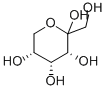
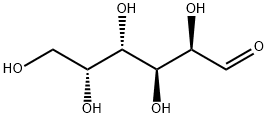
D-Psicose, also widely known as D-allulose, is a natural but rare monosaccharide. It is a ketohexose that has the same empirical formula as common monosaccharides such as glucose and fructose. It is epimeric with fructose at the 3-position. Its enantiomer, L-psicose1, is unknown in nature but has been synthesized.
Known as early as 1915 as D-pseudofructose, German chemists H. Ohle and F. Just determined its structure in 1935 and renamed it D-psicose. In 1942, F. W. Zerban at the New York Sugar Trade Laboratory (New York City) and Louis Sattler at Brooklyn College (NY) isolated it from commercial cane molasses. At the time, it was deemed to be unfermentable and therefore of little practical value.
The physical state of D-psicose is variously reported in the literature as a viscous liquid or a white crystalline solid with a melting point of 58 °C or 109 °C. These discrepancies are probably attributable to the difficulty of crystallizing the compound. At ≈1.0 kg/L, it is extremely soluble in water. (Glucose dissolves at ≈900 g/L, fructose at ≈4 kg/L.)
D-Psicose is 70% as sweet as sucrose (table sugar), but it has only ≈10% of the nutritional energy (calorie) value. As a result, it is under development as a replacement for sucrose and artificial sweeteners. It was originally produced from corn; but this year, food-ingredient startup Bonumose (Charlottesville, VA) and drug-services company Novasep (Lyon, France) teamed up to manufacture D-psicose and fellow low-calorie sugar D-tagatose2 from cellulose, starch, or their derivatives via an enzymatic process.
1. CAS Registry No. 16354-64-6.
2. CAS Registry No. 87-81-0.
Chemical properties
Clear colorless to yellow liquid or powder
The Uses of D-PSICOSE
D-Psicose is a C3 epimer of L-Fructose, which maintains the ability to reduce fat accumulation when added to a diet through inhibition of intestinal α-glucosidase.
What are the applications of Application
D-Psicose is a C3 epimer of L-fructose
Definition
ChEBI: The D-enantiomer of psicose.
Enzyme inhibitor
This ketohexose (FW = 180.16 g/mol), also known as D-ribo-2-hexulose and reportedly fpound in cane molasses, has epimers of D-psicose are Dfructose, D-sorbose, and L-tagatose. D-Psicose is an alternative substrate for fructokinase. The structural composition of D-psicose at 27°C in D2O is 22% a-pyranose, 24% b-pyranose, 39% a-furanose, and 15% bfuranose. Target(s): ketohexokinase, or hepatic fructokinase; also alternative substrate.
Properties of D-PSICOSE
| Melting point: | 109 °C |
| Boiling point: | 551.7±50.0 °C(Predicted) |
| alpha | D25 +4.7° (c = 4.3 in water; no detectable mutarotation) |
| Density | 1.589±0.06 g/cm3(Predicted) |
| refractive index | 16.3 ° (C=0.94, H2O) |
| storage temp. | Sealed in dry,2-8°C |
| solubility | Methanol (Slightly, Heated, Sonicated), Water (Soluble, Sonicated) |
| appearance | white crystals or viscous liquid |
| form | Powder |
| pka | 11.86±0.20(Predicted) |
| color | White |
| Merck | 14,7924 |
| CAS DataBase Reference | 551-68-8 |
Safety information for D-PSICOSE
| Signal word | Danger |
| Pictogram(s) |
 Corrosion Corrosives GHS05 |
| GHS Hazard Statements |
H314:Skin corrosion/irritation H318:Serious eye damage/eye irritation |
| Precautionary Statement Codes |
P280:Wear protective gloves/protective clothing/eye protection/face protection. P310:Immediately call a POISON CENTER or doctor/physician. P305+P351+P338:IF IN EYES: Rinse cautiously with water for several minutes. Remove contact lenses, if present and easy to do. Continuerinsing. |
Computed Descriptors for D-PSICOSE
New Products
N-Carbethoxy-4-piperidone 1-Aminocyclopentane carbonitrile Tetrabutylammonium perchlorate N,O-Dimethylhydroxylamine hydrochloride (RS)-beta-Amino-beta-(4-bromophenyl)propionic acid 2-Amino-5-bromo-4-(trifluoromethyl)pyridine N-Vinylformamide 4 pentyn 1 ol Phenethyl cinnamate Dipropyl disulfide Ethyl 3-phenylpropanoate β-Bromostyrene Methacrylate-PEG-Methacrylate, Mn:35000 2,4-Dihydroxyacetophenone 2-Chloro 5-Fluoro Pyridine Vasicinone 2-Chloroisonicotinic Acid Tween 80 or Polysorbate 80 5-Bromo-1-Pentyne 1-(2-Methyl-5-nitrophenyl)guanidine Nitrate Methyl trans-4-Aminocyclohexanecarboxylate Hydrochloride N-(4-Cyano-3-(trifluoromethyl)phenyl)-2-methyloxirane-2-carboxamide 2-Pentyn-1-oL 4-NitrobenzotrifluorideRelated products of tetrahydrofuran



You may like
-
 D-Psicose 95% CAS 551-68-8View Details
551-68-8 -
D-Psicose CAS 551-68-8View Details
551-68-8 -
D-Psicose CAS 551-68-8View Details
551-68-8 -
144-83-2 Sulfapyridine 98+View Details
144-83-2 -
29976-53-2 98+View Details
29976-53-2 -
674783-97-2 98+View Details
674783-97-2 -
1-Aminocyclopentane carbonitrile 98+View Details
49830-37-7 -
Tetrabutylammonium perchlorate 1923-70-2 98+View Details
1923-70-2