
D-Leucrose
- CAS NO.:7158-70-5
- Empirical Formula: C12H22O11
- Molecular Weight: 342.3
- MDL number: MFCD00190705
- SAFETY DATA SHEET (SDS)
- Update Date: 2026-09-12 18:53:32
What is D-Leucrose?
Description
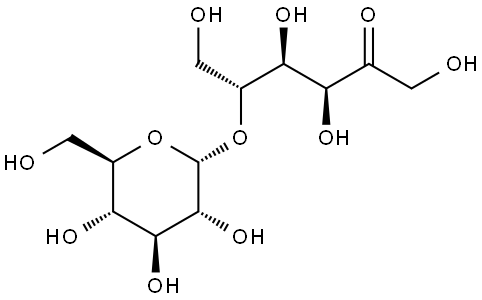
Leucrose is a ketodisaccharide, the chemical structure of which is
D-glucopyranosyl-a(l→5)-D-fructopyranose (it is a bond isomer
of sucrose, which is α-D-glycopyranosyl-β(l→2)-D-fructofurano side). It was discovered in 1952 as a natural by-product of the
fermentational product of dextran from sucrose by Leuconostoc
mesenteroides bacteria. It was also isolated from dextran-produc ing cultures of Streptococcus bovis. It occurs naturally in appre ciable amounts in pollen and honey. Leucrose in honey probably
arises from microbial action, since honey saccharase is unable to
form leucrose under the conditions of honey maturation. It is
present when formed in microbial cultures, in concentrations of
1-3%. Leucrose has a sweet taste but has only between 40-50%
of the sweetening power of sucrose.
Leucrose is a reducing sugar and crystallizes as the monohydrate.
The a(l→5) glucosidic bond shows considerable resistance to acid
hydrolysis, but leucrose is a substrate for the α-glucosidase of
yeast and it is hydrolyzed efficiently in the (human) small intestine
to glucose and fructose.
Leucrose is not fermented by the acid-forming microbial flora of
the human oral cavity into dentally harmful organic acids. Leu crose is also neither an acceptor for nor a donator of glucose, and
therefore does not contribute to dextran formation in dental plaque.
Leucrose is therefore a non-cariogenic sweetening agent useful
for incorporation into low-dental risk foodstuffs.
Leucrose is prepared from sucrose by an enzymic transglycosila tion process. The enzyme involved is α-(l-6)-glycosyl transferase
or dextran sucrase. This extracellular enzyme is produced by cul turing Leuconostoc mesenteroides bacteria in a 2% sucrose solu tion. After removal of the bacteria, the enzyme solution is adjusted
to the appropriate specific activity and then added to an aqueous
solution of one-third sucrose and two-thirds fructose. During trans glycosilation, a glucose molecule is removed from the sucrose and
transferred to another freely available fructose molecule by creating an a (l→5) bond, thereby forming leucrose. This reaction contin ues until 85-95% of the sucrose is converted to leucrose. The latter
is then separated from the remaining glucose and fructose solution
by column-chromatography and is crystallized by appropriate
cooling.
The specification of leucrose stipulates a purity of 99.6-99.8%,
specific rotation of -7.5, water of crystallization content of 4.5%,
melting point of 156-158°C, solubility at 30°C of 64%, relative
sweetening power 40-50% (depending on temperature and con centration), and a caloric value of 17 kJ/g.
Properties of D-Leucrose
| Boiling point: | 783.2±60.0 °C(Predicted) |
| Density | 1.69±0.1 g/cm3(Predicted) |
| pka | 11.81±0.20(Predicted) |
Safety information for D-Leucrose
| Signal word | Warning |
| Pictogram(s) |
 Exclamation Mark Irritant GHS07 |
| GHS Hazard Statements |
H315:Skin corrosion/irritation H319:Serious eye damage/eye irritation H335:Specific target organ toxicity, single exposure;Respiratory tract irritation |
| Precautionary Statement Codes |
P280:Wear protective gloves/protective clothing/eye protection/face protection. P321:Specific treatment (see … on this label). P305+P351+P338:IF IN EYES: Rinse cautiously with water for several minutes. Remove contact lenses, if present and easy to do. Continuerinsing. |
Computed Descriptors for D-Leucrose
New Products
2-(2-Chlorophenyl)glycine Propiolic Acid 1-(3-Hydroxy-4-methoxyphenyl)-2-nitroethene (±)-amino(2-fluorophenyl)acetic acid trans-3-Benzyloxy-4-methoxy-beta-nitrostyrene 1-Pentadecanol 2,4-Dihydroxybenzaldehyde Dipropyl disulfide Pyrrolo[1,2-a]pyrimidine-6-carboxylic acid, 4,6,7,8-tetrahydro-4-oxo-, sodium salt (1:1), (6S) Obidoxime hydrochloride API 4 pentyn 1 ol N-Vinylformamide Methacrylate-PEG-Methacrylate, Mn:35000 2,4-Dihydroxyacetophenone 2-Chloro 5-Fluoro Pyridine Vasicinone 2-Chloroisonicotinic Acid Tween 80 or Polysorbate 80 2-Butyn-1-oL N-(4-Cyano-3-(trifluoromethyl)phenyl)-2-methyloxirane-2-carboxamide N-(4-fluoro-2-methoxy-5-nitrophenyl)-4-(1-methyl-1H-indol-3-yl)pyrimidin-2-amine Pirtobrutinib intd. 2-Pentyn-1-oL 4-NitrobenzotrifluorideRelated products of tetrahydrofuran
You may like
-
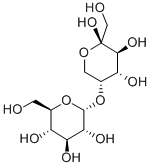
 D-Leucrose 95% CAS 7158-70-5View Details
7158-70-5 -
471-25-0 Propiolic Acid 98+View Details
471-25-0 -
84145-28-8 98+View Details
84145-28-8 -
trans-3-Benzyloxy-4-methoxy-beta-nitrostyrene 98+View Details
63909-29-5 -
2-(2-Chlorophenyl)glycine 88744-36-9 98+View Details
88744-36-9 -
40216-83-9 trans-4-Hydroxy-L-proline methyl ester hydrochloride 98+View Details
40216-83-9 -
629-76-5 98+View Details
629-76-5 -
1-(3-Hydroxy-4-methoxyphenyl)-2-nitroethene 98+View Details
39816-35-8