
D-GLUTAMICACID5-METHYLESTER
- Empirical Formula: C6H11NO4
- Molecular Weight: 161.15584
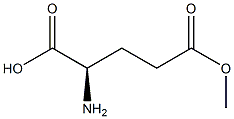
What is D-GLUTAMICACID5-METHYLESTER?
The Uses of D-GLUTAMICACID5-METHYLESTER
D-Glutamic acid 5-methyl ester is a protected form of D-Glutamic acid (G596965). D-Glutamic acid is an unnatural isomer of L-Glutamic acid (G596960), and is found in bacterial cell wall peptidoglycan of gram-positive and gram-negative bacteria. D-Glutamic acid also occurs as poly-gamma-Glutamic acid, which is a weak immunogen but is capable of acting as a hapten (a small molecule that induces the production of antibodies, as well as binding to them).
Safety information for D-GLUTAMICACID5-METHYLESTER
New Products
AMino-(3-Methylphenyl)-acetic acid 3-AMINO-3-(2-CHLORO-PHENYL)-PROPIONIC ACID 4-Fluorophenylglycine 1-Boc-3-(cyanomethyl)azetidine 1-N-Boc-3-(aminoethyl)azetidine Dimedone 4, 4'-Ditolylamine (or) 4,4-Dimethyl Diphenylamine 2-Bromo-5-Chloropyridine 2-Picolinic acid N-oxide 4-Butyl Resorcinol 2-(2,4-Diaminophenoxy)ethanol Dihydrochloride 5-Bromo-2-Hydroxy-3-Nitro Pyridine 4-(4-(Dimethylamino)-1-(4-fluorophenyl)-1-hydroxybutyl)-3-(hydroxymethyl)benzonitrile Tetracaine Hydrochloride Ep Grade 2,2,2-Trichloroethyl chloroformate 5-Bromo-4-chloro-3-indolyl-β-D-galactopyranoside 4-Pentyn-1-ol 2-Bromo-6-fluoroaniline 5-fluoro-1,3-benzodioxole 5-Phenyl-[1,3,4]-thiadiazol-2-amine 2-Chloro-6-nitro benzothiazole 2-(Chloromethyl) quinazolin-4(3H)-one 4-Chloro-2-methyl quinoline 2-Amino-4-phenyl-thiazoleYou may like
-
 142253-58-5 1-Boc-3-(cyanomethyl)azetidine 98+View Details
142253-58-5 -
898271-20-0 98+View Details
898271-20-0 -
142253-58-5 1-Boc-3-(cyanomethyl)azetidine 98+View Details
142253-58-5 -
898271-20-0 98+View Details
898271-20-0 -
Dimedone 98+View Details
126-81-8 -
142253-58-5 1-Boc-3-(cyanomethyl)azetidine 98+View Details
142253-58-5 -
898271-20-0 98+View Details
898271-20-0 -
Dimedone 98+View Details
126-81-8
Statement: All products displayed on this website are only used for non medical purposes such as industrial applications or scientific research, and cannot be used for clinical diagnosis or treatment of humans or animals. They are not medicinal or edible.