
D-arabinitol
- CAS NO.:488-82-4
- Empirical Formula: C5H12O5
- Molecular Weight: 152.15
- MDL number: MFCD00004709
- EINECS: 207-686-2
- SAFETY DATA SHEET (SDS)
- Update Date: 2026-08-25 20:17:46
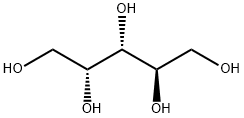
What is D-arabinitol?
Description
D-arabinitol is a characteristic metabolic product of candida species. While candida ssp. produces exclusively D-arabinitol, L-arabinitol is developed by the body’s own metabolism. D-arabinitol serum levels increase if candida yeasts proliferate within the organism and cause invasive Candidiasis. Both D-arabinitol and L-arabinitol are present in normal urine, and can easily be measured by gas chromatography of urine samples collected on filter paper.
Chemical properties
white to off-white fine crystalline powder
Occurrence
D-Arabinitol (lyxitol) is found in lichens; in a variety of fungi; in the urediospores of wheat stem rust; in the dried herbiage of the Peruvian shrub, pichi, along with D-mannitol, dulcitol, and perseitol; and in the avocado. It is formed by fermentation of glucose and in 40% yields using blackstrap molasses. D-Arabinitol is formed by catalytic hydrogenation of D-arabinose in the presence of Raney nickel and from the γ-lactones of D-arabinonic and D-lyxonic acids by reduction with sodium borohydride.
The Uses of D-arabinitol
D-Arabitol, a rare sugar alcohol, is a substrate used to identify, differentiate and characterize enzyme such as the gluconobacter oxydans dehydrogenase(s), Gox2181, hyperthermophilic D-arabitol dehydrogenase from Thermotoga maritime and NAD-dependent D-arabitoldehydrogenase from acetic acid bacterium, Acetobacter suboxydans.
What are the applications of Application
D-(+)-Arabitol is a sugar used to produce xylitol via biotransformation
Definition
ChEBI: D-arabinitol is the D-enantiomer of arabinitol. It is an enantiomer of a L-arabinitol. It is a metabolite found in the aging mouse brain.
Biotechnological Applications
D-arabinitol detection
Another approach to the diagnosis of invasive candidosis involves the detection in serum or urine of a metabolite, D-arabinitol, which is produced by most of the medically important Candida species with the exception of C. krusei and perhaps C. glabrata. Various methods have been developed to measure D-arabinitol concentrations in human serum and urine, including enzymatic-fluorometric and enzymatic-colorimetric procedures. Because increased levels of arabinitol are also found in human body fluids when renal function is impaired, the results are reported as the D-arabinitol- creatinine ratio. Although several large studies have demonstrated that patients with candidaemia have ele- vated serum D-arabinitol- creatinine ratios, this approach has still to achieve widespread clinical use.
Purification Methods
This pentol, which occurs in lichens and fungi, is purified by recrystallisation from 90% EtOH or MeOH. [Ashina & Yamagita Chem Ber 67 801 1934, derivarives: Nakagawa et al. Bull Chem Soc Jpn 40 2150 1967, Prince & Reichstein Helv Chim Acta 20 101 1937, Hough & Theobald Methods in Carbohydrate Chemistry I 94 1962, Academic Press, Beilstein 1 IV 2832.]
Properties of D-arabinitol
| Melting point: | 101-104 °C |
| Boiling point: | 194.6°C (rough estimate) |
| alpha | +10~+14゜(20℃/D)(c=5,Na2B4O7 soln.) |
| Density | 1.1497 (rough estimate) |
| refractive index | 1.3960 (estimate) |
| storage temp. | Sealed in dry,Room Temperature |
| solubility | H2O: 0.1 g/mL, clear, colorless |
| form | Fine Crystalline Powder |
| pka | 13.24±0.20(Predicted) |
| color | White to off-white |
| Water Solubility | Soluble in water (50 mg/ml). |
| Merck | 14,762 |
| BRN | 1720520 |
| CAS DataBase Reference | 488-82-4(CAS DataBase Reference) |
| EPA Substance Registry System | D-Arabinitol (488-82-4) |
Safety information for D-arabinitol
| Signal word | Warning |
| Pictogram(s) |
 Exclamation Mark Irritant GHS07 |
| GHS Hazard Statements |
H315:Skin corrosion/irritation H319:Serious eye damage/eye irritation H335:Specific target organ toxicity, single exposure;Respiratory tract irritation |
| Precautionary Statement Codes |
P261:Avoid breathing dust/fume/gas/mist/vapours/spray. P271:Use only outdoors or in a well-ventilated area. P280:Wear protective gloves/protective clothing/eye protection/face protection. |
Computed Descriptors for D-arabinitol
New Products
5-bromo-4-fluoro-2-nitrobenzaldehyde (R)-(-)-2-Amino-1-propanol Cyclobutanone Fmoc-OSu 1-(2-Chloroethyl)pyrrolidine Hydrochloride 2-Amino-2-(4-methylphenyl)acetic acid β-Bromostyrene Ethyl 3-phenylpropanoate Phenethyl cinnamate Dipropyl disulfide 4 pentyn 1 ol N-Vinylformamide Methacrylate-PEG-Methacrylate, Mn:35000 2,4-Dihydroxyacetophenone 2-Chloro 5-Fluoro Pyridine Vasicinone 2-Chloroisonicotinic Acid Tween 80 or Polysorbate 80 2-Butyn-1-oL 2-Pentyn-1-oL 4-Nitrobenzotrifluoride N-(4-fluoro-2-methoxy-5-nitrophenyl)-4-(1-methyl-1H-indol-3-yl)pyrimidin-2-amine Pirtobrutinib intd. N-(4-Cyano-3-(trifluoromethyl)phenyl)-2-methyloxirane-2-carboxamideRelated products of tetrahydrofuran


You may like
-
 488-82-4 D-Arabinitol 99%View Details
488-82-4 -
 D(+)Arabitol (D-Arabinitol) extrapure 99% CAS 488-82-4View Details
488-82-4 -
D-(+)-Arabitol CAS 488-82-4View Details
488-82-4 -
D(+)-Arabitol 98% (HPLC) CAS 488-82-4View Details
488-82-4 -
D( )Arabitol (D-Arabinitol) 99% CAS 488-82-4View Details
488-82-4 -
D-(+)-Arabitol CAS 488-82-4View Details
488-82-4 -
 D- Arabinitol488-82-4View Details
488-82-4 -
7250-67-1 1-(2-Chloroethyl)pyrrolidine Hydrochloride 98+View Details
7250-67-1