
CYCLOATE
Synonym(s):S-Ethyl N-cyclohexyl-N-ethylthiocarbamate
- CAS NO.:1134-23-2
- Empirical Formula: C11H21NOS
- Molecular Weight: 215.36
- MDL number: MFCD00055341
- EINECS: 214-482-7
- SAFETY DATA SHEET (SDS)
- Update Date: 2026-05-27 17:18:37
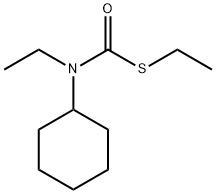
What is CYCLOATE?
Chemical properties
Cycolate is an oily, clear, or amber to yellow liquid. Aromatic odor;
The Uses of CYCLOATE
Herbicide used to control several broad-leaved weeds and many annual grasses in sugar beets, table beets and spinach
Definition
ChEBI: Cycloate is a primary aliphatic amine.
General Description
Colorless liquid with an aromatic odor. Used as a selective systemic herbicide.
Air & Water Reactions
Thio and dithiocarbamates slowly decompose in aqueous solution to form carbon disulfide and methylamine or other amines. Such decompositions are accelerated by acids or alkalis.
Reactivity Profile
CYCLOATE is a thiocarbamate ester. Flammable gases are generated by the combination of thiocarbamates and dithiocarbamates with aldehydes, nitrides, and hydrides. Thiocarbamates and dithiocarbamates are incompatible with acids, peroxides, and acid halides.
Flammability and Explosibility
Non flammable
Agricultural Uses
Herbicide: Used to control broadleaf weeds, annual and perennial grasses and nutgrass in spinach, beets, and sugar beets. Not approved for use in EU countries. Actively registered in the U.S.
Trade name
ETSAN®; EUREX®; R-2063®; RO- NEET®; RO-NEET®-6E; RO-NEET® 10G; RONIT®; SABET®
Potential Exposure
Cycolate is a thiocarbamate herbicide used to control broad leaf weeds, annual and perennial grasses and nutgrass in spinach, beets, and sugar beets.
Environmental Fate
Soil. The reported half-life in soil is approximately 4–8 weeks (Hartley and Kidd,
1987)
Groundwater. According to the U.S. EPA (1986) cycloate has a high potential to leach
to groundwater
Plant. Cycloate is rapidly metabolized in sugarbeets to carbon dioxide, ethylcyclohexylamine, sugars, amino acids and other natural constituents (Humburg et al., 1989)
Chemical/Physical. In the gas phase, cycloate reacts with hydroxyl and NO3 radicals
but not with ozone. With hydroxy radicals, cleavage of the cyclohexyl ring was suggested
leading to the formation of a compound tentatively identified as C2H5(CHO)NC(O)SC2H5.
The calculated photolysis lifetimes of cycloate in the troposphere with hydroxyl and NO3
radicals are 5.2 hours and 1.4 days, respectively (Kwok et al., 1992).
Shipping
UN3082 Environmentally Hazardous substances, liquid, n.o.s., Hazard class: 9; Labels: 9-Miscellaneous haz- ardous material, Technical Name Required
Incompatibilities
Cycolate reacts violently with powerful oxidizers such as calcium hypochlorite. Thiocarbamate esters are combustible. Poisonous gases are generated by the thermal decomposition of thiocarbamate compounds, including carbon disulfide, oxides of sulfur, oxides of nitro- gen, hydrogen sulfide, ammonia, and methylamine. Thio and dithiocarbamates slowly decompose in aqueous solu- tion to form carbon disulfide and methylamine or other amines. Such decompositions are accelerated by acids. Flammable gases are generated by the combination of thio- carbamates with aldehydes, nitrides, and hydrides. Thiocarbamates are incompatible with acids, peroxides, and acid halides.
Waste Disposal
Do not discharge into drains or sewers. Dispose of waste material as hazardous waste using a licensed disposal contractor to an approved landfill. Consult with environmental regulatory agencies for guid- ance on acceptable disposal practices. Incineration with effluent gas scrubbing is recommended. Containers must be disposed of properly by following package label directions or by contacting your local or federal environmental control agency, or by contacting your regional EPA office.
Properties of CYCLOATE
| Melting point: | 11.5°C |
| Boiling point: | 145 °C(Press: 10 Torr) |
| Density | 1.0156 |
| vapor pressure | 0.002Pa at 25℃ |
| refractive index | 1.5500 (estimate) |
| Flash point: | >100 °C |
| storage temp. | 0-6°C |
| pka | -1.30±0.20(Predicted) |
| form | Liquid |
| Water Solubility | 85mg/L(22 ºC) |
| BRN | 2937178 |
| CAS DataBase Reference | 1134-23-2 |
| EPA Substance Registry System | Cycloate (1134-23-2) |
Safety information for CYCLOATE
| Signal word | Danger |
| Pictogram(s) |
 Skull and Crossbones Acute Toxicity GHS06  Environment GHS09 |
| GHS Hazard Statements |
H331:Acute toxicity,inhalation H411:Hazardous to the aquatic environment, long-term hazard |
| Precautionary Statement Codes |
P261:Avoid breathing dust/fume/gas/mist/vapours/spray. P271:Use only outdoors or in a well-ventilated area. P273:Avoid release to the environment. P391:Collect spillage. Hazardous to the aquatic environment P403+P233:Store in a well-ventilated place. Keep container tightly closed. |
Computed Descriptors for CYCLOATE
New Products
Dibenzoyl-L-tartaric acid Anhydrous (Resolution Reagent) Cis-Tosylate Dibenzo[b,f][1,4]thiazepin-11(10H)-one 1,2,3,9-Tetrahydro-9-Methyl-4H-Carbazole-4-One 1-(4-methoxyphenyl)-4-(4-Nitrophenyl)Piperazine (IT-1) BOC Piperazine 1-Benzhydrylazetane-3-carbonitrile 8-oxa-1,3-diazaspiro[4.5]decane-2,4-dione (±)-amino(2-fluorophenyl)acetic acid 2-(2-Chlorophenyl)glycine AMINO-(3-CHLORO-PHENYL)-ACETIC ACID 2'-Fluoroacetophenone METHANOL-D1(OD) TERTIARY BUTANOL-D9 N-ETHYL-D5-AMINE HYDROCHLORIDE BENZOIC ACID-D CHLOROFORM-D TOLUENE-D3 Trans,trans muconic acid HC Blue-16 4-Amino-2-chloro-6,7-dimethoxyquinazoline Ethyl 4,5-bis(2-methoxyethoxy)-2-nitrobenzoate 2,3-Dimethoxypyridine 1-(3-Chlorophenyl)piperazine hydrochlorideRelated products of tetrahydrofuran
You may like
-
 Cycloate CAS 1134-23-2View Details
1134-23-2 -
 Product IntroductionView Details
 -
 Product InrtroductionView Details
 -
 DGO24View Details
 -
 DGO25View Details
 -
 DGO29View Details
 -
 DGO32View Details
 -
 DGO36View Details