
CYCLANILIDE
Synonym(s):1-[(2,4-Dichlorophenyl)aminocarbonyl]-1-cyclopropanecarboxylic acid
- CAS NO.:113136-77-9
- Empirical Formula: C11H9Cl2NO3
- Molecular Weight: 274.1
- MDL number: MFCD03792791
- EINECS: 419-150-7
- SAFETY DATA SHEET (SDS)
- Update Date: 2026-07-31 15:25:14
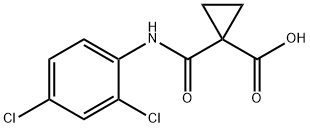
What is CYCLANILIDE?
Chemical properties
A white or pale yellow, crystalline or powdery solid. No characteristic odor.
The Uses of CYCLANILIDE
Cyclanilide is a plant growth regulator that functions by interactting with auxin-regulated processes. Cyclanilide is commonly used on cotton plants to either suppress vegetative growth or accelerate senescence. Cyclanilide is also used as a bioregulator of deciduous fruit trees.
What are the applications of Application
Cyclanilide is a plant growth regulator that functions by interactting with auxin-regulated processes
Definition
ChEBI: Cyclanilide is a monocarboxylic acid that is cyclopropanecarboxylic acid that is substituted by a 3,5-dichlorophenylcarbamoyl group at position 1. It is a plant growth regulator which is used as a cotton harvest aid. It has a role as a plant growth regulator and a fungicide. It is a dichlorobenzene, a member of cyclopropanes, an anilide and a monocarboxylic acid.
Potential Exposure
Cyclanilide, amalonanilate plant growth regulator and fungicide is used as a cotton harvest aid
Shipping
UN2811 Toxic solids, organic, n.o.s., Hazard Class: 6.1; Labels: 6.1-Poisonous materials, Technical Name Required.
Incompatibilities
May react violently with strong oxidi- zers, bromine, 90% hydrogen peroxide, phosphorus trichloride, silver powders, or dust. Incompatible with silver compounds. Mixture with some silver compounds forms explosive salts of silver oxalate. Keep away from reducing agents, oxidizers, sulfuric acid, caustics, ammonia, aliphatic amines, alkanolamines, isocyanates, alkylene oxides, epi- chlorohydrin. Compounds of the carboxyl group react with all bases, both inorganic and organic (i.e., amines) releasing substantial heat, water, and a salt that may be harmful. Incompatible with arsenic compounds (releases hydrogen cyanide gas), diazo compounds, dithiocarbamates, isocya- nates, mercaptans, nitrides, sulfides (releasing heat, toxic, and possibly flammable gases), thiosulfates, and dithionites (releasing hydrogen sulfate and oxides of sulfur).
Waste Disposal
Dissolve or mix material with a combustible solvent and burn in a chemical incinerator equipped with an afterburner and scrubber. In accordance with 40CFR165 recommendations for the disposal of pesti- cides and pesticide containers. noncombustible containers should be crushed and buried under more than 40 cm of soil . Must be disposed properly by following package label directions or by contacting your local or federal envi- ronmental control agency, or by contacting your regional EPA office.
Properties of CYCLANILIDE
| Melting point: | approximate 196℃ |
| Boiling point: | 513.2±50.0 °C(Predicted) |
| Density | 1.4691-1.4820 g/cm3 |
| storage temp. | Sealed in dry,Room Temperature |
| Water Solubility | Practically insoluble in water |
| solubility | DMSO (Slightly), Methanol (Slightly, Sonicated) |
| form | neat |
| pka | 3.39±0.20(Predicted) |
| color | White to Light yellow |
| CAS DataBase Reference | 113136-77-9 |
| EPA Substance Registry System | Cyclanilide (113136-77-9) |
Safety information for CYCLANILIDE
| Signal word | Danger |
| Pictogram(s) |
 Skull and Crossbones Acute Toxicity GHS06  Environment GHS09 |
| GHS Hazard Statements |
H301:Acute toxicity,oral H332:Acute toxicity,inhalation H411:Hazardous to the aquatic environment, long-term hazard |
| Precautionary Statement Codes |
P261:Avoid breathing dust/fume/gas/mist/vapours/spray. P264:Wash hands thoroughly after handling. P264:Wash skin thouroughly after handling. P270:Do not eat, drink or smoke when using this product. P273:Avoid release to the environment. P301+P310:IF SWALLOWED: Immediately call a POISON CENTER or doctor/physician. |
Computed Descriptors for CYCLANILIDE
| InChIKey | GLWWLNJJJCTFMZ-UHFFFAOYSA-N |
New Products
5-bromo-4-fluoro-2-nitrobenzaldehyde (R)-(-)-2-Amino-1-propanol Cyclobutanone Fmoc-OSu 1-(2-Chloroethyl)pyrrolidine Hydrochloride 2-Amino-2-(4-methylphenyl)acetic acid Obidoxime hydrochloride API Decanoic acid, 2-[4-(phenylmethoxy)phenyl]ethyl ester Piperazine, 1-(3-methoxyphenyl)-, hydrochloride (1:1) 4-Bromo-2,6-difluoroaniline 4 pentyn 1 ol N-Vinylformamide Methacrylate-PEG-Methacrylate, Mn:35000 2,4-Dihydroxyacetophenone 2-Chloro 5-Fluoro Pyridine Vasicinone 2-Chloroisonicotinic Acid Tween 80 or Polysorbate 80 2-Pentyn-1-oL 4-Nitrobenzotrifluoride N-(4-Cyano-3-(trifluoromethyl)phenyl)-2-methyloxirane-2-carboxamide N-(4-fluoro-2-methoxy-5-nitrophenyl)-4-(1-methyl-1H-indol-3-yl)pyrimidin-2-amine Pirtobrutinib intd. 2-Butyn-1-oLRelated products of tetrahydrofuran
![{1-[(methylamino)methyl]cyclopropyl}methanol](https://img.chemicalbook.in/CAS/GIF/959238-63-2.gif)
You may like
-
 Cyclanilide CAS 113136-77-9View Details
113136-77-9 -
Fmoc-OSu 98+View Details
82911-69-1 -
7250-67-1 1-(2-Chloroethyl)pyrrolidine Hydrochloride 98+View Details
7250-67-1 -
13227-01-5 98+View Details
13227-01-5 -
7250-67-1 1-(2-Chloroethyl)pyrrolidine Hydrochloride 98+View Details
7250-67-1 -
13227-01-5 98+View Details
13227-01-5 -
7250-67-1 1-(2-Chloroethyl)pyrrolidine Hydrochloride 98+View Details
7250-67-1 -
13227-01-5 98+View Details
13227-01-5