
CTPB
Synonym(s):Benzamide, N-[4-chloro-3-(trifluoromethyl)phenyl]-2-ethoxy-6-pentadecyl;CTPB;CTPB (enzyme activator);CTPB (enzyme inhibitor);N-(4-Chloro-3-trifluoromethyl-phenyl)-2-ethoxy-6-pentadecyl-benzamide
- CAS NO.:586976-24-1
- Empirical Formula: C31H43ClF3NO2
- Molecular Weight: 554.13
- MDL number: MFCD08702707
- SAFETY DATA SHEET (SDS)
- Update Date: 2026-05-11 16:31:51
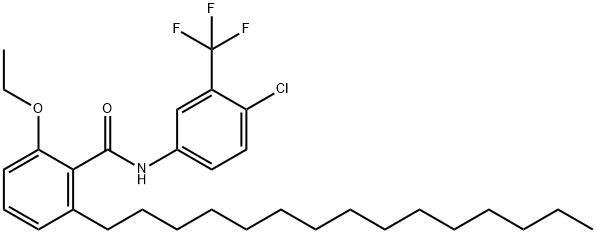
What is CTPB?
Description
CTPB (586976-24-1) is a selective activator of p300 HAT (histone acetyltransferase) selective over PCAF (p300 CPB-associated factor).1,2
The Uses of CTPB
CTPB is an amide derivative that selectively activates the histone acetyltransferase (HAT) p300, with maximal activation at 275 μM. It directly binds p300. CTPB does not alter PCAF HAT or histone deacetylase activity. It dose-dependently increases the acetylation of histones H3 and H4, with maximal effect at 200 μM.
What are the applications of Application
CTPB is a potent and selective histone acetyltransferase (HAT) p300 activator, able to directly bind p300.
Definition
ChEBI: CTPB is a benzamide obtained by formal condensation of the carboxy group of 2-ethoxy-6-pentadecylbenzoic acid with one of the amino groups of 4-chloro-3-(trifluoromethyl)aniline. It has a role as a histone acetyltransferase activator. It is a member of benzamides, an aromatic ether, a member of monochlorobenzenes and an organofluorine compound.
References
1) Balasubramanyam?et al.?(2003),?Small molecule modulators of histone acetyltransferase p300; J. Biol. Chem.,?278?19134 2) Mantelingu?et al.?(2007),?Activation of p300 histone acetyltransferase by small molecules altering enzyme structure: probed by surface-enhanced Raman spectroscopy; J. Phys. Chem. B.,?111?4527
Properties of CTPB
| Boiling point: | 560.7±50.0 °C(Predicted) |
| Density | 1.104±0.06 g/cm3(Predicted) |
| storage temp. | -20°C |
| solubility | DMSO: soluble |
| form | White to off-white crystalline solid. |
| pka | 12.27±0.70(Predicted) |
| color | white to off-white |
| Stability: | Stable for 1 year from date of purchase as supplied. Solutions in DMSO or ethanol may be stored at -20°C for up to 3 months. |
Safety information for CTPB
Computed Descriptors for CTPB
New Products
Dibenzoyl-L-tartaric acid Anhydrous (Resolution Reagent) Cis-Tosylate Dibenzo[b,f][1,4]thiazepin-11(10H)-one 1,2,3,9-Tetrahydro-9-Methyl-4H-Carbazole-4-One 1-(4-methoxyphenyl)-4-(4-Nitrophenyl)Piperazine (IT-1) BOC Piperazine 1-Benzhydrylazetane-3-carbonitrile 8-oxa-1,3-diazaspiro[4.5]decane-2,4-dione (±)-amino(2-fluorophenyl)acetic acid 2-(2-Chlorophenyl)glycine AMINO-(3-CHLORO-PHENYL)-ACETIC ACID 2'-Fluoroacetophenone METHANOL-D1(OD) TERTIARY BUTANOL-D9 N-ETHYL-D5-AMINE HYDROCHLORIDE BENZOIC ACID-D CHLOROFORM-D TOLUENE-D3 Trans,trans muconic acid HC Blue-16 4-Amino-2-chloro-6,7-dimethoxyquinazoline Ethyl 4,5-bis(2-methoxyethoxy)-2-nitrobenzoate 2,3-Dimethoxypyridine 1-(3-Chlorophenyl)piperazine hydrochlorideRelated products of tetrahydrofuran
![BIX 01294, 2-(Hexahydro-4-methyl-1H-1,4-diazepin-1-yl)-6,7-dimethoxy-N-[1-(phenylmethyl)-4-piperidinyl]-4-quinazolinamine hydrate trihydrochloride](https://img.chemicalbook.in/CAS/GIF/935693-62-2.gif)
You may like
-
 Product IntroductionView Details
 -
 Product InrtroductionView Details
 -
 DGO24View Details
 -
 DGO25View Details
 -
 DGO29View Details
 -
 DGO32View Details
 -
 DGO36View Details
 -
 DGO37View Details