
COUMACHLOR
Synonym(s):(±)-3-(α-Acetonyl-p-chlorobenzyl)-4-hydroxycoumarin;p-Chlorowarfarin
- CAS NO.:81-82-3
- Empirical Formula: C19H15ClO4
- Molecular Weight: 342.77
- MDL number: MFCD00012094
- EINECS: 201-378-1
- SAFETY DATA SHEET (SDS)
- Update Date: 2026-05-28 03:44:22
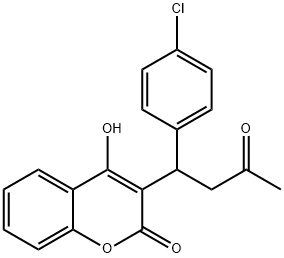
What is COUMACHLOR?
Chemical properties
White to Off-White Solid
The Uses of COUMACHLOR
Coumachlor was used as internal standard for simultaneous enantioseparation of (+/-)-warfarin by chiral capillary electrochromatography with electrospray ionization mass spectrometry.
The Uses of COUMACHLOR
An internal standard in the analysis of the rodenticide Warfarin.
The Uses of COUMACHLOR
Rodenticide.
Definition
ChEBI: Coumachlor is a hydroxycoumarin.
General Description
Coumachlor is an anticoagulant rodenticide. It forms complex with zirconium.
Properties of COUMACHLOR
| Melting point: | 168-170 °C (lit.) |
| Boiling point: | 543.1±50.0 °C(Predicted) |
| Density | 1.2972 (estimate) |
| storage temp. | Sealed in dry,2-8°C |
| solubility | acetone: soluble |
| form | powder |
| pka | 4.50±1.00(Predicted) |
| color | light yellow |
| Merck | 13,2581 |
| BRN | 6819431 |
| CAS DataBase Reference | 81-82-3(CAS DataBase Reference) |
| EPA Substance Registry System | Coumachlor (81-82-3) |
Safety information for COUMACHLOR
| Signal word | Danger |
| Pictogram(s) |
 Skull and Crossbones Acute Toxicity GHS06  Health Hazard GHS08 |
| GHS Hazard Statements |
H301:Acute toxicity,oral H310:Acute toxicity,dermal H373:Specific target organ toxicity, repeated exposure H412:Hazardous to the aquatic environment, long-term hazard |
| Precautionary Statement Codes |
P262:Do not get in eyes, on skin, or on clothing. P273:Avoid release to the environment. P280:Wear protective gloves/protective clothing/eye protection/face protection. P314:Get medical advice/attention if you feel unwell. P301+P310:IF SWALLOWED: Immediately call a POISON CENTER or doctor/physician. |
Computed Descriptors for COUMACHLOR
New Products
1-(4-methoxyphenyl)-4-(4-Nitrophenyl)Piperazine (IT-1) 1,2,3,9-Tetrahydro-9-Methyl-4H-Carbazole-4-One Dibenzo[b,f][1,4]thiazepin-11(10H)-one Cis-Tosylate Dibenzoyl-L-tartaric acid Anhydrous (Resolution Reagent) 1-Benzhydrylazetane-3-carbonitrile 8-oxa-1,3-diazaspiro[4.5]decane-2,4-dione (±)-amino(2-fluorophenyl)acetic acid 2-(2-Chlorophenyl)glycine AMINO-(3-CHLORO-PHENYL)-ACETIC ACID 2'-Fluoroacetophenone METHANOL-D1(OD) N-ETHYL-D5-AMINE HYDROCHLORIDE BENZOIC ACID-D CHLOROFORM-D BENZENE-D6 TOLUENE-D3 2-Hydroxybutanenitrile 1-Benzylindolin-2-one Ethyl 2-bromo-3-oxobutanoate 4-(3-chloropropyl)morpholine 1-Benzylindoline-2,3-dione 3-Oxocyclobutanecarboxylic acid 1-(3-Chlorophenyl)piperazine hydrochlorideRelated products of tetrahydrofuran
You may like
-
 5-Bromo-2-chloro- benzoic acid 21739-92-4 98%View Details
21739-92-4 -
Guar Hydroxypropyltrimonium Chloride 98%View Details
65497-29-2 -
(2,4-dimethoxyphenyl)methanol 7314-44-5 98%View Details
7314-44-5 -
52092-43-0 2-Bromo-4-nitropyridine-N-oxide 98%View Details
52092-43-0 -
2,4,6-Trichloro-5-nitropyrimidine 98%View Details
4359-87-9 -
ethyl 2-amino-4-methoxy-5-(3-morpholinopropoxy)benzoate 1040264-49-0 98%View Details
1040264-49-0 -
1-Methylpiperidine-4-thiol 1072-99-7 98%View Details
1072-99-7 -
68886-07-7 98%View Details
68886-07-7
Statement: All products displayed on this website are only used for non medical purposes such as industrial applications or scientific research, and cannot be used for clinical diagnosis or treatment of humans or animals. They are not medicinal or edible.