
COELENTERAZINE H
Synonym(s):2-Deoxycoelenterazine;CLZN-h
- CAS NO.:50909-86-9
- Empirical Formula: C26H21N3O2
- Molecular Weight: 407.46
- MDL number: MFCD00798394
- SAFETY DATA SHEET (SDS)
- Update Date: 2026-08-20 20:20:01
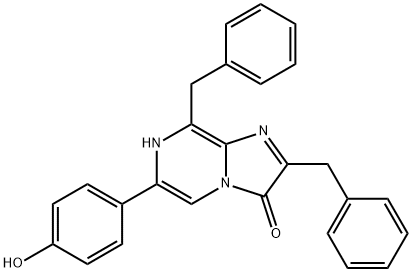
What is COELENTERAZINE H?
Description
Coelenterazine-h (50909-86-9) may be used as a substrate in gene reporter assays, live cell assays, and biochemical assays (ELISA, BRET etc). Renilla luciferase catalyzes coelenterazine oxidation by oxygen to produce light. Coelenterazine-h produces 10-fold higher light output than native coelenterazine. Coelenterazine-h also undergoes autoluminescence, which is enhanced by superoxide anion and peroxynitrite in cells.
The Uses of COELENTERAZINE H
Coelenterazine h, is a derivative of Coelenterazine (C636000), and iis more sensitive to Ca2+ than is the native complex, thus providing a valuable tool for measuring small changes in Ca2+ concentrations.
What are the applications of Application
Coelenterazine-h is an intracellular luminophore for measuring superoxide and Ca2+ in cells transfected with apoaequorin cDNA
Definition
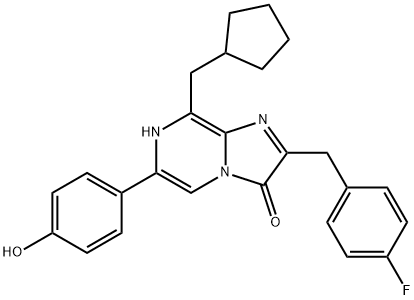
ChEBI: Renilla luciferin is a member of phenols and an imidazopyrazine. It has a role as a luciferin. It derives from a hydride of an imidazo[1,2-a]pyrazine.
General Description
Coelenterazine is an imidazopyrazinone derivative. It is a substrate for bioluminescence in many luminous marine organisms.
Biochem/physiol Actions
10 times higher luminescence intensity than native coelenterazine.
References
1) Shimomura?et al. (1989),?Semi-synthetic aequorins with improved sensitivity to Ca2+ ions; Biochem. J.,?261?913 2) Nakajima-Shimada?et al.?(1991),?Monitoring of intracellular calcium in Saccharomyces cerevisiae with an apoaequorin cDNA expression system; Proc. Natl. Acad. Sci. USA,?88?6878 3) Inouye?et al. (1992),?Monitoring gene expression in Chinese hamster ovary cells using secreted apoaequorin; Anal. Biochem.,?201?114
Properties of COELENTERAZINE H
| Melting point: | >200℃ |
| Boiling point: | 593.5±60.0 °C(Predicted) |
| Density | 1.26±0.1 g/cm3(Predicted) |
| storage temp. | -20°C |
| solubility | Soluble in methanol, ethanol |
| form | solid |
| pka | 10.50±0.30(Predicted) |
| color | Yellow |
| λmax | 437nm |
| Stability: | Stable for 1 year from ate of purchase as supplied. Solutions in DMSO or methanol may be stored at -20°C for up to 1 month. |
| Biological Applications | Calcium indicator; assaying luminescent enzyme; measuring luciferase activity; as a substrate for luciferase; screening HIV-1 protease inhibitors; bioluminescence resonance energy transfer (BRET) detection system |
Safety information for COELENTERAZINE H
| Signal word | Warning |
| Pictogram(s) |
 Exclamation Mark Irritant GHS07 |
| GHS Hazard Statements |
H315:Skin corrosion/irritation H319:Serious eye damage/eye irritation H335:Specific target organ toxicity, single exposure;Respiratory tract irritation |
| Precautionary Statement Codes |
P261:Avoid breathing dust/fume/gas/mist/vapours/spray. P264:Wash hands thoroughly after handling. P264:Wash skin thouroughly after handling. P271:Use only outdoors or in a well-ventilated area. P280:Wear protective gloves/protective clothing/eye protection/face protection. P302+P352:IF ON SKIN: wash with plenty of soap and water. P305+P351+P338:IF IN EYES: Rinse cautiously with water for several minutes. Remove contact lenses, if present and easy to do. Continuerinsing. |
Computed Descriptors for COELENTERAZINE H
New Products
N-Carbethoxy-4-piperidone 1-Aminocyclopentane carbonitrile Tetrabutylammonium perchlorate N,O-Dimethylhydroxylamine hydrochloride (RS)-beta-Amino-beta-(4-bromophenyl)propionic acid 2-Amino-5-bromo-4-(trifluoromethyl)pyridine N-Vinylformamide 4 pentyn 1 ol Phenethyl cinnamate Dipropyl disulfide Ethyl 3-phenylpropanoate β-Bromostyrene Methacrylate-PEG-Methacrylate, Mn:35000 2,4-Dihydroxyacetophenone 2-Chloro 5-Fluoro Pyridine Vasicinone 2-Chloroisonicotinic Acid Tween 80 or Polysorbate 80 5-Bromo-1-Pentyne 1-(2-Methyl-5-nitrophenyl)guanidine Nitrate Methyl trans-4-Aminocyclohexanecarboxylate Hydrochloride N-(4-Cyano-3-(trifluoromethyl)phenyl)-2-methyloxirane-2-carboxamide 2-Pentyn-1-oL 4-NitrobenzotrifluorideRelated products of tetrahydrofuran
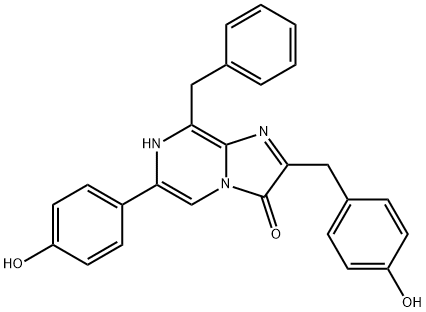
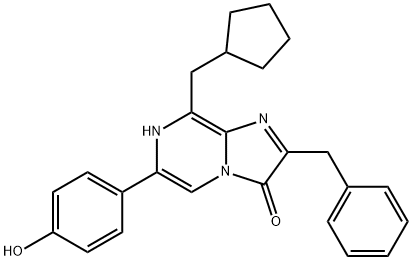
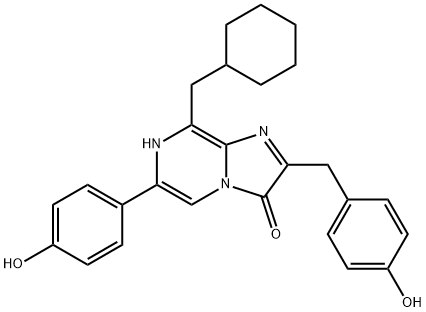

You may like
-
 Coelenterazine h CAS 50909-86-9View Details
50909-86-9 -
144-83-2 Sulfapyridine 98+View Details
144-83-2 -
29976-53-2 98+View Details
29976-53-2 -
(RS)-beta-Amino-beta-(4-bromophenyl)propionic acid 39773-47-2 98+View Details
39773-47-2 -
6638-79-5 N,O-Dimethylhydroxylamine hydrochloride 98+View Details
6638-79-5 -
674783-97-2 98+View Details
674783-97-2 -
1-Aminocyclopentane carbonitrile 98+View Details
49830-37-7 -
Tetrabutylammonium perchlorate 1923-70-2 98+View Details
1923-70-2