
C.I. Disperse Red 158
- CAS NO.:61968-48-7
- Molecular Weight: 0
What is C.I. Disperse Red 158?
Preparation
4-Nitrobenzenamine diazo, and 3-Methyl-N,N-bis(2-acetoxyethyl)benzenamine?coupling.
Properties and Applications
Yellow light red. Used in vinegar fiber, three vinegar fiber, polyester and jin to fiber dyeing.
| Standard | Ironing Fastness | Light Fastness | Persperation Fastness | Washing Fastness | |||
| Fading | Stain | Fading | Stain | Fading | Stain | ||
| ISO | 5 | 4 | 5 | 5 | 4-5 | 4-5 | 5 |
Safety information for C.I. Disperse Red 158
New Products
5-bromo-4-fluoro-2-nitrobenzaldehyde (R)-(-)-2-Amino-1-propanol Cyclobutanone Fmoc-OSu 1-(2-Chloroethyl)pyrrolidine Hydrochloride 2-Amino-2-(4-methylphenyl)acetic acid β-Bromostyrene Ethyl 3-phenylpropanoate Phenethyl cinnamate Dipropyl disulfide 4 pentyn 1 ol N-Vinylformamide Methacrylate-PEG-Methacrylate, Mn:35000 2,4-Dihydroxyacetophenone 2-Chloro 5-Fluoro Pyridine Vasicinone 2-Chloroisonicotinic Acid Tween 80 or Polysorbate 80 2-Butyn-1-oL 2-Pentyn-1-oL 4-Nitrobenzotrifluoride N-(4-fluoro-2-methoxy-5-nitrophenyl)-4-(1-methyl-1H-indol-3-yl)pyrimidin-2-amine Pirtobrutinib intd. N-(4-Cyano-3-(trifluoromethyl)phenyl)-2-methyloxirane-2-carboxamideRelated products of tetrahydrofuran

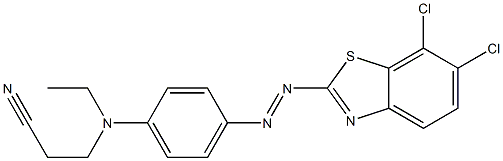

![3-[[4-[(Benzothiazol-2-yl)azo]-3-methylphenyl](2-hydroxyethyl)amino]propanenitrile](https://img.chemicalbook.in/CAS/GIF/25473-34-1.gif)
![2-[4-[N,N-Bis(2-hydroxyethyl)amino]-2-methylphenylazo]-5-nitrophenol](https://img.chemicalbook.in/CAS/GIF/6253-14-1.gif)
You may like
-
 Fmoc-OSu 98+View Details
82911-69-1 -
(R)-(-)-2-Amino-1-propanol 35320-23-1 98+View Details
35320-23-1 -
7250-67-1 1-(2-Chloroethyl)pyrrolidine Hydrochloride 98+View Details
7250-67-1 -
13227-01-5 98+View Details
13227-01-5 -
7250-67-1 1-(2-Chloroethyl)pyrrolidine Hydrochloride 98+View Details
7250-67-1 -
13227-01-5 98+View Details
13227-01-5 -
7250-67-1 1-(2-Chloroethyl)pyrrolidine Hydrochloride 98+View Details
7250-67-1 -
13227-01-5 98+View Details
13227-01-5
Statement: All products displayed on this website are only used for non medical purposes such as industrial applications or scientific research, and cannot be used for clinical diagnosis or treatment of humans or animals. They are not medicinal or edible.