
Chloropheniramine
- CAS NO.:132-22-9
- Empirical Formula: C16H19ClN2
- Molecular Weight: 274.79
- MDL number: MFCD00053581
- SAFETY DATA SHEET (SDS)
- Update Date: 2026-05-11 16:31:51
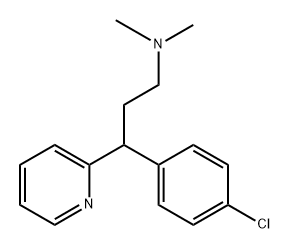
What is Chloropheniramine?
Absorption
Well absorbed in the gastrointestinal tract.
Toxicity
Oral LD50 (rat): 306 mg/kg; Oral LD50 (mice): 130 mg/kg; Oral LD50 (guinea pig): 198 mg/kg [Registry of Toxic Effects of Chemical Substances. Ed. D. Sweet, US Dept. of Health & Human Services: Cincinatti, 2010.] Also a mild reproductive toxin to women of childbearing age.
Chemical properties
BP
The Uses of Chloropheniramine
Chlorpheniramine is a drug in the class of first-generation
antihistamines, used to help alleviate symptoms of allergic
reactions potentiated by histamine release. Though it is
included in many multisymptom over-the-counter cold relief
medications, the Food and Drug Administration (FDA) issued
a safety alert in March 2011 detailing some risks associated
with these medications. The safety alert also indicated that
increased enforcement of FDA laws governing the marketing
of these drugs would occur, as many of the products had not
been approved in their current formulations for safety, effectiveness,
and quality.
Chlorpheniramine is commonly used in small-animal
veterinary medicine for its antihistaminic/antipruritic effects,
especially for the treatment of pruritus in cats, and occasionally
as a mild sedative.
Background
A histamine H1 antagonist used in allergic reactions, hay fever, rhinitis, urticaria, and asthma. It has also been used in veterinary applications. One of the most widely used of the classical antihistaminics, it generally causes less drowsiness and sedation than promethazine.
Indications
For the treatment of rhinitis, urticaria, allergy, common cold, asthma and hay fever.
Definition
ChEBI: Chlorphenamine is a tertiary amino compound that is propylamine which is substituted at position 3 by a pyridin-2-yl group and a p-chlorophenyl group and in which the hydrogens attached to the nitrogen are replaced by methyl groups. A histamine H1 antagonist, it is used to relieve the symptoms of hay fever, rhinitis, urticaria, and asthma. It has a role as a H1-receptor antagonist, an antipruritic drug, a histamine antagonist, a serotonin uptake inhibitor, an antidepressant and an anti-allergic agent. It is a tertiary amino compound, a member of monochlorobenzenes and a member of pyridines.
Pharmacokinetics
In allergic reactions an allergen interacts with and cross-links surface IgE antibodies on mast cells and basophils. Once the mast cell-antibody-antigen complex is formed, a complex series of events occurs that eventually leads to cell-degranulation and the release of histamine (and other chemical mediators) from the mast cell or basophil. Once released, histamine can react with local or widespread tissues through histamine receptors. Histamine, acting on H1-receptors, produces pruritis, vasodilatation, hypotension, flushing, headache, tachycardia, and bronchoconstriction. Histamine also increases vascular permeability and potentiates pain. Chlorpheniramine, is a histamine H1 antagonist (or more correctly, an inverse histamine agonist) of the alkylamine class. It competes with histamine for the normal H1-receptor sites on effector cells of the gastrointestinal tract, blood vessels and respiratory tract. It provides effective, temporary relief of sneezing, watery and itchy eyes, and runny nose due to hay fever and other upper respiratory allergies.
Environmental Fate
Toxicity of antihistamines is usually related to their anticholinergic
effects and may include loss of appetite, nausea,
vomiting, diarrhea or constipation, and other GI effects, as well
as dizziness, tinnitus, lassitude, incoordination, fatigue, blurred
vision, diplopia, euphoria, nervousness, insomnia, and
tremors. Acetylcholine is competitively blocked at muscarinic
receptors, resulting in symptoms of anticholinergic poisoning.
Concurrent use of alcohol, tricyclic antidepressants, monoamine
oxidase inhibitors, or other central nervous system
(CNS) depressants along with antihistamines may exaggerate
and extend the anticholinergic and CNS depressant effects of
antihistamines; concurrent use is not recommended.
Products that were marketed prior to the FDA safety alert
but not approved by the FDA included multisymptom cold
medications comprised of drug combinations of chlorpheniramine
with decongestants, antitussives, and analgesics. Risks
associated with the use of these products included improper
use in children and infants, potentially risky combination of
ingredients, and patients receiving too much or too little
medication because of problems with the way some ‘extendedrelease’
products were made. Newborn and premature infants
are even more prone to anticholinergic side effects and an
increased susceptibility toward convulsions; thus, this drug is
not recommended at all in this age group. Geriatric patients are
also more prone to anticholinergic effects, and a paradoxical
reaction characterized by hyperexcitability may occur in some
children taking antihistamines. Overdosage may also produce
central excitation resulting in convulsions.
Metabolism
Primarily hepatic via Cytochrome P450 (CYP450) enzymes.
Properties of Chloropheniramine
| Melting point: | 25°C |
| Boiling point: | bp1.0 142° |
| Density | 1.0895 (rough estimate) |
| refractive index | 1.5749 (estimate) |
| solubility | DMSO (Slightly), Methanol (Slightly) |
| form | Oil |
| pka | 9.33±0.28(Predicted) |
| color | Colourless to Light Yellow |
| Water Solubility | 5.496g/L(37.5 ºC) |
| EPA Substance Registry System | Chlorpheniramine (132-22-9) |
Safety information for Chloropheniramine
Computed Descriptors for Chloropheniramine
New Products
2-(2-Chlorophenyl)glycine Propiolic Acid 1-(3-Hydroxy-4-methoxyphenyl)-2-nitroethene (±)-amino(2-fluorophenyl)acetic acid trans-3-Benzyloxy-4-methoxy-beta-nitrostyrene 1-Pentadecanol 2,4-Dihydroxybenzaldehyde Dipropyl disulfide Pyrrolo[1,2-a]pyrimidine-6-carboxylic acid, 4,6,7,8-tetrahydro-4-oxo-, sodium salt (1:1), (6S) Obidoxime hydrochloride API 4 pentyn 1 ol N-Vinylformamide Methacrylate-PEG-Methacrylate, Mn:35000 2,4-Dihydroxyacetophenone 2-Chloro 5-Fluoro Pyridine Vasicinone 2-Chloroisonicotinic Acid Tween 80 or Polysorbate 80 2-Butyn-1-oL N-(4-Cyano-3-(trifluoromethyl)phenyl)-2-methyloxirane-2-carboxamide N-(4-fluoro-2-methoxy-5-nitrophenyl)-4-(1-methyl-1H-indol-3-yl)pyrimidin-2-amine Pirtobrutinib intd. 2-Pentyn-1-oL 4-NitrobenzotrifluorideRelated products of tetrahydrofuran

You may like
-
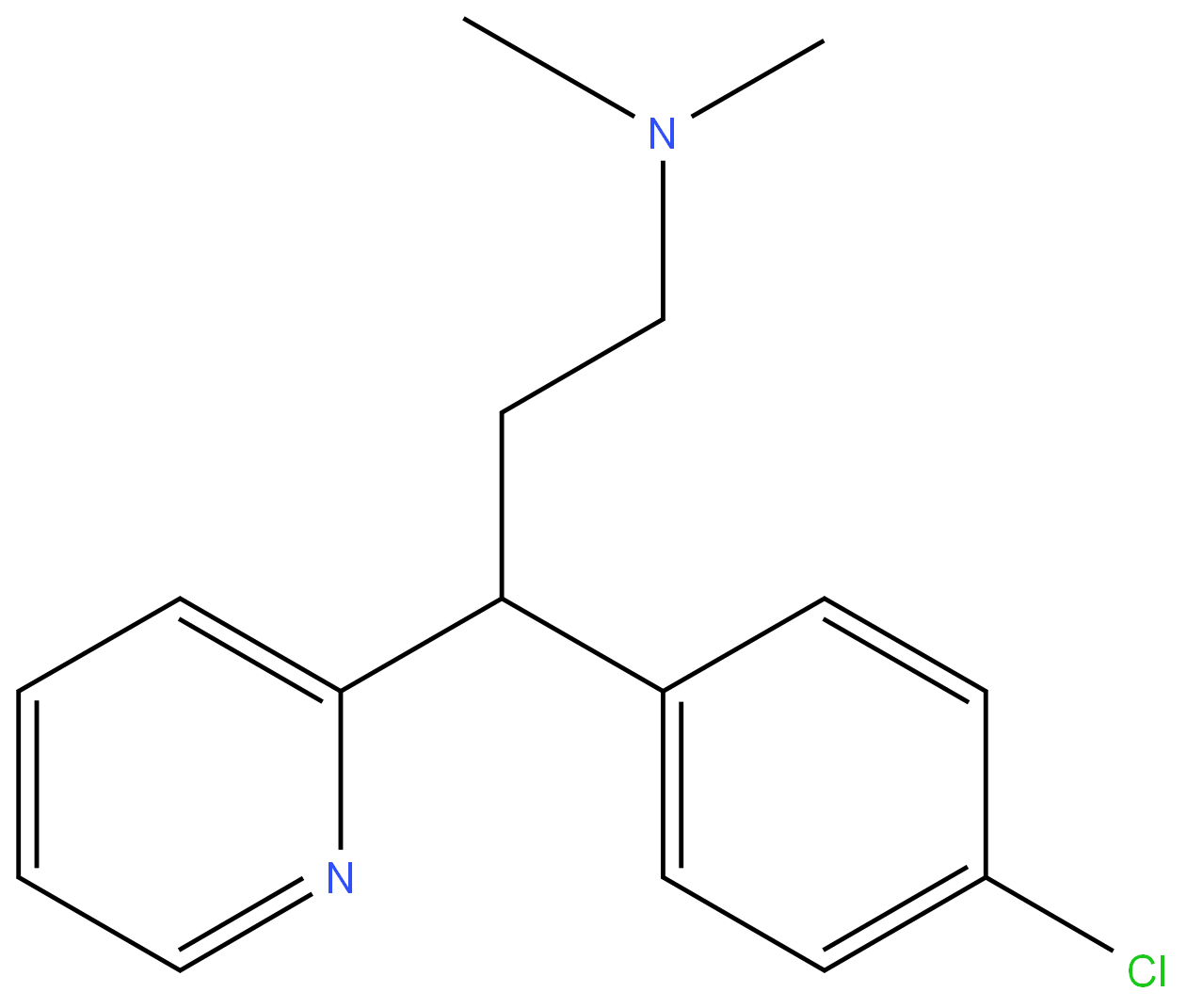 132-22-9 CHLORPHENIRAMINE BASE 98%View Details
132-22-9 -
 132-22-9 Chlorpheniramine 98%View Details
132-22-9 -
132-22-9 99%View Details
132-22-9 -
471-25-0 Propiolic Acid 98+View Details
471-25-0 -
84145-28-8 98+View Details
84145-28-8 -
2-(2-Chlorophenyl)glycine 88744-36-9 98+View Details
88744-36-9 -
40216-83-9 trans-4-Hydroxy-L-proline methyl ester hydrochloride 98+View Details
40216-83-9 -
1-(3-Hydroxy-4-methoxyphenyl)-2-nitroethene 98+View Details
39816-35-8