
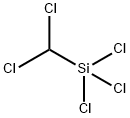
(Chloromethyl)trichlorosilane
- CAS NO.:1558-25-4
- Empirical Formula: CH2Cl4Si
- Molecular Weight: 183.92
- MDL number: MFCD00000873
- EINECS: 216-316-9
- SAFETY DATA SHEET (SDS)
- Update Date: 2026-10-07 14:32:37
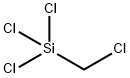
What is (Chloromethyl)trichlorosilane?
Chemical properties
Colorless clear liquid
Chemical properties
Trichloro(chloromethyl)silane is a colorless liquid. Sharp, biting odor.
The Uses of (Chloromethyl)trichlorosilane
(chloromethyl)trichlorosilane is usede in the synthesis of a highly branched polycarbosilane. Ferrocenophane has been prepared from (chloromethyl)trichlorosilane.
Definition
ChEBI: Trichloro(chloromethyl)silane is a silyl chloride.
General Description
Liquid.
Air & Water Reactions
Highly flammable. Reacts vigorously with water to form hydrogen chloride (hydrochloric acid)
Reactivity Profile
Chlorosilanes, such as (Chloromethyl)trichlorosilane, are compounds in which silicon is bonded to from one to four chlorine atoms with other bonds to hydrogen and/or alkyl groups. Chlorosilanes react with water, moist air, or steam to produce heat and toxic, corrosive fumes of hydrogen chloride. They may also produce flammable gaseous H2. They can serve as chlorination agents. Chlorosilanes react vigorously with both organic and inorganic acids and with bases to generate toxic or flammable gases.
Health Hazard
(Non-Specific -- Methyl Trichlorosilane) If inhaled, may be harmful; contact may cause burns to skin and eyes. Runoff from fire control or dilution water may cause pollution.
Fire Hazard
(Non-specific -- Methyl Trichloro- silane) Flammable/Combustible material; may be ignited by heat, sparks, or flames. Vapors may travel to a source of ignition and flash back. Container may explode in heat of fire. Vapor explosion hazard indoors, outdoors, or in sewers. Runoff to sewer may create fire or explosion hazard. May react violently with water.
Potential Exposure
Used in the synthesis of polysiloxane (silicone polymers).
Shipping
UN3389 Toxic by inhalation liquid, corrosive, n.o.s. with an LC50 ≤200 mL/m3 and saturated vapor concentration ≥500 Hazard Class: 6.1; Labels: 6.1-Poisonous materials, 8-Corrosive material, Technical Name Required, Inhalation Hazard Zone A. UN1295 Trichlorosilane, Hazard Class: 4.3; Labels: 4.3-Dangerous when wet material, 3-Flammable liquid, 8-Corrosive material.
Incompatibilities
Incompatible with oxidizers (chlorates, nitrates, peroxides, permanganates, perchlorates, chlorine, bromine, fluorine, etc.); contact may cause fires or explosions. Keep away from alkaline materials, strong bases, strong acids, oxoacids, epoxides. Chlorosilanes react vigorously with bases and both organic and inorganic acids generating toxic and/or flammable gases. Chlorosilanes react with water, moist air, or steam to produce heat and toxic, corrosive fumes of hydrogen chloride. They may also produce flammable gaseous hydrogen. Attacks metals in the presence of moisture.
Properties of (Chloromethyl)trichlorosilane
| Boiling point: | 117-118 °C |
| Density | 1.476 g/mL at 25 °C(lit.) |
| refractive index | n |
| Flash point: | 69 °C |
| storage temp. | Inert atmosphere,2-8°C |
| Specific Gravity | 1.476 |
| Water Solubility | slightly soluble |
| Sensitive | Moisture Sensitive |
| Hydrolytic Sensitivity | 8: reacts rapidly with moisture, water, protic solvents |
| BRN | 1811640 |
| CAS DataBase Reference | 1558-25-4(CAS DataBase Reference) |
| NIST Chemistry Reference | Silane, trichloro(chloromethyl)-(1558-25-4) |
| EPA Substance Registry System | Trichloro(chloromethyl)silane (1558-25-4) |
Safety information for (Chloromethyl)trichlorosilane
| Signal word | Warning |
| Pictogram(s) |
 Corrosion Corrosives GHS05  Skull and Crossbones Acute Toxicity GHS06 |
| GHS Hazard Statements |
H227:Flammable liquids H314:Skin corrosion/irritation H318:Serious eye damage/eye irritation H330:Acute toxicity,inhalation |
| Precautionary Statement Codes |
P280:Wear protective gloves/protective clothing/eye protection/face protection. P309:IF exposed or if you feel unwell: P310:Immediately call a POISON CENTER or doctor/physician. P302+P352:IF ON SKIN: wash with plenty of soap and water. P305+P351+P338:IF IN EYES: Rinse cautiously with water for several minutes. Remove contact lenses, if present and easy to do. Continuerinsing. P402:Store in a dry place. |
Computed Descriptors for (Chloromethyl)trichlorosilane
New Products
2-(2-Chlorophenyl)glycine Propiolic Acid 1-(3-Hydroxy-4-methoxyphenyl)-2-nitroethene (±)-amino(2-fluorophenyl)acetic acid trans-3-Benzyloxy-4-methoxy-beta-nitrostyrene 1-Pentadecanol 4-(4-Αminophenyl)-3-Morpholinone 3-Morpholino-1-(4-(2-oxopiperidin-1-yl) phenyl)-5,6-dihyropyridin-2-(1H)-one 1-(4-Aminophenyl)-3-morpholino-5,6-dihydropyridin-2(1H)-one N-cyanoacetylurethane 1H-IndazoleRelated products of tetrahydrofuran

You may like
-
 (Chloromethyl)trichlorosilane CAS 1558-25-4View Details
1558-25-4 -
(Chloromethyl)trichlorosilane, 99% CAS 1558-25-4View Details
1558-25-4 -
471-25-0 Propiolic Acid 98+View Details
471-25-0 -
84145-28-8 98+View Details
84145-28-8 -
trans-3-Benzyloxy-4-methoxy-beta-nitrostyrene 98+View Details
63909-29-5 -
2-(2-Chlorophenyl)glycine 88744-36-9 98+View Details
88744-36-9 -
40216-83-9 trans-4-Hydroxy-L-proline methyl ester hydrochloride 98+View Details
40216-83-9 -
1-(3-Hydroxy-4-methoxyphenyl)-2-nitroethene 98+View Details
39816-35-8