
Chlorisondamine diiodide
- CAS NO.:96750-66-2
- Empirical Formula: C14Cl4H20I2N2
- Molecular Weight: 611.94
- MDL number: MFCD01074794
- SAFETY DATA SHEET (SDS)
- Update Date: 2026-09-12 18:54:59
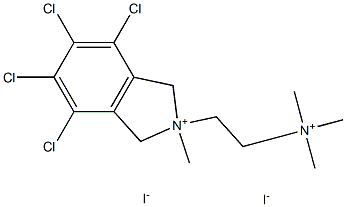
What is Chlorisondamine diiodide?
Description
Chlorisondamine is an antagonist of nicotinic acetylcholine receptors (nAChRs; IC50 = 1.8 μM in rat striatal synaptosomes) and a ganglion blocker. It decreases dopamine release induced by nicotine (Item Nos. 16535 | 20887) in a dose-dependent manner in rat striatal synaptosomes at concentrations ranging from 0-100 μM. The effect of chlorisondamine is long-lasting, with a 10 mg/kg dose blocking nicotine-induced stimulant activity for at least five weeks. Chlorisondamine (5 μg, i.c.v.) prevents rats from acquiring a (–)-nicotine-induced conditioned taste aversion response, a model of the aversive effects of nicotine. It also inhibits autonomic ganglia, providing approximately 50% inhibition of the contractile response in feline superior cervical ganglion nictitating membrane preparations when administered at a dose of 50 mg/kg.
The Uses of Chlorisondamine diiodide
Chlorisondamine diiodide has been used:
- as a nicotinic receptor antagonist to test its effect on trinitrobenzene sulfonic acid (TNBS)-induced colitis
- as an irreversible nicotinic acetylcholine(nAChR) blocker to pre-treat brain samples to test its effect on cytochrome P450 2B (CYP2B) induction
- as a ganglionic blocker to test its effect on regulating corticosterone levels in rat with chronic stress
Biochem/physiol Actions
Chlorisondamine diiodide mediates ganglionic and central blockade.
Properties of Chlorisondamine diiodide
| storage temp. | 2-8°C |
| solubility | H2O: ~3.75 mg/mL |
| form | solid |
| color | white |
| Water Solubility | Soluble to 10 mM in water |
Safety information for Chlorisondamine diiodide
| Signal word | Warning |
| Pictogram(s) |
 Exclamation Mark Irritant GHS07  Environment GHS09 |
| GHS Hazard Statements |
H302:Acute toxicity,oral H400:Hazardous to the aquatic environment, acute hazard |
| Precautionary Statement Codes |
P273:Avoid release to the environment. |
Computed Descriptors for Chlorisondamine diiodide
New Products
2-(2-Chlorophenyl)glycine Propiolic Acid 1-(3-Hydroxy-4-methoxyphenyl)-2-nitroethene (±)-amino(2-fluorophenyl)acetic acid trans-3-Benzyloxy-4-methoxy-beta-nitrostyrene 1-Pentadecanol 2,4-Dihydroxybenzaldehyde Dipropyl disulfide Pyrrolo[1,2-a]pyrimidine-6-carboxylic acid, 4,6,7,8-tetrahydro-4-oxo-, sodium salt (1:1), (6S) Obidoxime hydrochloride API 4 pentyn 1 ol N-Vinylformamide Methacrylate-PEG-Methacrylate, Mn:35000 2,4-Dihydroxyacetophenone 2-Chloro 5-Fluoro Pyridine Vasicinone 2-Chloroisonicotinic Acid Tween 80 or Polysorbate 80 2-Butyn-1-oL N-(4-Cyano-3-(trifluoromethyl)phenyl)-2-methyloxirane-2-carboxamide N-(4-fluoro-2-methoxy-5-nitrophenyl)-4-(1-methyl-1H-indol-3-yl)pyrimidin-2-amine Pirtobrutinib intd. 2-Pentyn-1-oL 4-NitrobenzotrifluorideYou may like
-
 Chlorisondamine diiodide CAS 96750-66-2View Details
96750-66-2 -
471-25-0 Propiolic Acid 98+View Details
471-25-0 -
84145-28-8 98+View Details
84145-28-8 -
trans-3-Benzyloxy-4-methoxy-beta-nitrostyrene 98+View Details
63909-29-5 -
2-(2-Chlorophenyl)glycine 88744-36-9 98+View Details
88744-36-9 -
40216-83-9 trans-4-Hydroxy-L-proline methyl ester hydrochloride 98+View Details
40216-83-9 -
629-76-5 98+View Details
629-76-5 -
1-(3-Hydroxy-4-methoxyphenyl)-2-nitroethene 98+View Details
39816-35-8