
CHITINASE
Synonym(s):N-acetyl-glucosaminidasechitobiase;Chitin digestion enzymes;N-acetyl-β-glucosaminidase and chitodextrinase;poly(β-(1→4)-[2-acetamido-2-deoxy-D-glucoside])- glycanohydrolase
- CAS NO.:9001-06-3
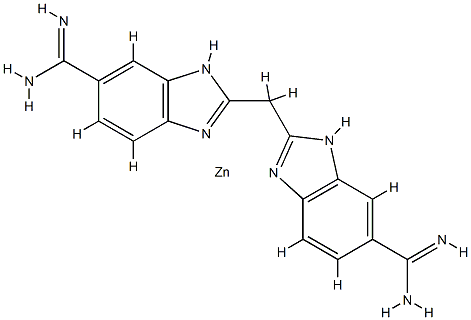
- Empirical Formula: C17H16N8Zn
- Molecular Weight: 397.75254
- MDL number: MFCD00130771
- EINECS: 232-578-7
- Update Date: 2026-05-28 05:56:08
What is CHITINASE?
The Uses of CHITINASE
Agriculture fields: control pathogens.
Human health care: Asthma.
Pharma: preparation of chitooligosaccharides and N-acetyl D glucosamine,
Preparation of single-cell protein
Isolation of protoplasts from fungi and yeast
Control of pathogenic fungi
Treatment of chitinous waste, mosquito control and morphogenesis
General Description
Chitinase is an extracellular complex of enzymes that degrade chitin. Chitin is a cell wall component of Fungi and exoskeketal essentials of different organisms which reshape their own chitin or digest/dissolve the chitin of other organisms (insects, fungi, yeast, and algae, and in the internal structures of other vertebrates) . Chitinases have been detected in many microorganisms and in plants. In fungi, chitinases assist in morphogenesis, to break down the inherent chitin content of fungal cell walls. Plant chitinases help in resistance to fungal attack and counteracting fungal growth, by targeting those same fungal cell walls. In bacteria, bacterial chitinases assist in utilizing chitin as a carbon source and as an energy source.Streptomyces griseus produces multiple chitinases of different molecular masses after growth induction with chitin as the carbon source.
The enzymatic hydrolysis of chitin to N-acetyl-D-glucosamine involves two consecutive enzyme reactions:
- The first reaction, chitodextrinase-chitinase, is a poly(β-(1→4)-[2-acetamido-2-deoxy-D-glucoside])- glycanohydrolase, which removes chitobiose units from chitin.
- The second activity is N-acetyl-glucosaminidasechitobiase, which cleaves the disaccharide to its monomer subunits, N-acetyl-D-glucosamine.
Biochem/physiol Actions
Chitinase serves as a biopesticide against several fungi and insects. This hydrolytic enzyme is capable of cleaving the glycosidic bonds in chitin.
Properties of CHITINASE
| storage temp. | -20°C |
| form | lyophilized powder |
| color | White to off-white |
| EPA Substance Registry System | Chitinase (9001-06-3) |
Safety information for CHITINASE
| Signal word | Danger |
| Pictogram(s) |
 Health Hazard GHS08 |
| GHS Hazard Statements |
H334:Sensitisation, respiratory |
| Precautionary Statement Codes |
P261:Avoid breathing dust/fume/gas/mist/vapours/spray. P284:Wear respiratory protection. P501:Dispose of contents/container to..… |
Computed Descriptors for CHITINASE
New Products
Dibenzoyl-L-tartaric acid Anhydrous (Resolution Reagent) Cis-Tosylate Dibenzo[b,f][1,4]thiazepin-11(10H)-one 1,2,3,9-Tetrahydro-9-Methyl-4H-Carbazole-4-One 1-(4-methoxyphenyl)-4-(4-Nitrophenyl)Piperazine (IT-1) BOC Piperazine 1-Benzhydrylazetane-3-carbonitrile 8-oxa-1,3-diazaspiro[4.5]decane-2,4-dione (±)-amino(2-fluorophenyl)acetic acid 2-(2-Chlorophenyl)glycine AMINO-(3-CHLORO-PHENYL)-ACETIC ACID 2'-Fluoroacetophenone METHANOL-D1(OD) TERTIARY BUTANOL-D9 N-ETHYL-D5-AMINE HYDROCHLORIDE BENZOIC ACID-D CHLOROFORM-D TOLUENE-D3 Trans,trans muconic acid HC Blue-16 4-Amino-2-chloro-6,7-dimethoxyquinazoline Ethyl 4,5-bis(2-methoxyethoxy)-2-nitrobenzoate 2,3-Dimethoxypyridine 1-(3-Chlorophenyl)piperazine hydrochlorideRelated products of tetrahydrofuran





You may like
-
 Chitinase from Trichoderma viride CASView Details
 -
Chitinase from Streptomyces griseus CASView Details
-
 Product IntroductionView Details
 -
 Product InrtroductionView Details
 -
 DGO24View Details
 -
 DGO25View Details
 -
 DGO29View Details
 -
 DGO32View Details