
chebulagic acid
Synonym(s):
- CAS NO.:23094-71-5
- Empirical Formula: C41H30O27
- Molecular Weight: 954.66
- MDL number: MFCD09264640
- SAFETY DATA SHEET (SDS)
- Update Date: 2026-07-27 17:00:41
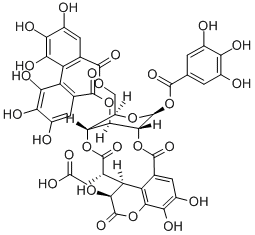
What is chebulagic acid?
Chemical properties
Derived from Myrobalan; Empress
Preparation
Crude chebulagic acid extracts from these fruits are usually extracted using Soxhlet extraction or reflux methods before purification using column chromatography and High-Performance Liquid Chromatography (HPLC).
Biological Activity
Chebulagic acid showed a weak inhibition of sucrose-hydrolysis activity. Meanwhile, chebulagic acid did not have an obvious influence on intestinal glucose uptake and was not effective on glucose transporters.
Pharmacology
Chebulagic acid is also called chekhotannin.Hydrolyzed tannin has good pharmacological effects such as anti-oxidation, anti-tumor, anti-virus, antibacterial and anti-lipid peroxidation, and is the basis of pharmacodynamic substances in many common Chinese medicines.
Properties of chebulagic acid
| Melting point: | >300℃ |
| Boiling point: | 1610.6±65.0 °C(Predicted) |
| Density | 2.13 |
| storage temp. | Store at -20°C |
| solubility | DMSO : 100 mg/mL (104.75 mM; Need ultrasonic) |
| form | Solid |
| form | neat |
| pka | 4.12±0.10(Predicted) |
| color | Beige |
Safety information for chebulagic acid
Computed Descriptors for chebulagic acid
| InChIKey | HGJXAVROWQLCTP-BVTGIWGTSA-N |
Related products of tetrahydrofuran



You may like
-
 Chebulagic acid CAS 23094-71-5View Details
23094-71-5 -
Olaparib Impurity 2 2409514-28-7 98%View Details
2409514-28-7 -
semgalutide intermediates 98%View Details
1446013-08-6 -
Erastigmine intermediate 2 98%View Details
-
Erastigmine intermediate 1 98%View Details
-
Zilucoplan sodium 98%View Details
1841136-73-9 -
95058-92-7 (3R,S)-2,2-二氟-3-羟基-(2,2-二甲基二氧环戊-4-基)丙酸乙酯 98%View Details
95058-92-7 -
tert-butyl (5-chloro-3-methyl-3H-imidazo[4,5-b]pyridin 98%View Details
Statement: All products displayed on this website are only used for non medical purposes such as industrial applications or scientific research, and cannot be used for clinical diagnosis or treatment of humans or animals. They are not medicinal or edible.