
Carbamic chloride
- CAS NO.:463-72-9
- Empirical Formula: CH2ClNO
- Molecular Weight: 79.49
- MDL number: MFCD17019496
- EINECS: 207-342-1
- SAFETY DATA SHEET (SDS)
- Update Date: 2026-06-24 13:15:37
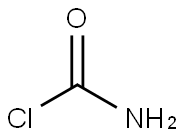
What is Carbamic chloride?
Chemical properties
Carbamoyl chloride, H2N – COCl, is unstable; it may be stabilized by Lewis acids (e.g., aluminum chloride) as adducts and in this form can be used in the Friedel-Crafts acylation of arenes. Since many of the monosubstituted carbamoyl chlorides also deteriorate on storage, the corresponding isocyanates are used instead. Disubstituted carbamoyl chlorides are stable and can be stored for prolonged periods.
Physical properties
The simple carbamoyl chlorides are colorless liquids or solids, usually with pungent odor.
The Uses of Carbamic chloride
Carbamoyl chloride can be used as an intermediate for carbamate pesticides.
The Uses of Carbamic chloride
Carbamoyl chlorides are intermediates with many uses. Of primary industrial importance are the reactions with alcohols, phenols, and oximes to give carbamic acid esters; with thiols (mercaptans) to give thiocarbamates; with amines and hydroxylamines to give substituted ureas; and with imidazoles and triazoles to give carbamoyl azoles.
Definition
ChEBI: Carbamyl chloride is an organonitrogen compound.
Synthesis
Carbamoyl chloride can be synthesized from methylamine and phosgene at 200-240℃.
Properties of Carbamic chloride
| Melting point: | 90℃ |
| Boiling point: | bp 61-62° (decompn) |
| Density | 1.3273 (rough estimate) |
| refractive index | 1.4480 (estimate) |
| pka | 11.60±0.50(Predicted) |
Safety information for Carbamic chloride
Computed Descriptors for Carbamic chloride
New Products
N-Carbethoxy-4-piperidone 1-Aminocyclopentane carbonitrile Tetrabutylammonium perchlorate N,O-Dimethylhydroxylamine hydrochloride (RS)-beta-Amino-beta-(4-bromophenyl)propionic acid 2-Amino-5-bromo-4-(trifluoromethyl)pyridine N-Vinylformamide 4 pentyn 1 ol Phenethyl cinnamate Pyrrolo[1,2-a]pyrimidine-6-carboxylic acid, 4,6,7,8-tetrahydro-4-oxo-, sodium salt (1:1), (6S) Ethyl 3-phenylpropanoate β-Bromostyrene Methacrylate-PEG-Methacrylate, Mn:35000 2,4-Dihydroxyacetophenone 2-Chloro 5-Fluoro Pyridine Vasicinone 2-Chloroisonicotinic Acid Tween 80 or Polysorbate 80 5-Bromo-1-Pentyne 1-(2-Methyl-5-nitrophenyl)guanidine Nitrate Methyl trans-4-Aminocyclohexanecarboxylate Hydrochloride 2-Pentyn-1-oL 4-Nitrobenzotrifluoride N-(4-Cyano-3-(trifluoromethyl)phenyl)-2-methyloxirane-2-carboxamideRelated products of tetrahydrofuran

![Dibenz[b,f]azepine-5-carbonyl chloride](https://img.chemicalbook.in/CAS/GIF/33948-22-0.gif)
You may like
-
 144-83-2 Sulfapyridine 98+View Details
144-83-2 -
29976-53-2 98+View Details
29976-53-2 -
2-Amino-5-bromo-4-(trifluoromethyl)pyridine 98+View Details
944401-56-3 -
(RS)-beta-Amino-beta-(4-bromophenyl)propionic acid 39773-47-2 98+View Details
39773-47-2 -
6638-79-5 N,O-Dimethylhydroxylamine hydrochloride 98+View Details
6638-79-5 -
674783-97-2 98+View Details
674783-97-2 -
1-Aminocyclopentane carbonitrile 98+View Details
49830-37-7 -
Tetrabutylammonium perchlorate 1923-70-2 98+View Details
1923-70-2