
CALCIUM STANNATE
- CAS NO.:12013-46-6
- Empirical Formula: CaH6OSn
- Molecular Weight: 180.84
- MDL number: MFCD00015980
- EINECS: 234-585-0
- SAFETY DATA SHEET (SDS)
- Update Date: 2026-05-28 03:33:54
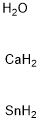
What is CALCIUM STANNATE?
Description
In another method, a precursor CaSn(OH)6 was
prepared using tin tetrachloride, calcium chloride and
sodium hydroxide at room temperature. Then the
precursor was annealed at relatively low temperature of 600°C to obtain CaSnO3. This compound has the CAS
number of CAS 12013-46-6. Its molecular weight is
206.7218 g/mol.
The cubic compounds, denoted by ASnO3 (A = Sr,
Ba), adopt the cubic perovskite structure whereas
Ca2SnO4 has the Sr2PbO4 structure.
Chemical properties
white, crystal(s) powder(s); used as an additive for ceramic capacitors, in the production of ceramic colors; anhydrous is -325 mesh, 5μm or less 99% pure [HAW93] [CER91]
Properties of CALCIUM STANNATE
| Density | 2.55[at 20℃] |
| solubility | insoluble in H2O |
| form | Powder |
| color | White |
| Water Solubility | Insoluble in water. |
| Exposure limits | ACGIH: TWA 2 mg/m3 NIOSH: IDLH 100 mg/m3; TWA 2 mg/m3 |
| CAS DataBase Reference | 12013-46-6(CAS DataBase Reference) |
| EPA Substance Registry System | Calcium tin oxide (CaSnO3) (12013-46-6) |
Safety information for CALCIUM STANNATE
| Signal word | Danger |
| Pictogram(s) |
 Exclamation Mark Irritant GHS07 |
| GHS Hazard Statements |
H315:Skin corrosion/irritation H319:Serious eye damage/eye irritation H335:Specific target organ toxicity, single exposure;Respiratory tract irritation |
| Precautionary Statement Codes |
P261:Avoid breathing dust/fume/gas/mist/vapours/spray. P304+P340:IF INHALED: Remove victim to fresh air and Keep at rest in a position comfortable for breathing. P305+P351+P338:IF IN EYES: Rinse cautiously with water for several minutes. Remove contact lenses, if present and easy to do. Continuerinsing. P405:Store locked up. |
Computed Descriptors for CALCIUM STANNATE
New Products
5-bromo-4-fluoro-2-nitrobenzaldehyde (R)-(-)-2-Amino-1-propanol Cyclobutanone Fmoc-OSu 1-(2-Chloroethyl)pyrrolidine Hydrochloride 2-Amino-2-(4-methylphenyl)acetic acid Obidoxime hydrochloride API Decanoic acid, 2-[4-(phenylmethoxy)phenyl]ethyl ester Piperazine, 1-(3-methoxyphenyl)-, hydrochloride (1:1) 4-Bromo-2,6-difluoroaniline 4 pentyn 1 ol N-Vinylformamide Methacrylate-PEG-Methacrylate, Mn:35000 2,4-Dihydroxyacetophenone 2-Chloro 5-Fluoro Pyridine Vasicinone 2-Chloroisonicotinic Acid Tween 80 or Polysorbate 80 N-(4-Cyano-3-(trifluoromethyl)phenyl)-2-methyloxirane-2-carboxamide 2-Pentyn-1-oL 4-Nitrobenzotrifluoride N-(4-fluoro-2-methoxy-5-nitrophenyl)-4-(1-methyl-1H-indol-3-yl)pyrimidin-2-amine Pirtobrutinib intd. 2-Butyn-1-oLRelated products of tetrahydrofuran



You may like
-
 Fmoc-OSu 98+View Details
82911-69-1 -
(R)-(-)-2-Amino-1-propanol 35320-23-1 98+View Details
35320-23-1 -
7250-67-1 1-(2-Chloroethyl)pyrrolidine Hydrochloride 98+View Details
7250-67-1 -
13227-01-5 98+View Details
13227-01-5 -
7250-67-1 1-(2-Chloroethyl)pyrrolidine Hydrochloride 98+View Details
7250-67-1 -
13227-01-5 98+View Details
13227-01-5 -
7250-67-1 1-(2-Chloroethyl)pyrrolidine Hydrochloride 98+View Details
7250-67-1 -
13227-01-5 98+View Details
13227-01-5
Statement: All products displayed on this website are only used for non medical purposes such as industrial applications or scientific research, and cannot be used for clinical diagnosis or treatment of humans or animals. They are not medicinal or edible.