
BUTOCARBOXIM
- CAS NO.:34681-10-2
- Empirical Formula: C7H14N2O2S
- Molecular Weight: 190.26
- MDL number: MFCD00055326
- EINECS: 252-139-3
- SAFETY DATA SHEET (SDS)
- Update Date: 2026-07-31 15:25:14
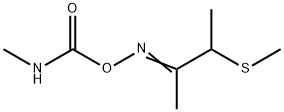
What is BUTOCARBOXIM?
The Uses of BUTOCARBOXIM
Butocarboxim is a systematic selectively acting insecticide with anticholinesterasic activity. Butocarboxim is used to control sucking pests such as mites, aphids, white flies as well as bees in agric ulture.
The Uses of BUTOCARBOXIM
Labelled Butocarboxim, a systematic selectively acting insecticide with anticholinesterasic activity. Butocarboxim is used to control sucking pests such as mites, aphids, white flies as well as bees i n agriculture.
Metabolic pathway
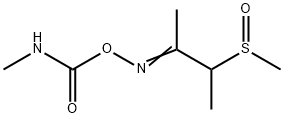
Butocarboxin is a structural isomer of aldicarb. Butoxycarboxim is the sulfur oxidation (sulfone) product of butocarboxim. Limited information is available to describe the degradation and metabolic fate of these two compounds. As with aldicarb, oxidation of the sulfur molecule of butocarboxim to butocarboxim sulfoxide and butoxycarboxim is the primary photolytic and metabolic reaction in soils, plants and animals (Scheme 1).
Degradation
Butocarboxim (1) is stable to hydrolytic degradation (pH 5-7, up to 50 °C,
PM) and is stable under UV light irradiation. It degrades under strong
acidic and alkaline conditions.
Butoxycarboxim (2) is susceptible to alkaline hydrolysis (DT50 values of
500, 18 and 16 days in pH 5, 7 and 9, respectively, PM). It is also stable
under UV light irradiation.
Properties of BUTOCARBOXIM
| Melting point: | 25 °C |
| Density | 1.2118 (rough estimate) |
| vapor pressure | 1.1×10⁻²pa(20°C) |
| refractive index | 1.5690 (estimate) |
| form | neat |
| Water Solubility | 35 g l-1 (20 °C) |
| pka | 13.83±0.46(Predicted) |
| EPA Substance Registry System | 2-Butanone, 3-(methylthio)-, O-[(methylamino)carbonyl]oxime (34681-10-2) |
Safety information for BUTOCARBOXIM
| Signal word | Danger |
| Pictogram(s) |
 Flame Flammables GHS02  Skull and Crossbones Acute Toxicity GHS06  Environment GHS09 |
| GHS Hazard Statements |
H226:Flammable liquids H319:Serious eye damage/eye irritation H410:Hazardous to the aquatic environment, long-term hazard |
| Precautionary Statement Codes |
P210:Keep away from heat/sparks/open flames/hot surfaces. — No smoking. P273:Avoid release to the environment. P280:Wear protective gloves/protective clothing/eye protection/face protection. P301+P310:IF SWALLOWED: Immediately call a POISON CENTER or doctor/physician. P303+P361+P353:IF ON SKIN (or hair): Remove/Take off Immediately all contaminated clothing. Rinse SKIN with water/shower. |
Computed Descriptors for BUTOCARBOXIM
New Products
N-Carbethoxy-4-piperidone 1-Aminocyclopentane carbonitrile Tetrabutylammonium perchlorate N,O-Dimethylhydroxylamine hydrochloride (RS)-beta-Amino-beta-(4-bromophenyl)propionic acid 2-Amino-5-bromo-4-(trifluoromethyl)pyridine N-Vinylformamide 4 pentyn 1 ol Phenethyl cinnamate Dipropyl disulfide Ethyl 3-phenylpropanoate β-Bromostyrene Methacrylate-PEG-Methacrylate, Mn:35000 2,4-Dihydroxyacetophenone 2-Chloro 5-Fluoro Pyridine Vasicinone 2-Chloroisonicotinic Acid Tween 80 or Polysorbate 80 5-Bromo-1-Pentyne 1-(2-Methyl-5-nitrophenyl)guanidine Nitrate Methyl trans-4-Aminocyclohexanecarboxylate Hydrochloride N-(4-Cyano-3-(trifluoromethyl)phenyl)-2-methyloxirane-2-carboxamide 2-Pentyn-1-oL 4-NitrobenzotrifluorideRelated products of tetrahydrofuran


You may like
-
 Butocarboxim CAS 34681-10-2View Details
34681-10-2 -
144-83-2 Sulfapyridine 98+View Details
144-83-2 -
29976-53-2 98+View Details
29976-53-2 -
(RS)-beta-Amino-beta-(4-bromophenyl)propionic acid 39773-47-2 98+View Details
39773-47-2 -
6638-79-5 N,O-Dimethylhydroxylamine hydrochloride 98+View Details
6638-79-5 -
674783-97-2 98+View Details
674783-97-2 -
1-Aminocyclopentane carbonitrile 98+View Details
49830-37-7 -
Tetrabutylammonium perchlorate 1923-70-2 98+View Details
1923-70-2