
Biliverdin dihydrochloride
- CAS NO.:55482-27-4
- Empirical Formula: C33H35ClN4O6
- Molecular Weight: 619.12
- MDL number: MFCD08669554
- SAFETY DATA SHEET (SDS)
- Update Date: 2026-09-12 18:50:31
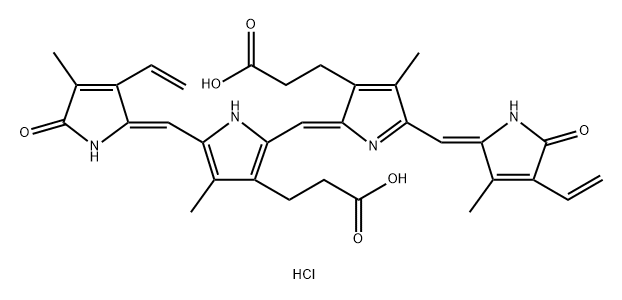
What is Biliverdin dihydrochloride?
The Uses of Biliverdin dihydrochloride
Biliverdin dihydrochloride was found responsible for cytoprotection. It was also found to induce tolerance to cardiac allografts. Biliverdin hydrochloride may regulate the cellular heme degradation process by occupying the heme binding site on heme oxygenase which would prevent access of the substrate to the catalytic site of the enzyme.
What are the applications of Application
Biliverdin hydrochloride is a heme oxygenase inhibitor and green bile pigment, able to be reduced to bilirubin.
General Description
Biliverdin?(BV) is considered as a near-infrared (NIR)-absorbing pigment, that is endogenic. It is a linear tetrapyrrolic intermediate of heme degradation (heme catabolism) to bilirubin. The bile of amphibia and birds contains only biliverdine, no bilirubin.
Biochem/physiol Actions
Biliverdin (BV) is an excellent anti-inflammatory agent that protects against lipopolysaccharides (LPS)-induced lung injury in mouse endothelial cells. It aids protection in polymicrobial sepsis. Biliverdin has cytoprotective effects on rat livers and protects from prolonged ischemia and reperfusion injury. It also shows antioxidant activities.
Properties of Biliverdin dihydrochloride
| RTECS | DU3033000 |
| storage temp. | -20°C |
| solubility | Soluble in DMSO, DMF, and basic aqueous solutions |
| form | Powder |
| Sensitive | Light Sensitive |
Safety information for Biliverdin dihydrochloride
| Signal word | Warning |
| Pictogram(s) |
 Exclamation Mark Irritant GHS07 |
| GHS Hazard Statements |
H315:Skin corrosion/irritation H319:Serious eye damage/eye irritation H335:Specific target organ toxicity, single exposure;Respiratory tract irritation |
| Precautionary Statement Codes |
P261:Avoid breathing dust/fume/gas/mist/vapours/spray. P264:Wash hands thoroughly after handling. P264:Wash skin thouroughly after handling. P271:Use only outdoors or in a well-ventilated area. P280:Wear protective gloves/protective clothing/eye protection/face protection. P302+P352:IF ON SKIN: wash with plenty of soap and water. P305+P351+P338:IF IN EYES: Rinse cautiously with water for several minutes. Remove contact lenses, if present and easy to do. Continuerinsing. |
Computed Descriptors for Biliverdin dihydrochloride
New Products
Cyclobutanone (R)-(-)-2-Amino-1-propanol Fmoc-OSu 5-bromo-4-fluoro-2-nitrobenzaldehyde 2-Amino-2-(4-methylphenyl)acetic acid 1-(2-Chloroethyl)pyrrolidine Hydrochloride 2,4-Dihydroxybenzaldehyde Obidoxime hydrochloride API Pyrrolo[1,2-a]pyrimidine-6-carboxylic acid, 4,6,7,8-tetrahydro-4-oxo-, sodium salt (1:1), (6S) Dipropyl disulfide N-Vinylformamide 4 pentyn 1 ol Methacrylate-PEG-Methacrylate, Mn:35000 2,4-Dihydroxyacetophenone 2-Chloro 5-Fluoro Pyridine Vasicinone 2-Chloroisonicotinic Acid Tween 80 or Polysorbate 80 2-Butyn-1-oL N-(4-fluoro-2-methoxy-5-nitrophenyl)-4-(1-methyl-1H-indol-3-yl)pyrimidin-2-amine Pirtobrutinib intd. 2-Pentyn-1-oL 4-Nitrobenzotrifluoride N-(4-Cyano-3-(trifluoromethyl)phenyl)-2-methyloxirane-2-carboxamideRelated products of tetrahydrofuran


You may like
-
 Biliverdin hydrochloride 95% CAS 55482-27-4View Details
55482-27-4 -
7250-67-1 1-(2-Chloroethyl)pyrrolidine Hydrochloride 98+View Details
7250-67-1 -
7250-67-1 1-(2-Chloroethyl)pyrrolidine Hydrochloride 98+View Details
7250-67-1 -
13227-01-5 98+View Details
13227-01-5 -
545445-44-1 3-Morpholino-1-(4-(2-oxopiperidin-1-yl) phenyl)-5,6-dihyropyridin-2-(1H)-one 98%View Details
545445-44-1 -
6629-04-5 98%View Details
6629-04-5 -
4-(4-Αminophenyl)-3-Morpholinone 98%View Details
438056-69-0 -
1-(4-Aminophenyl)-3-morpholino-5,6-dihydropyridin-2(1H)-one 1267610-26-3 98%View Details
1267610-26-3