
BENZYL IODIDE
- CAS NO.:620-05-3
- Empirical Formula: C7H7I
- Molecular Weight: 218.04
- MDL number: MFCD00013717
- EINECS: 210-623-1
- SAFETY DATA SHEET (SDS)
- Update Date: 2026-05-28 00:06:51
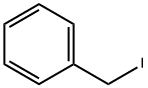
What is BENZYL IODIDE?
Chemical properties
Colorless crystals or liquid. Soluble in alcohol, carbon disulfide, ether; insoluble in water.
The Uses of BENZYL IODIDE
A tear gas.
The Uses of BENZYL IODIDE
(Iodomethyl)benzene can be used as sensory irritants.
Synthesis Reference(s)
The Journal of Organic Chemistry, 48, p. 3667, 1983 DOI: 10.1021/jo00169a010
Tetrahedron Letters, 36, p. 609, 1995 DOI: 10.1016/0040-4039(94)02315-3
Synthesis, p. 853, 1980 DOI: 10.1055/s-1980-29239
General Description
Low-melting crystals or a colorless liquid. Melting point 34.1°C. Insoluble in water and denser (1.74 g / cm3) than water. Hence sinks in water. Toxic by ingestion, inhalation and skin absorption. Very irritating to skin and eyes.
Air & Water Reactions
Insoluble in water.
Reactivity Profile
Look at benzyl chloride, benzyl bromide.
Hazard
Powerful irritant.
Health Hazard
TOXIC; inhalation, ingestion or contact (skin, eyes) with vapors, dusts or substance may cause severe injury, burns or death. Contact with molten substance may cause severe burns to skin and eyes. Reaction with water or moist air will release toxic, corrosive or flammable gases. Reaction with water may generate much heat that will increase the concentration of fumes in the air. Fire will produce irritating, corrosive and/or toxic gases. Runoff from fire control or dilution water may be corrosive and/or toxic and cause pollution.
Fire Hazard
Combustible material: may burn but does not ignite readily. Substance will react with water (some violently) releasing flammable, toxic or corrosive gases and runoff. When heated, vapors may form explosive mixtures with air: indoors, outdoors and sewers explosion hazards. Most vapors are heavier than air. They will spread along ground and collect in low or confined areas (sewers, basements, tanks). Vapors may travel to source of ignition and flash back. Contact with metals may evolve flammable hydrogen gas. Containers may explode when heated or if contaminated with water.
Properties of BENZYL IODIDE
| Melting point: | 280-282℃ |
| Boiling point: | 218℃ |
| Density | 1.750 |
| refractive index | 1.6330 |
| Flash point: | 98℃ |
| storage temp. | under inert gas (nitrogen or Argon) at 2–8 °C |
| Dielectric constant | 6.1(20℃) |
| CAS DataBase Reference | 620-05-3 |
| EPA Substance Registry System | Benzene, (iodomethyl)- (620-05-3) |
Safety information for BENZYL IODIDE
| Signal word | Danger |
| Pictogram(s) |
 Corrosion Corrosives GHS05  Exclamation Mark Irritant GHS07 |
| GHS Hazard Statements |
H315:Skin corrosion/irritation H318:Serious eye damage/eye irritation H335:Specific target organ toxicity, single exposure;Respiratory tract irritation |
| Precautionary Statement Codes |
P261:Avoid breathing dust/fume/gas/mist/vapours/spray. P264:Wash hands thoroughly after handling. P264:Wash skin thouroughly after handling. P271:Use only outdoors or in a well-ventilated area. P280:Wear protective gloves/protective clothing/eye protection/face protection. P362:Take off contaminated clothing and wash before reuse. P302+P352:IF ON SKIN: wash with plenty of soap and water. P332+P313:IF SKIN irritation occurs: Get medical advice/attention. P405:Store locked up. P403+P233:Store in a well-ventilated place. Keep container tightly closed. P501:Dispose of contents/container to..… |
Computed Descriptors for BENZYL IODIDE
New Products
Cis-Tosylate Dibenzoyl-L-tartaric acid Anhydrous (Resolution Reagent) 2,6-Dipicolic Acid 1,2,3,9-Tetrahydro-9-Methyl-4H-Carbazole-4-One Dibenzo[b,f][1,4]thiazepin-11(10H)-one N-BOC-piperidine-4-carboxylic acid 1-Benzhydrylazetane-3-carbonitrile AMINO-(3-CHLORO-PHENYL)-ACETIC ACID 2-(2-Chlorophenyl)glycine (±)-amino(2-fluorophenyl)acetic acid 8-oxa-1,3-diazaspiro[4.5]decane-2,4-dione MEHYL AMINE-D3.HCL METHANE SULFONIC ACID-D4 PHOSPORIC ACID-D3 85 W% IN D2O DEUTERIUM OXIDE FOR NMR TOLUENE-D3 BENZENE-D6 1-(3-Chlorophenyl)piperazine hydrochlorideRelated products of tetrahydrofuran



You may like
-
 7292-71-9 AMINO-(3-CHLORO-PHENYL)-ACETIC ACID 98+View Details
7292-71-9 -
84145-28-8 98+View Details
84145-28-8 -
2-(2-Chlorophenyl)glycine 98+View Details
88744-36-9 -
8-oxa-1,3-diazaspiro[4.5]decane-2,4-dione 39124-19-1 98+View Details
39124-19-1 -
7292-71-9 AMINO-(3-CHLORO-PHENYL)-ACETIC ACID 98+View Details
7292-71-9 -
84145-28-8 98+View Details
84145-28-8 -
2-(2-Chlorophenyl)glycine 98+View Details
88744-36-9 -
8-oxa-1,3-diazaspiro[4.5]decane-2,4-dione 39124-19-1 98+View Details
39124-19-1