
BAPTA-AM
- CAS NO.:126150-97-8
- Empirical Formula: C34H40N2O18
- Molecular Weight: 764.68
- MDL number: MFCD00036696
- EINECS: 634-129-4
- SAFETY DATA SHEET (SDS)
- Update Date: 2026-08-02 18:55:13
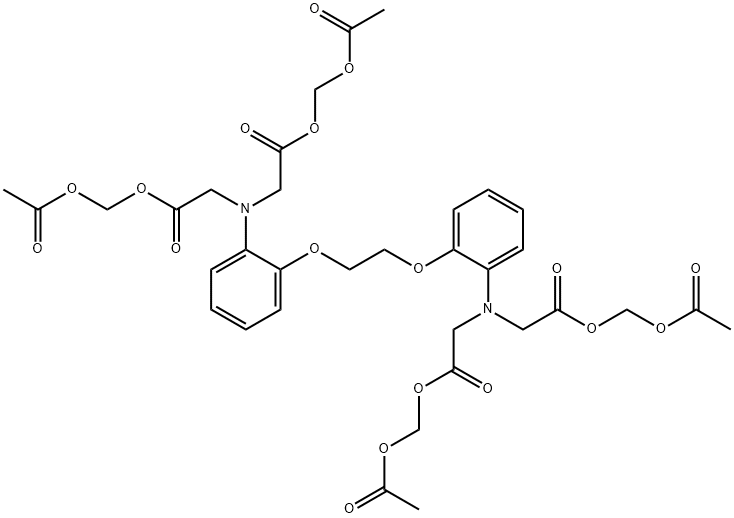
What is BAPTA-AM?
Description
BAPTA-AM (126150-97-8) is a selective cell permeable Ca2+ chelator. It is a widely used intracellular calcium sponge.1,2 Rapidly taken up by cells where it is irreversibly hydrolyzed to BAPTA by intracellular esterases. Pretreatment of cells with BAPTA-AM inhibits thapsigargin-induced responses.3
Chemical properties
Off-White to Light Yellow Solid
The Uses of BAPTA-AM
BAPTA-AM is a lipophilic diester of BAPTA used for inhibition of proteolytic activities of certain metalloproteinases, calpain and TACE. Fluorescence: max. Abs. 287nm; e x 10-3: 5.9
The Uses of BAPTA-AM
A cell permeable derivative of BAPTA which is widely used as an intracellular calcium sponge. Fluorescence: max. Abs. 287nm; e x 10-3: 5.9
The Uses of BAPTA-AM
A membrane-permeable form of BAPTA;Selective chelator of intracellular Ca2+ stores.
The Uses of BAPTA-AM
BAPTA is membrane-impermeable calcium chelator that binds extracellular calcium ions (Kd = 0.11 μM), with selectivity over magnesium ions or protons. BAPTA and its derivatives can also be used as calcium indicators, since the absorption maximum for BAPTA changes when it is complexed with calcium (absorption maxima free/complexed = 254/274 nm, emission maxima free/complexed = 363/363 nm). BAPTA AM is a cell permeable analog of BAPTA that binds calcium only after the acetoxymethyl group is removed by cytoplasmic esterases. It is commonly used at 10-100 μM to evaluate the role of intracellular calcium in cell signaling. It can also be used in animals. BAPTA AM also inhibits voltage-gated potassium (Kv) channels, including Kv1.3, Kv1.5, and Kv11.1 (Ki = 1.45, 1.23, and 1.30 μM, respectively).
What are the applications of Application
BAPTA/AM is a membrane-permeable, selective, Ca2+-chelating analog of BAPTA that has antithrombotic activity in vitro.
Definition
ChEBI: 2-[N-[2-(acetyloxymethoxy)-2-oxoethyl]-2-[2-[2-[bis[2-(acetyloxymethoxy)-2-oxoethyl]amino]phenoxy]ethoxy]anilino]acetic acid acetyloxymethyl ester is an alpha-amino acid ester.
General Description
BAPTA-AM inhibits free radical-mediated toxicity, enhances apoptosis in non-neuronal cells and protects neurons from ischemic damage. It regulates ion channels and blocks neuronal Ca2+-activated K+?channel currents. BAPTA-AM maintains intracellular Ca2+ homeostasis.
Biological Activity
Selective calcium chelator that is the cell-permeable analog of BAPTA (Cat No. 2786 ). Blocks hK v 1.5, hERG and hK v 1.3 channels (K i values are 1.23, 1.30 and 1.45 μ M respectively). Displays antithrombotic activity in vitro .
Biochem/physiol Actions
Selective chelator of intracellular Ca2+ stores.
Storage
-20°C
References
1) Smith et al. (1992), Cytosolic calcium as a second messenger for collagen-induced platelet responses; Biochem. J., 288 925 2) Yoshida et al. (1993), Role of calcium ion in induction of apoptosis by etoposide in human leukemia HL-60 cells; Biochem. Biophys. Res. Commun., 196 927 3) Jiang et al. (1994), Intracellular Ca2+ signals activate apoptosis in thymocytes: studies using the Ca(2+)-ATPase inhibitor thapsigargin; Exp. Cell Res., 212 84
Properties of BAPTA-AM
| Melting point: | 86-90°C |
| Boiling point: | 796.1±60.0 °C(Predicted) |
| Density | 1.350±0.06 g/cm3(Predicted) |
| storage temp. | -20°C |
| solubility | Soluble in chloroform, dimethyl sulfoxide |
| form | powder |
| pka | 1.69±0.50(Predicted) |
| color | White |
| λmax | 287 nm |
| BRN | 7458534 |
| Stability: | Light Sensitive |
| Biological Applications | Calcium indicators; treating cancer,chronic bacterial infection,glaucoma,ocular hypertension,HIV-associated conditions,infectious diseases,neurodegenerative disorders,neurological conditions,psychiatric conditions |
| CAS DataBase Reference | 126150-97-8(CAS DataBase Reference) |
Safety information for BAPTA-AM
| Signal word | Warning |
| Pictogram(s) |
 Exclamation Mark Irritant GHS07 |
| GHS Hazard Statements |
H315:Skin corrosion/irritation H319:Serious eye damage/eye irritation H335:Specific target organ toxicity, single exposure;Respiratory tract irritation |
| Precautionary Statement Codes |
P261:Avoid breathing dust/fume/gas/mist/vapours/spray. P271:Use only outdoors or in a well-ventilated area. P280:Wear protective gloves/protective clothing/eye protection/face protection. |
Computed Descriptors for BAPTA-AM
| InChIKey | YJIYWYAMZFVECX-UHFFFAOYSA-N |
New Products
2-(2-Chlorophenyl)glycine Propiolic Acid 1-(3-Hydroxy-4-methoxyphenyl)-2-nitroethene (±)-amino(2-fluorophenyl)acetic acid trans-3-Benzyloxy-4-methoxy-beta-nitrostyrene 1-Pentadecanol 2,4-Dihydroxybenzaldehyde Dipropyl disulfide Pyrrolo[1,2-a]pyrimidine-6-carboxylic acid, 4,6,7,8-tetrahydro-4-oxo-, sodium salt (1:1), (6S) Obidoxime hydrochloride API 4 pentyn 1 ol N-Vinylformamide Methacrylate-PEG-Methacrylate, Mn:35000 2,4-Dihydroxyacetophenone 2-Chloro 5-Fluoro Pyridine Vasicinone 2-Chloroisonicotinic Acid Tween 80 or Polysorbate 80 2-Butyn-1-oL N-(4-Cyano-3-(trifluoromethyl)phenyl)-2-methyloxirane-2-carboxamide N-(4-fluoro-2-methoxy-5-nitrophenyl)-4-(1-methyl-1H-indol-3-yl)pyrimidin-2-amine Pirtobrutinib intd. 2-Pentyn-1-oL 4-NitrobenzotrifluorideRelated products of tetrahydrofuran


You may like
-
 Tetrakis(acetoxymethyl) 1,2-Bis(2-aminophenoxy)ethane-N,N,N',N'-tetraacetate CAS 126150-97-8View Details
126150-97-8 -
BAPTA-AM CAS 126150-97-8View Details
126150-97-8 -
BAPTA/AM CAS 126150-97-8View Details
126150-97-8 -
471-25-0 Propiolic Acid 98+View Details
471-25-0 -
84145-28-8 98+View Details
84145-28-8 -
2-(2-Chlorophenyl)glycine 88744-36-9 98+View Details
88744-36-9 -
40216-83-9 trans-4-Hydroxy-L-proline methyl ester hydrochloride 98+View Details
40216-83-9 -
1-(3-Hydroxy-4-methoxyphenyl)-2-nitroethene 98+View Details
39816-35-8