
Atropine sulfate
Synonym(s):α-(Hydroxymethyl)benzeneacetic acid 8-methyl-8-azabicyclo[3.2.1]oct-3-yl ester;Atropine sulfate salt monohydrate;Tropine tropate
- CAS NO.:55-48-1
- Empirical Formula: 2C17H23NO3.H2O4S
- Molecular Weight: 676.82
- MDL number: MFCD00077268
- EINECS: 200-235-0
- SAFETY DATA SHEET (SDS)
- Update Date: 2026-06-24 18:39:39
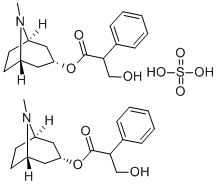
What is Atropine sulfate?
The Uses of Atropine sulfate
anticholinergic agent
The Uses of Atropine sulfate
cholinergic receptor antagonist
What are the applications of Application
Atropine sulfate is a tropane alkaloid and muscarinic acetylcholine receptor antagonist
brand name
Atrophate [Veterinary] (Schering-Plough Animal Health); Atropisol (Ciba Vision, US Ophthalmics); Isopto Atropine (Alcon).
General Description
Atropine sulfate (Atropisol)is prepared by neutralizing atropine in acetone or ethersolution with an alcoholic solution of sulfuric acid, withcare used to prevent hydrolysis. The salt occurs as colorlesscrystals or as a white, crystalline powder. It is efflorescentin dry air and should be protected from light to preventdecomposition.
Atropine sulfate is freely soluble in water (1:0.5), in alcohol(1:5, 1:2.5 at boiling point), and in glycerin (1:2.5).Aqueous solutions are not very stable, although solutionsmay be sterilized at 120°C (15 lb pressure) in an autoclave if the pH is kept below 6. Sterilization probably is besteffected by the use of aseptic techniques and a bacteriologicalfilter. It has been suggested that no more than a 30-daysupply of an aqueous solution should be made and that forsmall quantities the best procedure is to use hypodermictablets and sterile distilled water. Kondritzer andZvirblis have studied the kinetics of alkaline and protoncatalyzedhydrolyses of atropine in aqueous solution. Theregion of maximal stability lies between pH 3 and approximately5. They have also proposed an equation to predictthe half-life of atropine undergoing hydrolysis at constantpH and temperature.
Clinical Use
Atropine may be used to treat some types of arrhythmias. Itincreases the heart rate by blocking the effects of ACh on thevagus. In this context, it is used to treat certain reversible bradyarrhythmiasthat may accompany acute myocardial infarction.It is also used as an adjunct to anesthesia to protect againstbradycardia, hypotension, and even cardiac arrest induced bythe skeletal muscle relaxant succinylcholine chloride.
Another use for atropine sulfate emerged following thedevelopment of the organophosphates, which are potent inhibitorsof AChE. Atropine is a specific antidote to preventthe muscarinic effects of ACh accumulation, such as vomiting,abdominal cramps, diarrhea, salivation, sweating, bronchoconstriction,and excessive bronchial secretions. It isused intravenously but does not protect against respiratoryfailure caused by depression of the respiratory center andthe muscles of respiration.
Safety Profile
Poison by subcutaneous, intravenous, and intraperitoneal routes. Moderately toxic by ingestion. Human (child) pulmonary system effects by ingestion. Human systemic effects: decreased body temperature, cardiac arrhythmias. An experimental teratogen. Other experimental reproductive effects. See also ATROPINE. When heated to decomposition it emits very toxic fumes of NO,xand SOx.
Veterinary Drugs and Treatments
The principal veterinary indications for systemic atropine include:
!!Preanesthetic to prevent or reduce secretions of the respiratory
tract
!!Treat sinus bradycardia, sinoatrial arrest, and incomplete AV
block
!!Differentiate vagally-mediated bradycardia for other causes
!!As an antidote for overdoses of cholinergic agents (e.g., physostigmine,
etc.)
!!As an antidote for organophosphate, carbamate, muscarinic
mushroom, blue-green algae intoxication
!!Hypersialism
!!Treatment of bronchoconstrictive disease
Properties of Atropine sulfate
| Melting point: | 189-192 °C (A)(lit.) |
| Boiling point: | 135 °C |
| Density | 1.1172 (rough estimate) |
| refractive index | 1.6900 (estimate) |
| storage temp. | 0-6°C |
| solubility | Soluble in DMSO |
| form | Solid |
| color | Crystals |
| CAS DataBase Reference | 55-48-1(CAS DataBase Reference) |
| EPA Substance Registry System | Atropine sulfate (55-48-1) |
Safety information for Atropine sulfate
Computed Descriptors for Atropine sulfate
| InChIKey | HOBWAPHTEJGALG-AADVZIIPNA-N |
Atropine sulfate manufacturer
New Products
5-bromo-4-fluoro-2-nitrobenzaldehyde (R)-(-)-2-Amino-1-propanol Cyclobutanone Fmoc-OSu 1-(2-Chloroethyl)pyrrolidine Hydrochloride 2-Amino-2-(4-methylphenyl)acetic acid β-Bromostyrene Ethyl 3-phenylpropanoate Phenethyl cinnamate Dipropyl disulfide 4 pentyn 1 ol N-Vinylformamide Methacrylate-PEG-Methacrylate, Mn:35000 2,4-Dihydroxyacetophenone 2-Chloro 5-Fluoro Pyridine Vasicinone 2-Chloroisonicotinic Acid Tween 80 or Polysorbate 80 2-Butyn-1-oL 2-Pentyn-1-oL 4-Nitrobenzotrifluoride N-(4-fluoro-2-methoxy-5-nitrophenyl)-4-(1-methyl-1H-indol-3-yl)pyrimidin-2-amine Pirtobrutinib intd. N-(4-Cyano-3-(trifluoromethyl)phenyl)-2-methyloxirane-2-carboxamideRelated products of tetrahydrofuran


You may like
-
 55-48-1 / 17108-73-5 Atropine Sulfate 99%View Details
55-48-1 / 17108-73-5 -
55-48-1 / 17108-73-5 99%View Details
55-48-1 / 17108-73-5 -
 55-48-1 / 17108-73-5 98%View Details
55-48-1 / 17108-73-5 -
Atropine Sulfate 55-48-1 / 17108-73-5 98%View Details
55-48-1 / 17108-73-5 -
Atropine Sulfate 55-48-1 / 17108-73-5 99%View Details
55-48-1 / 17108-73-5 -
Atropine Sulfate 55-48-1 / 17108-73-5 98%View Details
55-48-1 / 17108-73-5 -
Atropine sulfate 95% CAS 55-48-1View Details
55-48-1 -
7250-67-1 1-(2-Chloroethyl)pyrrolidine Hydrochloride 98+View Details
7250-67-1