
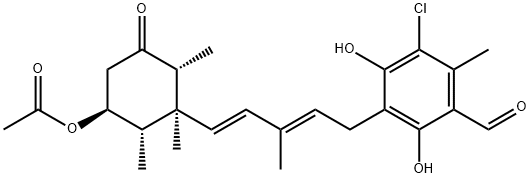
ascochlorin
Synonym(s):5-Chloro-2,4-dihydroxy-6-methyl-3-[(2E,4Z)-3-methyl-5-(1,2,6-trimethyl-3-oxocyclohexyl)penta-2,4-dienyl]benzaldehyde;Antibiotics LL-Z 1272g;Ilicicolin D;NSC 287492
- CAS NO.:26166-39-2
- Empirical Formula: C23H29ClO4
- Molecular Weight: 404.931
- MDL number: MFCD01939947
- SAFETY DATA SHEET (SDS)
- Update Date: 2026-04-21 11:20:27
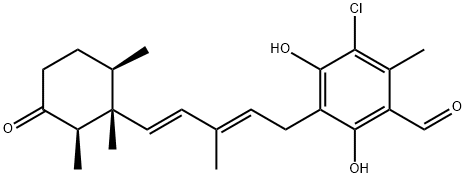
What is ascochlorin?
The Uses of ascochlorin
Ascochlorin is an antitumor fungal metabolite which specifically inhibits matrix metalloproteinase-9 (MMP-9) activity through suppression of activator protein-1 (AP-1)-dependent induction of MMP-9 gene expression. Via AP-1 suppression, ascochlorin selectively kills MX-1 cells, a human breast cancer cell line lacking estrogen receptors. Ascochlorin also shows activity against Newcastle disease and herpes simplex viruses.
The Uses of ascochlorin
Ascochlorin is an isoprenoid antibiotic and antiviral that has diverse effects on mammalian cells. It suppresses PMA-induced invasion in renal carcinoma cells (IC50 = ~10 μM) by inhibiting the expression of matrix metalloproteinase-9. At 2 μM, ascochlorin profoundly increases the expression of p53 by increasing protein stability in cancer cells, and, at 50 μm, it inhibits signaling through STAT3. Ascochlorin also binds and inhibits the mitochondrial cytochrome bc1 complex, blocking reduction of cytochrome b by ubiquinone.[Cayman Chemical]
What are the applications of Application
Ascochlorin is an inhibitor of matrix metalloproteinase-9 activity
Definition
ChEBI: Ascochlorin is a dihydroxybenzaldehyde that is 2,4-dihydroxybenzaldehyde which is substituted by a (1E,3E)-3-methyl-1-[(1R,2R,6R)-1,2,6-trimethyl-3-oxocyclohexyl]penta-1,3-dien-5-yl group at position 3, chlorine at position 5, and a methyl group at position 6. A meroterpenoid produced by several fungi including Ascochyta viciae. It exhibits anticancer, antifungal and antiprotozoal activities. It has a role as an antineoplastic agent, a fungal metabolite, an antifungal agent, an antiprotozoal drug and an angiogenesis inhibitor. It is a dihydroxybenzaldehyde, a member of monochlorobenzenes, an olefinic compound, a member of resorcinols, a meroterpenoid, a sesquiterpenoid and a member of cyclohexanones. It is a conjugate acid of an ascochlorin(1-).
Properties of ascochlorin
| Melting point: | 172-174 °C |
| Boiling point: | 556.9±39.0 °C(Predicted) |
| Density | 1.199±0.06 g/cm3(Predicted) |
| storage temp. | -20°C |
| solubility | DMSO: soluble |
| pka | 6.26±0.50(Predicted) |
| form | A powder |
Safety information for ascochlorin
Computed Descriptors for ascochlorin
New Products
2-(2-Chlorophenyl)glycine Propiolic Acid 1-(3-Hydroxy-4-methoxyphenyl)-2-nitroethene (±)-amino(2-fluorophenyl)acetic acid trans-3-Benzyloxy-4-methoxy-beta-nitrostyrene 1-Pentadecanol 4-(4-Αminophenyl)-3-Morpholinone 3-Morpholino-1-(4-(2-oxopiperidin-1-yl) phenyl)-5,6-dihyropyridin-2-(1H)-one 1-(4-Aminophenyl)-3-morpholino-5,6-dihydropyridin-2(1H)-one N-cyanoacetylurethane 1H-IndazoleRelated products of tetrahydrofuran
You may like
-
 40216-83-9 trans-4-Hydroxy-L-proline methyl ester hydrochloride 98+View Details
40216-83-9 -
471-25-0 Propiolic Acid 98+View Details
471-25-0 -
84145-28-8 98+View Details
84145-28-8 -
trans-3-Benzyloxy-4-methoxy-beta-nitrostyrene 98+View Details
63909-29-5 -
2-(2-Chlorophenyl)glycine 88744-36-9 98+View Details
88744-36-9 -
40216-83-9 trans-4-Hydroxy-L-proline methyl ester hydrochloride 98+View Details
40216-83-9 -
629-76-5 98+View Details
629-76-5 -
1-(3-Hydroxy-4-methoxyphenyl)-2-nitroethene 98+View Details
39816-35-8