
arglabin
- CAS NO.:84692-91-1
- Empirical Formula: C15H18O3
- Molecular Weight: 246.3
- MDL number: MFCD11519463
- SAFETY DATA SHEET (SDS)
- Update Date: 2026-06-03 11:24:09
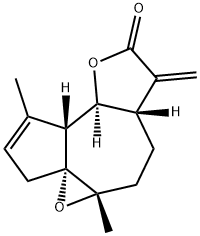
What is arglabin?
Description
Arglabin is a new antineoplastic agent launched in Russia for the treatment of a variety of cancers. It is a sesquiterpene gamma-lactone extracted from Artemisia glabella, a plant from Kazakstan; it was first developed in Kazakstan followed by US and other countries as an ethical pharmaceutical. Arglabin can be obtained by resin extraction from A.glabella, purification by chromatography and finally recrystallization. Arglabin is a potent and selective inhibitor of farnesyl transferase, an enzyme critical to the function of the Ras oncogene in cancer cell reproduction. It showed a strong Inhibitory effect against tumor cells proliferation in in vitro models of transformed mouse hepatocytes and splenocytes. This cytotoxic effect against tumor cells was 50-100 times higher than that on intact cells. In many patients with various cancers, Arglabin was shown to stop or inhibit the tumour development, alone or in combination with other anticancer agents, and was reportedly well tolerated with few sideeffects. Promising response rates were also reported with Arglabin after treating other 《difficult-to-treat cancers》 such as breast, ovarian, lung or colon cancers.
Originator
NuOncology Labs (Kazakstan)
The Uses of arglabin
Arglabin is a sesquiterpene lactone used in the inhibition of glucose induced NF-kB activation and MCP-1/TGF-β1 expression treating diabetic nephropathy. Cytocoxic.
Definition
ChEBI: An organic heterotetracyclic compound and guaianolide sesquiterpene lactone that is acrylic acid which is substituted at position 2 by a 4-hydroxy-3,8-dimethyl-1,3a,4,5,6,7-hexahydroazulen-5-yl group in which the double bond in the 7-membered ring has been epoxidised and in which the hydroxy group and the carboxy group have undergone formal condensation to give the corresponding gamma-lactone. It is found in Artemisia glabella. Arglabin-DMA HCl, the hydrochloride salt of the add ct resulting from the conjugate addition of dimethylamine to the ene-lactone moiety, has been successfully used in Khazakhstan for the treatment of breast, colon, ovarian and lung cancers.
Storage
Room temperature
Properties of arglabin
| Melting point: | 100-102 °C |
| Boiling point: | 404.6±45.0 °C(Predicted) |
| Density | 1.22±0.1 g/cm3(Predicted) |
| storage temp. | Amber Vial, -20°C Freezer, Under inert atmosphere |
| solubility | Chloroform (Slightly) |
| form | Solid |
| color | Off-White |
Safety information for arglabin
Computed Descriptors for arglabin
New Products
Dibenzoyl-L-tartaric acid Anhydrous (Resolution Reagent) 2-Bromo-5-hydroxybenzoic acid. 1-(4-methoxyphenyl)-4-(4-Nitrophenyl)Piperazine (IT-1) Dibenzo[b,f][1,4]thiazepin-11(10H)-one 1-Benzhydrylazetane-3-carbonitrile AMINO-(3-CHLORO-PHENYL)-ACETIC ACID 2-(2-Chlorophenyl)glycine 8-oxa-1,3-diazaspiro[4.5]decane-2,4-dione (±)-amino(2-fluorophenyl)acetic acid 2'-Fluoroacetophenone PHOSPORIC ACID-D3 85 W% IN D2O METHANE-D3-SULFONYL CHLORIDE 3-BROMO PYRIDINE-D4 2-BROMOACETYL BROMIDE-D2 DEUTERIUM OXIDE FOR NMR BENZENE-D6 1-Acetyl-4-(4-hydroxyphenyl)piperazine 1-(3-Chlorophenyl)piperazine hydrochlorideRelated products of tetrahydrofuran

![2-[2-(Methylamino)benzoyl]-3,4-dihydro-β-carboline-1(2H)-one](https://img.chemicalbook.in/CAS/20150408/GIF/526-43-2.gif)
You may like
-
 Arglabin CAS 84692-91-1View Details
84692-91-1 -
7292-71-9 AMINO-(3-CHLORO-PHENYL)-ACETIC ACID 98+View Details
7292-71-9 -
84145-28-8 98+View Details
84145-28-8 -
2-(2-Chlorophenyl)glycine 98+View Details
88744-36-9 -
8-oxa-1,3-diazaspiro[4.5]decane-2,4-dione 39124-19-1 98+View Details
39124-19-1 -
445-27-2 2'-Fluoroacetophenone 98+View Details
445-27-2 -
445-27-2 2'-Fluoroacetophenone 98+View Details
445-27-2 -
445-27-2 2'-Fluoroacetophenone 98+View Details
445-27-2