
ARCC-4
- CAS NO.:1973403-00-7
- Empirical Formula: C53H56F3N7O7S2
- Molecular Weight: 1024.18
- MDL number: MFCD32858266
- Update Date: 2026-05-28 05:54:46
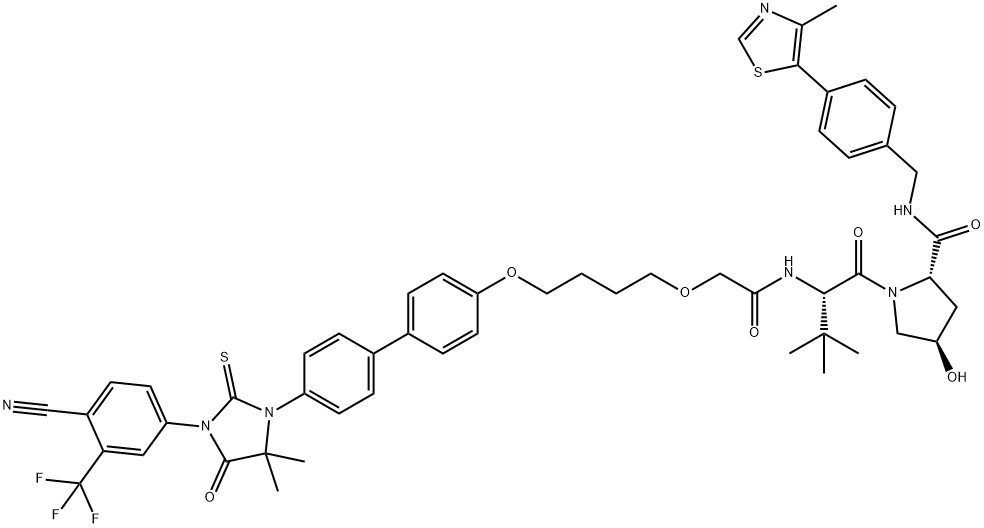
What is ARCC-4?
The Uses of ARCC-4
(4R)??-N-??[2-??[4-??[[4'-??[3-??[4-??Cyano-??3-??(trifluoromethyl)??phenyl]??-??5,??5-??dimethyl-??4-??oxo-??2-??thioxo-??1-??imidazolidinyl]??[1,??1'-??biphenyl]??-??4-??yl]??oxy]??butoxy]??acetyl]??-??3-??methyl-??L-??valyl-??4-??hydroxy-??N-??[[4-??(4-??methyl-??5-??thiazolyl)??phenyl]??methyl]??-??(L)-??prolinamide is required for the targeted degradation of the androgen receptor.
Biological Activity
ARCC-4 is a low-nanomolar androgen receptor (AR) degrader based on PROTAC, with a DC50 of 5 nM. ARCC-4 is an enzalutamide-based von Hippel-Lindau (VHL)-recruiting AR PROTAC and outperforms enzalutamide. ARCC-4 effectively degrades clinically relevant AR mutants associated with antiandrogen therapy[1]. ARCC-4 induces apoptosis and inhibiting proliferation of AR-amplified prostate cancer cells[1].ARCC-4 enhances protein-protein interactions between AR and VHL, thereby promoting the association of the trimeric complex[1].ARCC-4 (0.1-10,000 nM; 20 hours) potently degrades AR with a D50 of 5 nM and Dmax of over 95%[1].ARCC-4 (100 nM; 12 hours) shows near complete AR degradation (>98%) in prostate cancer cells[1]. ARCC-4 selectively degrades AR via the proteasome but not PR-A or PR-B suppression[1].ARCC-4 shows efficacy against clinically relevant AR mutations[1].ARCC-4 maintains activity despite elevated androgen levels[1]. Western Blot Analysis[1] Cell Line: VCaP cells
Storage
Store at -20°C
References
[1]. Salami J, et al. Androgen receptor degradation by the proteolysis-targeting chimera ARCC-4 outperforms enzalutamide in cellular models of prostate cancer drug resistance. Commun Biol. 2018 Aug 2;1:100.
Properties of ARCC-4
| Density | 1.39±0.1 g/cm3(Predicted) |
| storage temp. | Store at -20°C |
| solubility | DMSO: 200 mg/mL (195.28 mM) |
| pka | 13.63±0.46(Predicted) |
| form | Solid |
| color | White to off-white |
| Water Solubility | Water: < 0.1 mg/mL (insoluble) |
Safety information for ARCC-4
Computed Descriptors for ARCC-4
New Products
5-bromo-4-fluoro-2-nitrobenzaldehyde (R)-(-)-2-Amino-1-propanol Cyclobutanone Fmoc-OSu 1-(2-Chloroethyl)pyrrolidine Hydrochloride 2-Amino-2-(4-methylphenyl)acetic acid Obidoxime hydrochloride API Decanoic acid, 2-[4-(phenylmethoxy)phenyl]ethyl ester Piperazine, 1-(3-methoxyphenyl)-, hydrochloride (1:1) 4-Bromo-2,6-difluoroaniline 4 pentyn 1 ol N-Vinylformamide Methacrylate-PEG-Methacrylate, Mn:35000 2,4-Dihydroxyacetophenone 2-Chloro 5-Fluoro Pyridine Vasicinone 2-Chloroisonicotinic Acid Tween 80 or Polysorbate 80 2-Pentyn-1-oL 4-Nitrobenzotrifluoride N-(4-Cyano-3-(trifluoromethyl)phenyl)-2-methyloxirane-2-carboxamide N-(4-fluoro-2-methoxy-5-nitrophenyl)-4-(1-methyl-1H-indol-3-yl)pyrimidin-2-amine Pirtobrutinib intd. 2-Butyn-1-oLRelated products of tetrahydrofuran
![3-Pyridazinecarboxamide, N-[trans-4-(3-chloro-4-cyanophenoxy)cyclohexyl]-6-[4-[[4-[2-(2,6-dioxo-3-piperidinyl)-6-fluoro-2,3-dihydro-1,3-dioxo-1H-isoindol-5-yl]-1-piperazinyl]methyl]-1-piperidinyl]-](https://img.chemicalbook.in/CAS/20210305/GIF/2222112-77-6.gif)
You may like
-
 Fmoc-OSu 98+View Details
82911-69-1 -
(R)-(-)-2-Amino-1-propanol 35320-23-1 98+View Details
35320-23-1 -
7250-67-1 1-(2-Chloroethyl)pyrrolidine Hydrochloride 98+View Details
7250-67-1 -
13227-01-5 98+View Details
13227-01-5 -
7250-67-1 1-(2-Chloroethyl)pyrrolidine Hydrochloride 98+View Details
7250-67-1 -
13227-01-5 98+View Details
13227-01-5 -
7250-67-1 1-(2-Chloroethyl)pyrrolidine Hydrochloride 98+View Details
7250-67-1 -
13227-01-5 98+View Details
13227-01-5