
Amisulbrom
Synonym(s):3-(3-Bromo-6-fluoro-2-methylindol-1-ylsulfonyl)-N,N-dimethyl-1H-1,2,4-triazole-1-sulfonamide
- CAS NO.:348635-87-0
- Empirical Formula: C13H13BrFN5O4S2
- Molecular Weight: 466.31
- MDL number: MFCD11865361
- SAFETY DATA SHEET (SDS)
- Update Date: 2026-08-25 20:17:46
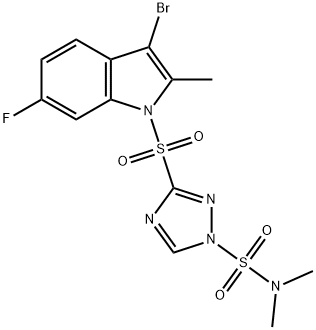
What is Amisulbrom?
The Uses of Amisulbrom
Amisulbrom is a fungicide used in pesticide formulations in the treatment of blight in vegetation.
Definition
ChEBI: A member of the class of bromoindoles that is 3-bromo-6-fluoro-2-methylindole substituted at position 1 by a 1-(dimethylsulfamyl)-1,2,4-triazole-3-sulfonyl group. A fungicide for use on potatoes to control late blight (Phytophthora infestans) nd downy mildew [Plasmopara viticola). It has a low mammalian toxicity but it is considered to be a reproduction toxicant, is moderately toxic to birds and honey bees but poses a greater risk to aquatic species and earthworms.
General Description
Amisulbrom is classified under the triazole group of fungicides. It contains a sulfone functional group with potent bioactivity.
Properties of Amisulbrom
| Melting point: | 128~132℃ |
| Boiling point: | 651.5±65.0 °C(Predicted) |
| Density | 1.85±0.1 g/cm3(Predicted) |
| storage temp. | under inert gas (nitrogen or Argon) at 2-8°C |
| solubility | DMSO (Sparingly), Methanol (Slightly, Sonicated) |
| pka | -5.12±0.50(Predicted) |
| form | neat |
| BRN | 11328670 |
| EPA Substance Registry System | 1H-1,2,4-Triazole-1-sulfonamide, 3-[(3-bromo-6-fluoro-2-methyl-1H-indol-1-yl)sulfonyl]-N,N-dimethyl- (348635-87-0) |
Safety information for Amisulbrom
| Signal word | Warning |
| Pictogram(s) |
 Exclamation Mark Irritant GHS07  Health Hazard GHS08  Environment GHS09 |
| GHS Hazard Statements |
H319:Serious eye damage/eye irritation H351:Carcinogenicity H410:Hazardous to the aquatic environment, long-term hazard |
| Precautionary Statement Codes |
P201:Obtain special instructions before use. P202:Do not handle until all safety precautions have been read and understood. P264:Wash hands thoroughly after handling. P264:Wash skin thouroughly after handling. P273:Avoid release to the environment. P305+P351+P338:IF IN EYES: Rinse cautiously with water for several minutes. Remove contact lenses, if present and easy to do. Continuerinsing. P308+P313:IF exposed or concerned: Get medical advice/attention. |
Computed Descriptors for Amisulbrom
New Products
2-(2-Chlorophenyl)glycine Propiolic Acid 1-(3-Hydroxy-4-methoxyphenyl)-2-nitroethene (±)-amino(2-fluorophenyl)acetic acid trans-3-Benzyloxy-4-methoxy-beta-nitrostyrene 1-Pentadecanol 2,4-Dihydroxybenzaldehyde Dipropyl disulfide Pyrrolo[1,2-a]pyrimidine-6-carboxylic acid, 4,6,7,8-tetrahydro-4-oxo-, sodium salt (1:1), (6S) Obidoxime hydrochloride API 4 pentyn 1 ol N-Vinylformamide Methacrylate-PEG-Methacrylate, Mn:35000 2,4-Dihydroxyacetophenone 2-Chloro 5-Fluoro Pyridine Vasicinone 2-Chloroisonicotinic Acid Tween 80 or Polysorbate 80 2-Butyn-1-oL N-(4-Cyano-3-(trifluoromethyl)phenyl)-2-methyloxirane-2-carboxamide N-(4-fluoro-2-methoxy-5-nitrophenyl)-4-(1-methyl-1H-indol-3-yl)pyrimidin-2-amine Pirtobrutinib intd. 2-Pentyn-1-oL 4-NitrobenzotrifluorideYou may like
-
 Amisulbrom 95% CAS 348635-87-0View Details
348635-87-0 -
Amisulbrom CAS 348635-87-0View Details
348635-87-0 -
471-25-0 Propiolic Acid 98+View Details
471-25-0 -
84145-28-8 98+View Details
84145-28-8 -
trans-3-Benzyloxy-4-methoxy-beta-nitrostyrene 98+View Details
63909-29-5 -
2-(2-Chlorophenyl)glycine 88744-36-9 98+View Details
88744-36-9 -
40216-83-9 trans-4-Hydroxy-L-proline methyl ester hydrochloride 98+View Details
40216-83-9 -
1-(3-Hydroxy-4-methoxyphenyl)-2-nitroethene 98+View Details
39816-35-8
Statement: All products displayed on this website are only used for non medical purposes such as industrial applications or scientific research, and cannot be used for clinical diagnosis or treatment of humans or animals. They are not medicinal or edible.