
Alclometasone Dipropionate
- CAS NO.:66734-13-2
- Empirical Formula: C28H37ClO7
- Molecular Weight: 521.04
- MDL number: MFCD00865997
- EINECS: 2664643
- SAFETY DATA SHEET (SDS)
- Update Date: 2026-07-15 20:54:36
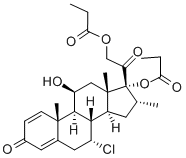
What is Alclometasone Dipropionate?
Description
Alclometasone dipropionate (ACM) is a synthetic nonfluorinated corticosteroid which has been marketed since 1986 for the topical treatment of inflammatory and pruritic corticosteroid-responsive dermatoses. As esterification of the hydroxyl group at positions 17 and 21 of the alclometasone molecule enhances topical anti-inflammatory activity, the dipropionate salt of alclometasone is much more potent than alclometasone itself. It reduces cutaneous anaphylaxis reactions induced by tuberculin or albumin in mice when administered topically (20 μl of a 0.1% solution). ACM also inhibits androgen-dependent cytochrome P450 activity and the O-depropylation activity of 7-alkoxy-coumarin O-dealkylase in a dose-dependent manner in male rats but has no effect on hepatic drug metabolism in female rats or mice of both sexes. Formulations containing ACM have been used to treat radiation, allergic contact dermatitis and psoriasis.
Chemical properties
Alclometasone dipropionate is a white powder, insoluble in water, slightly soluble in propylene glycol and moderately soluble in hexylene glycol. Crystallization from acetone-methanol-isopropyl ether.
Originator
Schering (USA)
Characteristics
The alclometasone dipropionate [7α-chloro-11β,17,21- trihydroxy-16α-methylpregna-1,4-dien-3,20-dione 17,21- dipropionate) molecule is obtained by insertion of a chlorine atom in position 7α of 16α-me thylprensoline 17,21-dipropionate. The unique properties of the compound result from the presence of a chlorine atom in position 7α instead of positions C6 or C9, which increases the potency of its effect without increasing the incidence of local and systemic adverse effects. Additionally, as a highly lipophilic compound, alclometasone dipropionate rapidly penetrates into the skin where its active metabolites bind to specific receptors.
The Uses of Alclometasone Dipropionate
Alclometasone dipropionate is a corticosteroid used topically for its glucocorticoid activity in the treatment of various skin disorders. It is usually used as a cream or ointment containing 0.05%. It is topically used in dermatology as an anti-inflammatory, antipruritic, antiallergic, antiproliferative and vasoconstrictive agent. Alclometasone dipropionate has been used since 1986 for the treatment of corticosteroid-responsive dermatoses. It is ranked in Group 6 based on potency and has been dassified as group D. According to the A-D grouping, patch-test reactions occur six to seven times more frequently within well-defined groups of structurally related chemicals than between corticosteroids of different groups.
Definition
ChEBI: Alclometasone dipropionate is a prednisolone compound having an alpha-chloro substituent at the 7-position, an alpha-methyl substituent at the 16-position and O-propanoyl groups at the 17- and 21-positions. It has a role as an anti-inflammatory drug. It is a 20-oxo steroid, an 11beta-hydroxy steroid, a glucocorticoid, a steroid ester, a propanoate ester, a 3-oxo-Delta(1),Delta(4)-steroid and a chlorinated steroid. It is functionally related to a prednisolone.
Preparation
Alclometasone dipropionate synthesis: The dehydrogenation of 16alpha-methyl-11beta,17alpha,21-trihydroxypregna-1,4-diene-3,20-dione-21-acetate (I) with dichlorodicyanobenzoquinone (II) in dioxane HCl gives 16alpha-methyl-11beta,17alpha,21-trihydroxypregna-1,4,6-triene-3,20-dione-21-acetate (III), which is hydrolyzed with aqueous NaHCO3 to the corresponding free triol (IV). The reaction of (IV) with triethyl orthopropionate (A) by means of p-toluenesulfonic acid in DMSO yields 16alpha-methyl-11beta,17alpha,21-trihydroxypregna-1,4,6-triene-3,20-dione-17,21-ethylorthopropionate (V), which is hydrolyzed partially with acetic acid to 16alpha-methyl-11beta,17alpha,21-trihydroxypregna-1,4,6-triene-3,20-dione-17-propionate (VI). The acylation of (VI) with propionic anhydride affords 16alpha-methyl-11beta,17alpha,21-trihydroxypregna-1,4,6-triene-3,20-dione-17,21-dipropionate (VII), which is finally treated with dry HCl in dioxane.
brand name
Aclovate (GlaxoSmithKline), Aclosone, Legederm, Almeta, Vaderm, Modrasone, Delonal.
Therapeutic Function
Antiinflammatory, Antiallergic
Side Effects
The following local adverse reactions have been reported with alclometasone dipropionate cream in approximately 2% of patients: itching and burning, erythema, dryness, irritation, and papular rashes.
The following local adverse reactions have been reported with alclometasone dipropionate ointment in approximately 1% of patients: itching, burning, and erythema. The following additional local adverse reactions have been reported infrequently with topical corticosteroids, but may occur more frequently with the use of occlusive dressings. These reactions are listed in approximate decreasing order of occurrence: folliculitis, acneiform eruptions, hypopigmentation, perioral dermatitis, allergic contact dermatitis, secondary infection, skin atrophy, striae, and miliaria.
Safety Profile
Alclometasone dipropionate has been classified as the FDA category C of drug safety during pregnancy (irrespective of the trimester of pregnancy), which means that it should be used during pregnancy only if the potential benefit to the mother justifies the potential risk to the foetus. The safety of alclometasone use in paediatric patients below 1 year of age has not been established and there are no adequate, randomised studies in large patient groups.
Mode of action
At the cellular level, alclometasone dipropionate, like other glucocorticoids, after crossing the cell membrane binds to specific glucocorticoid receptors (GCR) in the cytoplasm. Subsequently, the glucocorticoid-GCR complex moves into the nucleus, where its binds to DNA at specific regions, known as the glucocorticoid response elements (GRE). At further stages, the expression of certain genes is either stimulated (transactivation) or inhibited (transuppression). In clinical practice, glucocorticoids are used for their anti-inflammatory, immunosuppressant and antiproliferative effects.
Properties of Alclometasone Dipropionate
| Melting point: | 212-216° |
| Boiling point: | 613.3°C (rough estimate) |
| alpha | D26 +42.6° (c = 0.3 in DMF) |
| Density | 1.0766 (rough estimate) |
| refractive index | 1.4429 (estimate) |
| storage temp. | Hygroscopic, -20°C Freezer, Under inert atmosphere |
| solubility | Chloroform (Slightly), DMF (Slightly), Methanol (Slightly) |
| pka | 13.70±0.70(Predicted) |
| form | Solid |
| color | White to Off-White |
| Stability: | Hygroscopic |
Safety information for Alclometasone Dipropionate
Computed Descriptors for Alclometasone Dipropionate
New Products
2-Amino-5-bromo- benzoic acid Dibenzoyl-L-tartaric acid Anhydrous (Resolution Reagent) 1,2,3,9-Tetrahydro-9-Methyl-4H-Carbazole-4-One Cis-Tosylate Dibenzo[b,f][1,4]thiazepin-11(10H)-one BOC Piperazine N-Methyl-2-amino-2-methylpropionamide 4-(FMOC-AMINO)-TETRAHYDROPYRAN-4-CARBOXYLIC ACID 1-Aminocyclobutanecarboxylic Acid Hydrochloride 3-Oxocyclobutanecarboxylic acid AMINO(2-BROMOPHENYL)ACETIC ACID 6-BROMOTETRAZOLO[1,5-A]PYRIDINE 4-Amino-2-chloro-6,7-dimethoxyquinazoline 2,3-Dimethoxypyridine 2,6-bis(bromomethyl)pyridine tert-Butyl 4-mercaptopiperidine-1-carboxylate 4'-(Methylmercapto)-acetophrnonone 1-Benzhydrylazetidin-3-ol-Hcl 1-(3-Chlorophenyl)piperazine hydrochloride Enzyme Breaker for Coal Bed Methane Slickwaterr Gas Well Guar Gum Enzyme Breaker Enzyme Breaker for Conventional Slickwater Fracturing Conventional Fracturing Guar Gum Enzyme Breaker Coalbed Methane Guar Gum Enzyme BreakerRelated products of tetrahydrofuran

You may like
-
 Alclometasone dipropionate CAS 66734-13-2View Details
66734-13-2 -
254762-66-8 AMINO(2-BROMOPHENYL)ACETIC ACID 98+View Details
254762-66-8 -
23716-23-1 98+View Details
23716-23-1 -
6-BROMOTETRAZOLO[1,5-A]PYRIDINE 98+View Details
5799-75-7 -
254762-66-8 AMINO(2-BROMOPHENYL)ACETIC ACID 98+View Details
254762-66-8 -
23716-23-1 98+View Details
23716-23-1 -
6-BROMOTETRAZOLO[1,5-A]PYRIDINE 98+View Details
5799-75-7 -
1778-09-2 4'-(Methylmercapto)-acetophrnonone 98%View Details
1778-09-2