
ACONINE
- CAS NO.:509-20-6
- Empirical Formula: C25H41NO9
- Molecular Weight: 499.6
- MDL number: MFCD01673464
- SAFETY DATA SHEET (SDS)
- Update Date: 2026-04-24 14:58:37
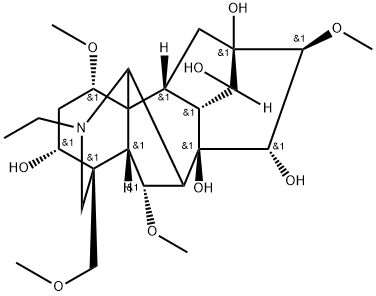
What is ACONINE?
Description
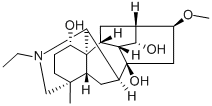
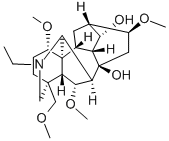
Aconine is an alkaloid originally isolated from Aconitum species and active metabolite of aconitine. It inhibits osteoclast differentiation of RANKL-stimulated RAW 264.7 cells and bone resorption in a pit formation assay in a concentration-dependent manner. Aconine also inhibits RANKL-induced activation of NF-κB and NFATc1 in RAW 264.7 cells. In vivo, aconine is toxic to mice when administered intravenously at a dose of 120 mg/kg. It induces flaccid paralysis and toxicity in rats with toxic dose (TD50) and LD50 values of 1.5 and 1.7 μmol per animal, respectively.
The Uses of ACONINE
Aconine is a derivative of Aconitine (A189875), a neurotoxin which activates tetrodotoxin-sensitive Na+ channels, inducing presynaptic depolarization, thus blocking the nerve action potential which, in turn, blocks the release of neurotransmitters and decreases the end plate potential at the neuromuscular junction.
Definition
ChEBI: Aconine is a diterpene alkaloid with formula C25H41NO9 that is isolated from several Aconitum species. It has a role as a plant metabolite, a human urinary metabolite, a NF-kappaB inhibitor and a xenobiotic. It is a bridged compound, a diterpene alkaloid, an organic heteropolycyclic compound, a polyether, a tertiary amino compound, a pentol, a secondary alcohol and a tertiary alcohol. It derives from a hydride of an aconitane.
Properties of ACONINE
| Melting point: | 129-131℃ |
| Boiling point: | 590.79°C (rough estimate) |
| alpha | D +23° |
| Density | 1.42 |
| refractive index | 1.6000 (estimate) |
| storage temp. | -20°C Freezer |
| solubility | Chloroform (Slightly), DMSO (Slightly) |
| form | Solid |
| pka | 9.52(at 25℃) |
| color | Off-White to Pale Yellow |
Safety information for ACONINE
Computed Descriptors for ACONINE
New Products
2-Amino-5-bromo-4-(trifluoromethyl)pyridine Sulfapyridine Fmoc-OSu (R)-(-)-2-Amino-1-propanol Cyclobutanone 5-bromo-4-fluoro-2-nitrobenzaldehyde β-Bromostyrene Ethyl 3-phenylpropanoate Phenethyl cinnamate Dipropyl disulfide N-Vinylformamide 4 pentyn 1 ol Methacrylate-PEG-Methacrylate, Mn:35000 2,4-Dihydroxyacetophenone 2-Chloro 5-Fluoro Pyridine Vasicinone 2-Chloroisonicotinic Acid Tween 80 or Polysorbate 80 2-Butyn-1-oL 2-Pentyn-1-oL 4-Nitrobenzotrifluoride N-(4-fluoro-2-methoxy-5-nitrophenyl)-4-(1-methyl-1H-indol-3-yl)pyrimidin-2-amine Pirtobrutinib intd. N-(4-Cyano-3-(trifluoromethyl)phenyl)-2-methyloxirane-2-carboxamideRelated products of tetrahydrofuran
You may like
-
 1191-95-3 Cyclobutanone 98+View Details
1191-95-3 -
213382-45-7 98+View Details
213382-45-7 -
Fmoc-OSu 98+View Details
82911-69-1 -
(R)-(-)-2-Amino-1-propanol 35320-23-1 98+View Details
35320-23-1 -
1191-95-3 Cyclobutanone 98+View Details
1191-95-3 -
213382-45-7 98+View Details
213382-45-7 -
Fmoc-OSu 98+View Details
82911-69-1 -
(R)-(-)-2-Amino-1-propanol 35320-23-1 98+View Details
35320-23-1