
ACETYL IODIDE
- CAS NO.:507-02-8
- Empirical Formula: C2H3IO
- Molecular Weight: 169.95
- MDL number: MFCD00039399
- EINECS: 208-062-2
- SAFETY DATA SHEET (SDS)
- Update Date: 2026-05-28 04:27:05
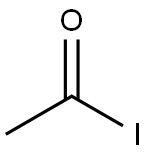
What is ACETYL IODIDE?
Description
Acetyl iodide is a colourless, fuming liquid with a pungent odour. It is soluble in benzene and ether. Acetyl iodide is toxic, corrosive, and reacts with water or steam to produce toxic and corrosive fumes. The vapours of acetyl iodide are irritating to the eyes and mucous membranes. Vapour causes pulmonary oedema. It is corrosive to metals and skin. Acetyl iodide turns brown on exposure to air as it reacts exothermically with moisture in the air to give hydrogen iodide (hydroiodic acid), a strong irritant. It decomposes in water to give acidic products. Inhalation, ingestion, or contact of the skin and the eyes with vapours, dusts, or substance may cause severe injury, burns, or death. Contact with molten form of acetyl iodide causes severe burns to skin and eyes. Reaction with water or moist air will release toxic, corrosive, or flammable gases. Reaction with water may generate much heat that will increase the concentration of fumes in the air. Fire will produce irritating, corrosive, and/ or toxic gases. Run-off from fire control or dilution water may be corrosive and/or toxic and cause pollution.
What are the applications of Application
Acetyl Iodide is an ether used in organic synthesis
General Description
A colorless, fuming liquid with a pungent odor. Soluble in benzene and ether (Merck 11th ed., 1989). Vapors are irritating to the eyes and mucous membranes. Vapor causes pulmonary edema. Corrosive to metals and skin.
Air & Water Reactions
Turns brown on exposure to air as ACETYL IODIDE reacts exothermically with moisture in the air to give hydrogen Iodide (hydroiodic acid), a strong irritant. Decomposes in water to give acidic products.
Reactivity Profile
ACETYL IODIDE decomposes exothermically in water or alcohol. Reacts vigorously and exothermically with bases. May react vigorously or explosively if mixed with diisopropyl ether or other ethers in the presence of trace amounts of metal salts [J. Haz. Mat., 1981, 4, 291].
Health Hazard
TOXIC; inhalation, ingestion or contact (skin, eyes) with vapors, dusts or substance may cause severe injury, burns or death. Contact with molten substance may cause severe burns to skin and eyes. Reaction with water or moist air will release toxic, corrosive or flammable gases. Reaction with water may generate much heat that will increase the concentration of fumes in the air. Fire will produce irritating, corrosive and/or toxic gases. Runoff from fire control or dilution water may be corrosive and/or toxic and cause pollution.
Fire Hazard
Combustible material: may burn but does not ignite readily. Substance will react with water (some violently) releasing flammable, toxic or corrosive gases and runoff. When heated, vapors may form explosive mixtures with air: indoors, outdoors and sewers explosion hazards. Most vapors are heavier than air. They will spread along ground and collect in low or confined areas (sewers, basements, tanks). Vapors may travel to source of ignition and flash back. Contact with metals may evolve flammable hydrogen gas. Containers may explode when heated or if contaminated with water.
Safety Profile
A toxic, corrosive material. Reacts with water or steam to produce toxic and corrosive fumes. Dangerous to use. When heated to decomposition it emits toxic fumes of I-. See also IODIDES.
Purification Methods
Purify it by fractional distillation. [Beilstein 2 H 174, 2 I 80, 2 II 177, 2 III 393, 2 IV 399.] TOXIC and LACHRYMATORY.
Properties of ACETYL IODIDE
| Boiling point: | 108°C |
| Density | d420 2.0674 |
| refractive index | nD20 1.5491 |
| form | clear liquid to cloudy liquid |
| color | Red to Dark red to Brown |
| Merck | 14,94 |
| CAS DataBase Reference | 507-02-8(CAS DataBase Reference) |
| EPA Substance Registry System | Acetyl iodide (507-02-8) |
Safety information for ACETYL IODIDE
| Signal word | Danger |
| Pictogram(s) |
 Flame Flammables GHS02  Corrosion Corrosives GHS05 |
| GHS Hazard Statements |
H225:Flammable liquids H290:Corrosive to Metals H314:Skin corrosion/irritation |
| Precautionary Statement Codes |
P210:Keep away from heat/sparks/open flames/hot surfaces. — No smoking. P233:Keep container tightly closed. P234:Keep only in original container. P240:Ground/bond container and receiving equipment. P260:Do not breathe dust/fume/gas/mist/vapours/spray. P264:Wash hands thoroughly after handling. P264:Wash skin thouroughly after handling. P280:Wear protective gloves/protective clothing/eye protection/face protection. P390:Absorb spillage to prevent material damage. P405:Store locked up. P406:Store in corrosive resistant/… container with a resistant inner liner. P403+P235:Store in a well-ventilated place. Keep cool. P501:Dispose of contents/container to..… |
Computed Descriptors for ACETYL IODIDE
New Products
Dibenzoyl-L-tartaric acid Anhydrous (Resolution Reagent) Cis-Tosylate Dibenzo[b,f][1,4]thiazepin-11(10H)-one 1,2,3,9-Tetrahydro-9-Methyl-4H-Carbazole-4-One 1-(4-methoxyphenyl)-4-(4-Nitrophenyl)Piperazine (IT-1) BOC Piperazine 1-Benzhydrylazetane-3-carbonitrile 8-oxa-1,3-diazaspiro[4.5]decane-2,4-dione (±)-amino(2-fluorophenyl)acetic acid 2-(2-Chlorophenyl)glycine AMINO-(3-CHLORO-PHENYL)-ACETIC ACID 2'-Fluoroacetophenone METHANOL-D1(OD) TERTIARY BUTANOL-D9 N-ETHYL-D5-AMINE HYDROCHLORIDE BENZOIC ACID-D CHLOROFORM-D TOLUENE-D3 Trans,trans muconic acid HC Blue-16 4-Amino-2-chloro-6,7-dimethoxyquinazoline Ethyl 4,5-bis(2-methoxyethoxy)-2-nitrobenzoate 2,3-Dimethoxypyridine 1-(3-Chlorophenyl)piperazine hydrochlorideRelated products of tetrahydrofuran



You may like
-
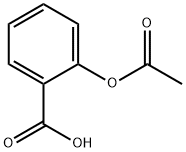
 Acetyl Iodide CAS 507-02-8View Details
507-02-8 -
 Product IntroductionView Details
 -
 Product InrtroductionView Details
 -
 DGO24View Details
 -
 DGO25View Details
 -
 DGO29View Details
 -
 DGO32View Details
 -
 DGO36View Details