
6-Nitroindoline
Synonym(s):6-Nitro-2,3-dihydroindole;NSC 80658
- CAS NO.:19727-83-4
- Empirical Formula: C8H8N2O2
- Molecular Weight: 164.16
- MDL number: MFCD00005710
- EINECS: 243-257-6
- SAFETY DATA SHEET (SDS)
- Update Date: 2026-05-28 00:05:55
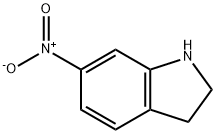
What is 6-Nitroindoline?
Chemical properties
orange crystalline powder or red crystals
The Uses of 6-Nitroindoline
• ;Reactant for preparation of 2-[(2,3-Dihydro-1H-indol-1-yl)methyl]melatonin analogs as novel MT2-selective melatonin receptor antagonists1• ;Reactant for synthesis of isoindigo and azaisoindigo glycosides as anticancer agents2• ;Reactant for preparation of arylfurancarboxamides with Nav1.8 voltage-gated Na channel blocking/analgesic activities3• ;Reactant for preparation of bicyclic benzamides as 5-HT1 receptor agonists4• ;Reactant for preparation of antiarrhythmic benzopyrans5• ;Reactant for preparation of 5-HT2C/2B receptor antagonists6
The Uses of 6-Nitroindoline
- Reactant for preparation of 2-[(2,3-Dihydro-1H-indol-1-yl)methyl]melatonin analogs as novel MT2-selective melatonin receptor antagonists
- Reactant for synthesis of isoindigo and azaisoindigo glycosides as anticancer agents
- Reactant for preparation of arylfurancarboxamides with Nav1.8 voltage-gated Na channel blocking/analgesic activities
- Reactant for preparation of bicyclic benzamides as 5-HT1 receptor agonists
- Reactant for preparation of antiarrhythmic benzopyrans
- Reactant for preparation of 5-HT2C/2B receptor antagonists
Properties of 6-Nitroindoline
| Melting point: | 67-69 °C (lit.) |
| Boiling point: | 291.62°C (rough estimate) |
| Density | 1.2739 (rough estimate) |
| refractive index | 1.6000 (estimate) |
| storage temp. | under inert gas (nitrogen or Argon) at 2–8 °C |
| pka | 3.39±0.20(Predicted) |
| form | Crystalline Powder or Crystals |
| color | Orange or red |
| BRN | 156434 |
| CAS DataBase Reference | 19727-83-4(CAS DataBase Reference) |
Safety information for 6-Nitroindoline
| Signal word | Warning |
| Pictogram(s) |
 Exclamation Mark Irritant GHS07 |
| GHS Hazard Statements |
H315:Skin corrosion/irritation H319:Serious eye damage/eye irritation H335:Specific target organ toxicity, single exposure;Respiratory tract irritation |
| Precautionary Statement Codes |
P261:Avoid breathing dust/fume/gas/mist/vapours/spray. P264:Wash hands thoroughly after handling. P264:Wash skin thouroughly after handling. P271:Use only outdoors or in a well-ventilated area. P280:Wear protective gloves/protective clothing/eye protection/face protection. P302+P352:IF ON SKIN: wash with plenty of soap and water. P305+P351+P338:IF IN EYES: Rinse cautiously with water for several minutes. Remove contact lenses, if present and easy to do. Continuerinsing. |
Computed Descriptors for 6-Nitroindoline
New Products
N-Carbethoxy-4-piperidone 1-Aminocyclopentane carbonitrile Tetrabutylammonium perchlorate N,O-Dimethylhydroxylamine hydrochloride (RS)-beta-Amino-beta-(4-bromophenyl)propionic acid 2-Amino-5-bromo-4-(trifluoromethyl)pyridine N-Vinylformamide 4 pentyn 1 ol Phenethyl cinnamate Dipropyl disulfide Ethyl 3-phenylpropanoate β-Bromostyrene Methacrylate-PEG-Methacrylate, Mn:35000 2,4-Dihydroxyacetophenone 2-Chloro 5-Fluoro Pyridine Vasicinone 2-Chloroisonicotinic Acid Tween 80 or Polysorbate 80 5-Bromo-1-Pentyne 1-(2-Methyl-5-nitrophenyl)guanidine Nitrate Methyl trans-4-Aminocyclohexanecarboxylate Hydrochloride N-(4-Cyano-3-(trifluoromethyl)phenyl)-2-methyloxirane-2-carboxamide 2-Pentyn-1-oL 4-NitrobenzotrifluorideRelated products of tetrahydrofuran


You may like
-
 6-Nitroindoline, 98% CAS 19727-83-4View Details
19727-83-4 -
6-Nitroindoline CAS 19727-83-4View Details
19727-83-4 -
144-83-2 Sulfapyridine 98+View Details
144-83-2 -
29976-53-2 98+View Details
29976-53-2 -
6638-79-5 N,O-Dimethylhydroxylamine hydrochloride 98+View Details
6638-79-5 -
674783-97-2 98+View Details
674783-97-2 -
1-Aminocyclopentane carbonitrile 98+View Details
49830-37-7 -
Tetrabutylammonium perchlorate 1923-70-2 98+View Details
1923-70-2
Statement: All products displayed on this website are only used for non medical purposes such as industrial applications or scientific research, and cannot be used for clinical diagnosis or treatment of humans or animals. They are not medicinal or edible.