
5,5-Dimethyl-2-(2,3,4,9-tetrahydro-3,3-dimethyl-1OXO-1H-xanthen-9-yl)-1,3-cyclohexanedione
Synonym(s):5,5-Dimethyl-2-(2,3,4,9-tetrahydro--3,3-dimethyl-1oxo-1H-xanthen-9-yl)-1,3-cyclohexane-dione;5,5-Mmethyl-2-(2,3,4,9-tetrahydro-3,3-dimethyl-1-oxo-1H-xanthen-9-yl)-1,3 cyclohexanedione;9-(4,4-Dimethyl-2,6-dioxocyclohexyl)-1,2,3,4-tetrahydro-3,3-dimethyl-1-xanthenone;L152804;L-152804
- CAS NO.:6508-43-6
- Empirical Formula: C23H26O4
- Molecular Weight: 366.45
- MDL number: MFCD00184132
- SAFETY DATA SHEET (SDS)
- Update Date: 2026-09-12 18:55:56
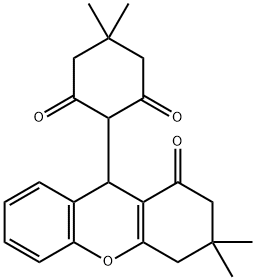
What is 5,5-Dimethyl-2-(2,3,4,9-tetrahydro-3,3-dimethyl-1OXO-1H-xanthen-9-yl)-1,3-cyclohexanedione?
The Uses of 5,5-Dimethyl-2-(2,3,4,9-tetrahydro-3,3-dimethyl-1OXO-1H-xanthen-9-yl)-1,3-cyclohexanedione
L-152,804 is a potent and orally available Y5 antagonist, which is the receptor postulated to be responsible for hypothalamic "feeding".
What are the applications of Application
L-152,804 is a potent, selective non-peptide NPY5-R receptor antagonist
Definition
ChEBI: 2-(3,3-dimethyl-1-oxo-4,9-dihydro-2H-xanthen-9-yl)-5,5-dimethylcyclohexane-1,3-dione is a member of xanthenes.
Biological Activity
Potent, selective non-peptide neuropeptide Y Y 5 receptor antagonist (K i = 26 nM for hY 5 ). Displays > 300-fold selectivity over hY 1 , hY 2 , and hY 4 receptors. Causes weight loss in diet-induced obese mice by modulating food intake and energy expenditure. Centrally active upon oral administration in vivo .
Storage
Desiccate at +4°C
Properties of 5,5-Dimethyl-2-(2,3,4,9-tetrahydro-3,3-dimethyl-1OXO-1H-xanthen-9-yl)-1,3-cyclohexanedione
| Melting point: | 207-208 °C |
| Boiling point: | 513.7±50.0 °C(Predicted) |
| Density | 1.20±0.1 g/cm3(Predicted) |
| storage temp. | Desiccate at +4°C |
| solubility | DMSO: soluble5mg/mL, clear (warmed) |
| form | powder |
| pka | 4.86±0.42(Predicted) |
| color | white to beige |
Safety information for 5,5-Dimethyl-2-(2,3,4,9-tetrahydro-3,3-dimethyl-1OXO-1H-xanthen-9-yl)-1,3-cyclohexanedione
| Signal word | Danger |
| Pictogram(s) |
 Skull and Crossbones Acute Toxicity GHS06  Environment GHS09 |
| GHS Hazard Statements |
H301:Acute toxicity,oral H410:Hazardous to the aquatic environment, long-term hazard |
| Precautionary Statement Codes |
P273:Avoid release to the environment. P301+P310:IF SWALLOWED: Immediately call a POISON CENTER or doctor/physician. P501:Dispose of contents/container to..… |
Computed Descriptors for 5,5-Dimethyl-2-(2,3,4,9-tetrahydro-3,3-dimethyl-1OXO-1H-xanthen-9-yl)-1,3-cyclohexanedione
New Products
5-bromo-4-fluoro-2-nitrobenzaldehyde Cyclobutanone (R)-(-)-2-Amino-1-propanol Fmoc-OSu 1-(2-Chloroethyl)pyrrolidine Hydrochloride 2-Amino-2-(4-methylphenyl)acetic acid 2,4-Dihydroxybenzaldehyde Obidoxime hydrochloride API Pyrrolo[1,2-a]pyrimidine-6-carboxylic acid, 4,6,7,8-tetrahydro-4-oxo-, sodium salt (1:1), (6S) Dipropyl disulfide 4 pentyn 1 ol N-Vinylformamide Methacrylate-PEG-Methacrylate, Mn:35000 2,4-Dihydroxyacetophenone 2-Chloro 5-Fluoro Pyridine Vasicinone 2-Chloroisonicotinic Acid Tween 80 or Polysorbate 80 2-Butyn-1-oL 2-Pentyn-1-oL 4-Nitrobenzotrifluoride N-(4-Cyano-3-(trifluoromethyl)phenyl)-2-methyloxirane-2-carboxamide N-(4-fluoro-2-methoxy-5-nitrophenyl)-4-(1-methyl-1H-indol-3-yl)pyrimidin-2-amine Pirtobrutinib intd.Related products of tetrahydrofuran
You may like
-
 7250-67-1 1-(2-Chloroethyl)pyrrolidine Hydrochloride 98+View Details
7250-67-1 -
7250-67-1 1-(2-Chloroethyl)pyrrolidine Hydrochloride 98+View Details
7250-67-1 -
13227-01-5 98+View Details
13227-01-5 -
545445-44-1 3-Morpholino-1-(4-(2-oxopiperidin-1-yl) phenyl)-5,6-dihyropyridin-2-(1H)-one 98%View Details
545445-44-1 -
6629-04-5 98%View Details
6629-04-5 -
4-(4-Αminophenyl)-3-Morpholinone 98%View Details
438056-69-0 -
1-(4-Aminophenyl)-3-morpholino-5,6-dihydropyridin-2(1H)-one 1267610-26-3 98%View Details
1267610-26-3 -
 1H-Indazole | CAS No. 271-44-3 | Pharmaceutical IntermediateView Details
271-44-3
Statement: All products displayed on this website are only used for non medical purposes such as industrial applications or scientific research, and cannot be used for clinical diagnosis or treatment of humans or animals. They are not medicinal or edible.