
5-CARBOXYFLUORESCEIN DIACETATE
Synonym(s):5-Carboxy-di-O-acetylfluorescein;5-Carboxyfluorescein Diacetate - CAS 79955-27-4 - Calbiochem;5-CFDA
- CAS NO.:79955-27-4
- Empirical Formula: C25H16O9
- Molecular Weight: 460.39
- MDL number: MFCD00036872
- SAFETY DATA SHEET (SDS)
- Update Date: 2026-07-16 07:06:08
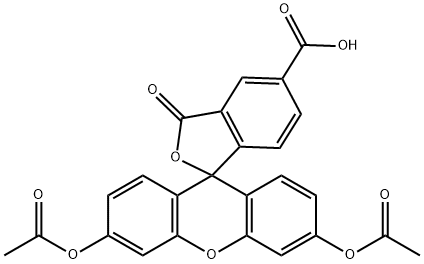
What is 5-CARBOXYFLUORESCEIN DIACETATE?
The Uses of 5-CARBOXYFLUORESCEIN DIACETATE
5-Carboxyfluorescein diacetate is used in the synthesis of Rhodamines.
The Uses of 5-CARBOXYFLUORESCEIN DIACETATE
Carboxyfluorescein diacetate (CFDA), which was originally used to measure intracellular pH but was soon adapted for use as a cell viability indicator. Upon hydrolysis by intracellular nonspecific esterases, CFDA forms carboxyfluorescein.
The Uses of 5-CARBOXYFLUORESCEIN DIACETATE
5-Carboxyfluorescein Diacetate is used in the synthesis of Rhodamines. Dyes and metabolites.
What are the applications of Application
5-Carboxyfluorescein Diacetate is a non-fluorescent, hydrophobic agent that permeates intact cell membranes
Properties of 5-CARBOXYFLUORESCEIN DIACETATE
| Melting point: | >250°C |
| Boiling point: | 693.1±55.0 °C(Predicted) |
| Density | 1.57±0.1 g/cm3(Predicted) |
| storage temp. | Sealed in dry,Store in freezer, under -20°C |
| solubility | DMSO: soluble |
| form | Solid |
| pka | 6.4(at 25℃) |
| color | Colorless solid |
| PH Range | Weak green ' uorescence (6.0) to strong green ' uourescence (7.2) |
| λmax | <300nm |
| BRN | 68265 |
| Major Application | Sensors, method for measuring bacteria, detecting intracellular pH inyeast, determination of extracellular and intracellular pH of microorganisms, detecting living cells, identification of cancerous cells, method for assessing microorganism viability, proliferative activities in tumor tissues, measuring the growth of keratinocytes, agent, neurodegenerative disorders, antineoplastic drugs |
| Biological Applications | Analyzing intracellular glutathione levels in cells; assessing gap junctional intercellular communication in cells; characterizing antifungal activity of micafungin, caspofungin; counting/detecting/evaluating microorganisms; detecting cells; detecting/measuring intracellular pH in yeast; determining extracellular/intracellular pH in bacteria under CO2 treatment; evaluating/measuring keratinocytes growth rate; identifying cancerous cells measuring gas (carbon dioxide or ammonia) concentration in body fluids; screening xenobiotic phloem mobility in plants; studying low-density lipoprotein (LDL)/cholesterol metabolism; as a substrate for measuring esterase activity |
Safety information for 5-CARBOXYFLUORESCEIN DIACETATE
Computed Descriptors for 5-CARBOXYFLUORESCEIN DIACETATE
New Products
9-Mesityl-10-methylacridinium perchlorate Sulfapyridine Fmoc-OSu (R)-(-)-2-Amino-1-propanol Cyclobutanone 5-bromo-4-fluoro-2-nitrobenzaldehyde 4 pentyn 1 ol N-Vinylformamide Phenethyl cinnamate Pyrrolo[1,2-a]pyrimidine-6-carboxylic acid, 4,6,7,8-tetrahydro-4-oxo-, sodium salt (1:1), (6S) Ethyl 3-phenylpropanoate β-Bromostyrene Methacrylate-PEG-Methacrylate, Mn:35000 2,4-Dihydroxyacetophenone 2-Chloro 5-Fluoro Pyridine Vasicinone 2-Chloroisonicotinic Acid Tween 80 or Polysorbate 80 Methyl trans-4-Aminocyclohexanecarboxylate Hydrochloride N-(4-fluoro-2-methoxy-5-nitrophenyl)-4-(1-methyl-1H-indol-3-yl)pyrimidin-2-amine Pirtobrutinib intd. 4-Nitrobenzotrifluoride 2-Pentyn-1-oL N-(4-Cyano-3-(trifluoromethyl)phenyl)-2-methyloxirane-2-carboxamideRelated products of tetrahydrofuran

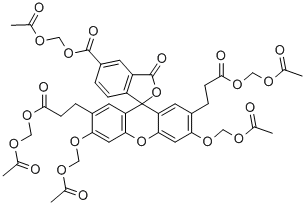
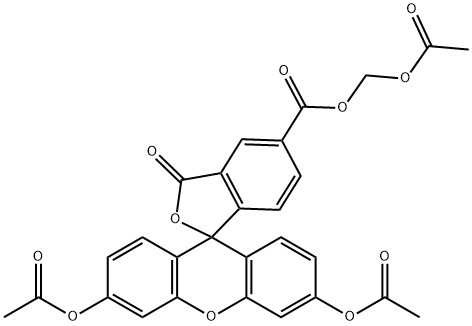


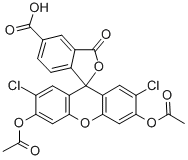

You may like
-
 5-Carboxyfluorescein Diacetate CAS 79955-27-4View Details
79955-27-4 -
5-Carboxyfluorescein Diacetate CAS 79955-27-4View Details
79955-27-4 -
Fmoc-OSu 98+View Details
82911-69-1 -
(R)-(-)-2-Amino-1-propanol 35320-23-1 98+View Details
35320-23-1 -
1191-95-3 Cyclobutanone 98+View Details
1191-95-3 -
213382-45-7 98+View Details
213382-45-7 -
Fmoc-OSu 98+View Details
82911-69-1 -
(R)-(-)-2-Amino-1-propanol 35320-23-1 98+View Details
35320-23-1
Statement: All products displayed on this website are only used for non medical purposes such as industrial applications or scientific research, and cannot be used for clinical diagnosis or treatment of humans or animals. They are not medicinal or edible.