
4,6-Dioxoheptanoic acid
Synonym(s):Succinylacetone;Succinylacetone-3,4,5,6,7-13C5
- CAS NO.:51568-18-4
- Empirical Formula: C7H10O4
- Molecular Weight: 158.15
- MDL number: MFCD00002797
- SAFETY DATA SHEET (SDS)
- Update Date: 2026-09-12 18:49:13
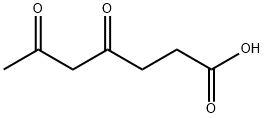
What is 4,6-Dioxoheptanoic acid?
Chemical properties
White Solid
The Uses of 4,6-Dioxoheptanoic acid
4,6-Dioxoheptanoic acid has been used:
- as component of dendritic cell conditioning medium and in the inhibition of ALA dehydratase (ALAD) in dendritic cells(50)
- as an inhibitor of heme biosynthesis in human mononuclear cells(51) and HeLa cells(52)
- as a standard for the quantification of succinylacetone from Plasmodium falciparum cultures(53)
The Uses of 4,6-Dioxoheptanoic acid
Succinylacetone (SA) is a specific marker for the inherited metabolic disease, hepatorenal tyrosinemia. It was developed a stable-isotope quid urine using a 13C4-SA as internal standard.
What are the applications of Application
Succinylacetone is a catabolic byproduct of tyrosine breakdown and an inhbitor of heme biosynthesis.
Definition
ChEBI: A dioxo monocarboxylic acid that is heptanoic acid in which oxo groups replace the hydrogens at positions 4 and 6. It is an abnormal metabolite of the tyrosine metabolic pathway and a marker for type 1 tyrosinaemia.
Biochem/physiol Actions
4,6-Dioxoheptanoic acid is an inhibitor of heme biosynthesis. It is a catabolic byproduct of tyrosine breakdown and inhibits δ-aminolevulinic acid (ALA) dehydratase enzyme. It is a potential marker for detecting tyrosinemia type I and is measured in dried blood spot of new borns.
Properties of 4,6-Dioxoheptanoic acid
| Melting point: | 66-67 °C(lit.) |
| Boiling point: | 318.7±17.0 °C(Predicted) |
| Density | 1.189±0.06 g/cm3(Predicted) |
| storage temp. | 2-8°C |
| solubility | Chloroform (Slightly), DMSO (Slightly), Methanol (Slightly) |
| form | powder |
| pka | 4.54±0.17(Predicted) |
| color | White to Off-White |
| CAS DataBase Reference | 51568-18-4 |
Safety information for 4,6-Dioxoheptanoic acid
| Signal word | Warning |
| Pictogram(s) |
 Exclamation Mark Irritant GHS07 |
| GHS Hazard Statements |
H315:Skin corrosion/irritation H319:Serious eye damage/eye irritation H335:Specific target organ toxicity, single exposure;Respiratory tract irritation |
| Precautionary Statement Codes |
P261:Avoid breathing dust/fume/gas/mist/vapours/spray. P264:Wash hands thoroughly after handling. P264:Wash skin thouroughly after handling. P271:Use only outdoors or in a well-ventilated area. P280:Wear protective gloves/protective clothing/eye protection/face protection. P302+P352:IF ON SKIN: wash with plenty of soap and water. P305+P351+P338:IF IN EYES: Rinse cautiously with water for several minutes. Remove contact lenses, if present and easy to do. Continuerinsing. |
Computed Descriptors for 4,6-Dioxoheptanoic acid
New Products
5-bromo-4-fluoro-2-nitrobenzaldehyde (R)-(-)-2-Amino-1-propanol Cyclobutanone Fmoc-OSu 1-(2-Chloroethyl)pyrrolidine Hydrochloride 2-Amino-2-(4-methylphenyl)acetic acid β-Bromostyrene Ethyl 3-phenylpropanoate Phenethyl cinnamate Dipropyl disulfide 4 pentyn 1 ol N-Vinylformamide Methacrylate-PEG-Methacrylate, Mn:35000 2,4-Dihydroxyacetophenone 2-Chloro 5-Fluoro Pyridine Vasicinone 2-Chloroisonicotinic Acid Tween 80 or Polysorbate 80 2-Butyn-1-oL 2-Pentyn-1-oL 4-Nitrobenzotrifluoride N-(4-fluoro-2-methoxy-5-nitrophenyl)-4-(1-methyl-1H-indol-3-yl)pyrimidin-2-amine Pirtobrutinib intd. N-(4-Cyano-3-(trifluoromethyl)phenyl)-2-methyloxirane-2-carboxamideRelated products of tetrahydrofuran


You may like
-
 4,6-Dioxoheptanoic acid CAS 51568-18-4View Details
51568-18-4 -
Fmoc-OSu 98+View Details
82911-69-1 -
7250-67-1 1-(2-Chloroethyl)pyrrolidine Hydrochloride 98+View Details
7250-67-1 -
13227-01-5 98+View Details
13227-01-5 -
7250-67-1 1-(2-Chloroethyl)pyrrolidine Hydrochloride 98+View Details
7250-67-1 -
13227-01-5 98+View Details
13227-01-5 -
7250-67-1 1-(2-Chloroethyl)pyrrolidine Hydrochloride 98+View Details
7250-67-1 -
13227-01-5 98+View Details
13227-01-5