
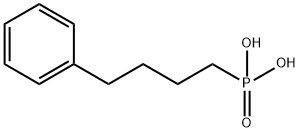
4-phenylbutylphosphonic acid
- CAS NO.:46348-61-2
- Empirical Formula: C10H15O3P
- Molecular Weight: 214.2
- SAFETY DATA SHEET (SDS)
- Update Date: 2026-01-13 11:21:15
What is 4-phenylbutylphosphonic acid?
The Uses of 4-phenylbutylphosphonic acid
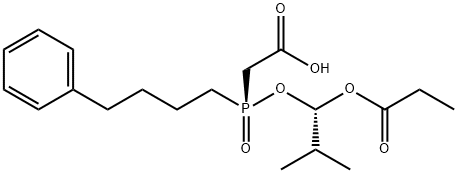
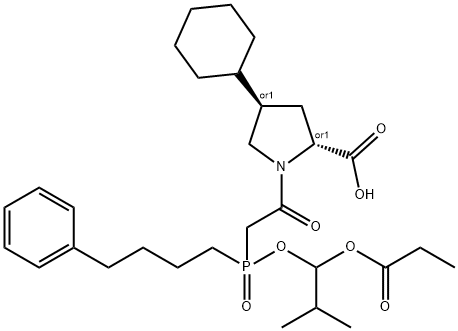
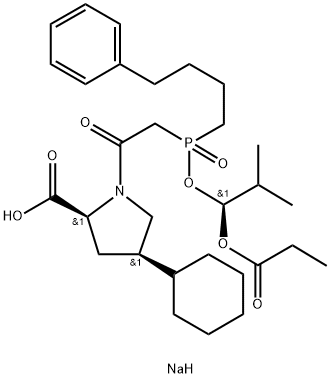
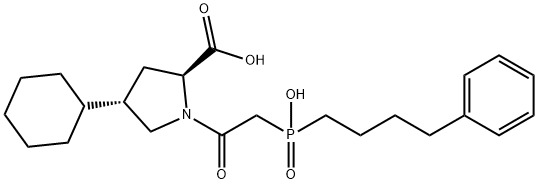
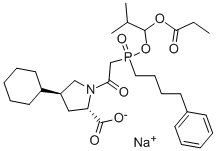
4-Phenylbutylphosphonic Acid is an impurity in the synthesis of Fosinopril (F727800), a phosphinic acid containing angiotensin converting enzyme (ACE) inhibitor. Antihypertensive.
Properties of 4-phenylbutylphosphonic acid
| Melting point: | 93℃ (ethyl acetate hexane ) |
Safety information for 4-phenylbutylphosphonic acid
Computed Descriptors for 4-phenylbutylphosphonic acid
New Products
9-Mesityl-10-methylacridinium perchlorate Sulfapyridine Fmoc-OSu (R)-(-)-2-Amino-1-propanol Cyclobutanone 5-bromo-4-fluoro-2-nitrobenzaldehyde 4 pentyn 1 ol N-Vinylformamide Phenethyl cinnamate Pyrrolo[1,2-a]pyrimidine-6-carboxylic acid, 4,6,7,8-tetrahydro-4-oxo-, sodium salt (1:1), (6S) Ethyl 3-phenylpropanoate β-Bromostyrene Methacrylate-PEG-Methacrylate, Mn:35000 2,4-Dihydroxyacetophenone 2-Chloro 5-Fluoro Pyridine Vasicinone 2-Chloroisonicotinic Acid Tween 80 or Polysorbate 80 Methyl trans-4-Aminocyclohexanecarboxylate Hydrochloride N-(4-fluoro-2-methoxy-5-nitrophenyl)-4-(1-methyl-1H-indol-3-yl)pyrimidin-2-amine Pirtobrutinib intd. 4-Nitrobenzotrifluoride 2-Pentyn-1-oL N-(4-Cyano-3-(trifluoromethyl)phenyl)-2-methyloxirane-2-carboxamideRelated products of tetrahydrofuran
![sodium:(2S,4S)-4-cyclohexyl-1-[2-[(2-methyl-1-propanoyloxypropoxy)-[4-(2,3,4,5,6-pentadeuteriophenyl)butyl]phosphoryl]acetyl]pyrrolidine-2-carboxylate](https://img.chemicalbook.in/CAS/20180527/GIF/1217513-43-3.gif)
You may like
-
 Fosinopril Related Compound H CAS 46348-61-2View Details
46348-61-2 -
1191-95-3 Cyclobutanone 98+View Details
1191-95-3 -
Fmoc-OSu 98+View Details
82911-69-1 -
(R)-(-)-2-Amino-1-propanol 35320-23-1 98+View Details
35320-23-1 -
1191-95-3 Cyclobutanone 98+View Details
1191-95-3 -
213382-45-7 98+View Details
213382-45-7 -
Fmoc-OSu 98+View Details
82911-69-1 -
(R)-(-)-2-Amino-1-propanol 35320-23-1 98+View Details
35320-23-1
Statement: All products displayed on this website are only used for non medical purposes such as industrial applications or scientific research, and cannot be used for clinical diagnosis or treatment of humans or animals. They are not medicinal or edible.